

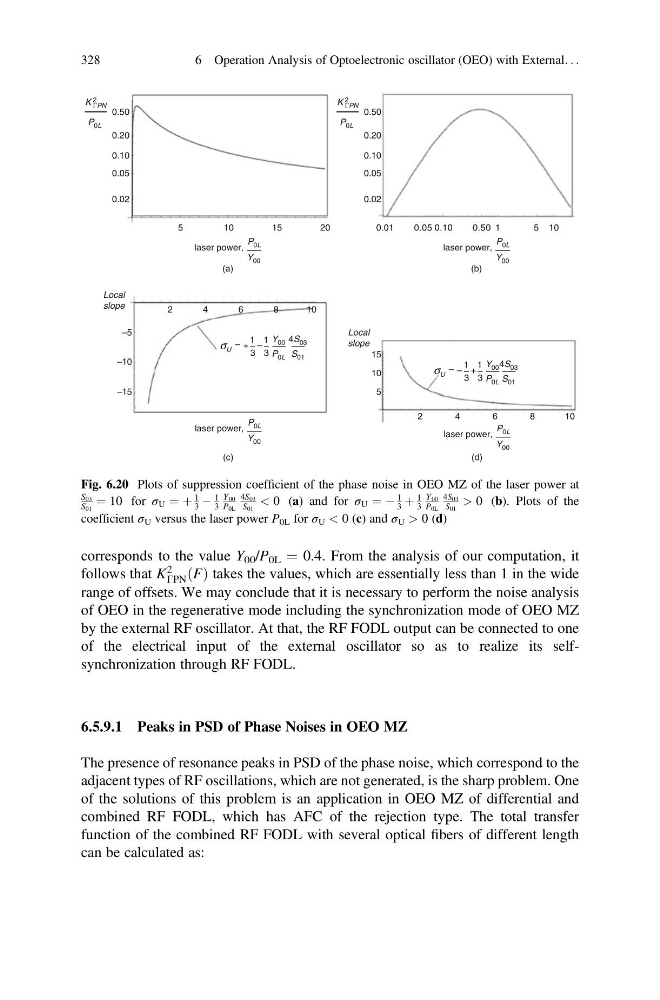
corresponds to the value Y 00 /P 0L ¼ 0.4. From the analysis of our computation, it
follows that K
2
ΓPN F
ð Þ takes the values, which are essentially less than 1 in the wide
range of offsets. We may conclude that it is necessary to perform the noise analysis
of OEO in the regenerative mode including the synchronization mode of OEO MZ
by the external RF oscillator. At that, the RF FODL output can be connected to one
of the electrical input of the external oscillator so as to realize its selfsynchronization through RF FODL.
6.5.9.1 Peaks in PSD of Phase Noises in OEO MZ
The presence of resonance peaks in PSD of the phase noise, which correspond to the
adjacent types of RF oscillations, which are not generated, is the sharp problem. One
of the solutions of this problem is an application in OEO MZ of differential and
combined RF FODL, which has AFC of the rejection type. The total transfer
function of the combined RF FODL with several optical fibers of different length
can be calculated as:
P 0L
K 2
ΓPN
s U
P 0L
Y 00
S 01
4S 03
3
1
3
1 +
–
s U
P 0L
Y 00
S 01
4S 03
3
1
3
1 –
+
0.20
0.10
0.05
0.50
0.02
Local
slope
Local
slope
5
–5
2
8
6
4
1 0
–15
15
10
5
8
6
4
2
1 0
–10
15
10
(a)
(c)
(d)
(b)
P 0L
Y 00
laser power,
P 0L
Y 00
laser power,
20
0.01
0.05 0.10
0.50 1
10
5
P 0L
Y 00
laser power,
P 0L
Y 00
laser power,
P 0L
K 2
ΓPN
0.20
0.10
0.05
0.50
0.02
Fig. 6.20 Plots of suppression coefficient of the phase noise in OEO MZ of the laser power at
S03
S01 ¼ 10 for σ U ¼ þ
1
3 À
1
3
Y00
P0L
4S03
S01 < 0 (a) and for σ U ¼ À
1
3 þ
1
3
Y00
P0L
4S03
S01 > 0 (b). Plots of the
coefficient σ U versus the laser power P 0L for σ U < 0 (c) and σ U > 0 (d)
328
6 Operation Analysis of Optoelectronic oscillator (OEO) with External. . .
follows that K
2
ΓPN F
ð Þ takes the values, which are essentially less than 1 in the wide
range of offsets. We may conclude that it is necessary to perform the noise analysis
of OEO in the regenerative mode including the synchronization mode of OEO MZ
by the external RF oscillator. At that, the RF FODL output can be connected to one
of the electrical input of the external oscillator so as to realize its selfsynchronization through RF FODL.
6.5.9.1 Peaks in PSD of Phase Noises in OEO MZ
The presence of resonance peaks in PSD of the phase noise, which correspond to the
adjacent types of RF oscillations, which are not generated, is the sharp problem. One
of the solutions of this problem is an application in OEO MZ of differential and
combined RF FODL, which has AFC of the rejection type. The total transfer
function of the combined RF FODL with several optical fibers of different length
can be calculated as:
P 0L
K 2
ΓPN
s U
P 0L
Y 00
S 01
4S 03
3
1
3
1 +
–
s U
P 0L
Y 00
S 01
4S 03
3
1
3
1 –
+
0.20
0.10
0.05
0.50
0.02
Local
slope
Local
slope
5
–5
2
8
6
4
1 0
–15
15
10
5
8
6
4
2
1 0
–10
15
10
(a)
(c)
(d)
(b)
P 0L
Y 00
laser power,
P 0L
Y 00
laser power,
20
0.01
0.05 0.10
0.50 1
10
5
P 0L
Y 00
laser power,
P 0L
Y 00
laser power,
P 0L
K 2
ΓPN
0.20
0.10
0.05
0.50
0.02
Fig. 6.20 Plots of suppression coefficient of the phase noise in OEO MZ of the laser power at
S03
S01 ¼ 10 for σ U ¼ þ
1
3 À
1
3
Y00
P0L
4S03
S01 < 0 (a) and for σ U ¼ À
1
3 þ
1
3
Y00
P0L
4S03
S01 > 0 (b). Plots of the
coefficient σ U versus the laser power P 0L for σ U < 0 (c) and σ U > 0 (d)
328
6 Operation Analysis of Optoelectronic oscillator (OEO) with External. . .