

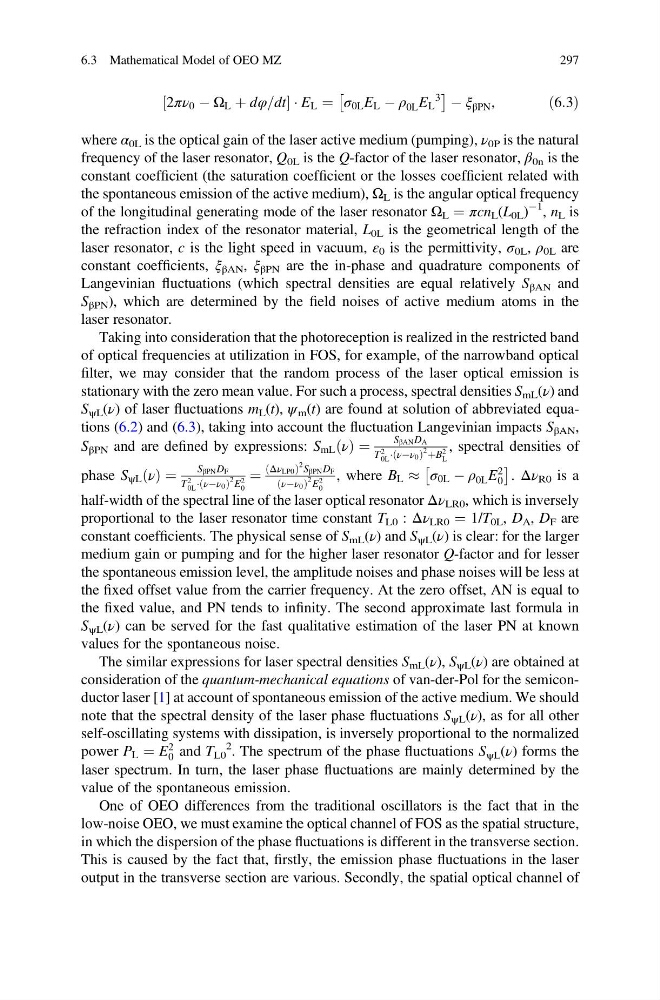
2πν 0 À Ω L þ dφ=dt
½
Á E L ¼ σ 0L E L À ρ 0L E L
3
Â
à À ξ βPN ,
ð6:3Þ
where α 0L is the optical gain of the laser active medium (pumping), ν 0P is the natural
frequency of the laser resonator, Q 0L is the Q-factor of the laser resonator, β 0n is the
constant coefficient (the saturation coefficient or the losses coefficient related with
the spontaneous emission of the active medium), Ω L is the angular optical frequency
of the longitudinal generating mode of the laser resonator Ω L ¼ πcn L (L 0L )
À1 , n L is
the refraction index of the resonator material, L 0L is the geometrical length of the
laser resonator, c is the light speed in vacuum, ε 0 is the permittivity, σ 0L , ρ 0L are
constant coefficients, ξ βAN , ξ βPN are the in-phase and quadrature components of
Langevinian fluctuations (which spectral densities are equal relatively S βAN and
S βPN ), which are determined by the field noises of active medium atoms in the
laser resonator.
Taking into consideration that the photoreception is realized in the restricted band
of optical frequencies at utilization in FOS, for example, of the narrowband optical
filter, we may consider that the random process of the laser optical emission is
stationary with the zero mean value. For such a process, spectral densities S mL (ν) and
S ψL (ν) of laser fluctuations m L (t), ψ m (t) are found at solution of abbreviated equations (6.2) and (6.3), taking into account the fluctuation Langevinian impacts S βAN ,
S βPN and are defined by expressions: S mL ν
ð Þ ¼
S βAN D A
T
2
0L Á νÀν 0
ð
Þ
2 þB
2
L
, spectral densities of
phase S ψL ν
ð Þ ¼
S βPN D F
T
2
0L Á νÀν 0
ð
Þ
2 E
2
0
¼
Δν LP0
ð
Þ
2 S βPN D F
νÀν 0
ð
Þ
2 E
2
0
, where B L % σ 0L À ρ 0L E
2
0
Â
Ã
. Δν R0 is a
half-width of the spectral line of the laser optical resonator Δν LR0 , which is inversely
proportional to the laser resonator time constant T L0 : Δν LR0 ¼ 1/T 0L , D A , D F are
constant coefficients. The physical sense of S mL (ν) and S ψL (ν) is clear: for the larger
medium gain or pumping and for the higher laser resonator Q-factor and for lesser
the spontaneous emission level, the amplitude noises and phase noises will be less at
the fixed offset value from the carrier frequency. At the zero offset, AN is equal to
the fixed value, and PN tends to infinity. The second approximate last formula in
S ψL (ν) can be served for the fast qualitative estimation of the laser PN at known
values for the spontaneous noise.
The similar expressions for laser spectral densities S mL (ν), S ψL (ν) are obtained at
consideration of the quantum-mechanical equations of van-der-Pol for the semiconductor laser [1] at account of spontaneous emission of the active medium. We should
note that the spectral density of the laser phase fluctuations S ψL (ν), as for all other
self-oscillating systems with dissipation, is inversely proportional to the normalized
power P L ¼ E
2
0 and T L0
2 . The spectrum of the phase fluctuations S ψL (ν) forms the
laser spectrum. In turn, the laser phase fluctuations are mainly determined by the
value of the spontaneous emission.
One of OEO differences from the traditional oscillators is the fact that in the
low-noise OEO, we must examine the optical channel of FOS as the spatial structure,
in which the dispersion of the phase fluctuations is different in the transverse section.
This is caused by the fact that, firstly, the emission phase fluctuations in the laser
output in the transverse section are various. Secondly, the spatial optical channel of
6.3 Mathematical Model of OEO MZ
297
½
Á E L ¼ σ 0L E L À ρ 0L E L
3
Â
à À ξ βPN ,
ð6:3Þ
where α 0L is the optical gain of the laser active medium (pumping), ν 0P is the natural
frequency of the laser resonator, Q 0L is the Q-factor of the laser resonator, β 0n is the
constant coefficient (the saturation coefficient or the losses coefficient related with
the spontaneous emission of the active medium), Ω L is the angular optical frequency
of the longitudinal generating mode of the laser resonator Ω L ¼ πcn L (L 0L )
À1 , n L is
the refraction index of the resonator material, L 0L is the geometrical length of the
laser resonator, c is the light speed in vacuum, ε 0 is the permittivity, σ 0L , ρ 0L are
constant coefficients, ξ βAN , ξ βPN are the in-phase and quadrature components of
Langevinian fluctuations (which spectral densities are equal relatively S βAN and
S βPN ), which are determined by the field noises of active medium atoms in the
laser resonator.
Taking into consideration that the photoreception is realized in the restricted band
of optical frequencies at utilization in FOS, for example, of the narrowband optical
filter, we may consider that the random process of the laser optical emission is
stationary with the zero mean value. For such a process, spectral densities S mL (ν) and
S ψL (ν) of laser fluctuations m L (t), ψ m (t) are found at solution of abbreviated equations (6.2) and (6.3), taking into account the fluctuation Langevinian impacts S βAN ,
S βPN and are defined by expressions: S mL ν
ð Þ ¼
S βAN D A
T
2
0L Á νÀν 0
ð
Þ
2 þB
2
L
, spectral densities of
phase S ψL ν
ð Þ ¼
S βPN D F
T
2
0L Á νÀν 0
ð
Þ
2 E
2
0
¼
Δν LP0
ð
Þ
2 S βPN D F
νÀν 0
ð
Þ
2 E
2
0
, where B L % σ 0L À ρ 0L E
2
0
Â
Ã
. Δν R0 is a
half-width of the spectral line of the laser optical resonator Δν LR0 , which is inversely
proportional to the laser resonator time constant T L0 : Δν LR0 ¼ 1/T 0L , D A , D F are
constant coefficients. The physical sense of S mL (ν) and S ψL (ν) is clear: for the larger
medium gain or pumping and for the higher laser resonator Q-factor and for lesser
the spontaneous emission level, the amplitude noises and phase noises will be less at
the fixed offset value from the carrier frequency. At the zero offset, AN is equal to
the fixed value, and PN tends to infinity. The second approximate last formula in
S ψL (ν) can be served for the fast qualitative estimation of the laser PN at known
values for the spontaneous noise.
The similar expressions for laser spectral densities S mL (ν), S ψL (ν) are obtained at
consideration of the quantum-mechanical equations of van-der-Pol for the semiconductor laser [1] at account of spontaneous emission of the active medium. We should
note that the spectral density of the laser phase fluctuations S ψL (ν), as for all other
self-oscillating systems with dissipation, is inversely proportional to the normalized
power P L ¼ E
2
0 and T L0
2 . The spectrum of the phase fluctuations S ψL (ν) forms the
laser spectrum. In turn, the laser phase fluctuations are mainly determined by the
value of the spontaneous emission.
One of OEO differences from the traditional oscillators is the fact that in the
low-noise OEO, we must examine the optical channel of FOS as the spatial structure,
in which the dispersion of the phase fluctuations is different in the transverse section.
This is caused by the fact that, firstly, the emission phase fluctuations in the laser
output in the transverse section are various. Secondly, the spatial optical channel of
6.3 Mathematical Model of OEO MZ
297