

S RFL F
ð Þ ¼
E
2
0L
2
U
2
10MZ
2
K
2
2ΓPN Á
1= Δν L
ð
Þ
1 þ F=Δν L
½
2
Á 1 À
A 2
A 1
exp À
2 ΔT M þ T FOS
ð
Þ
T c
&
'
:
ð5:102Þ
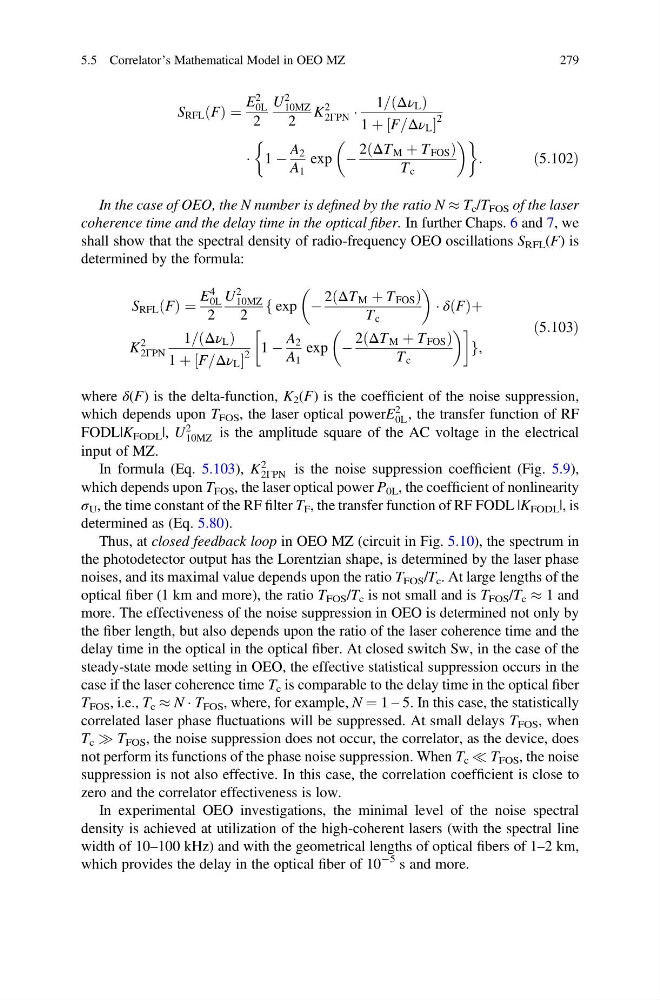
In the case of OEO, the N number is defined by the ratio N % T c /T FOS of the laser
coherence time and the delay time in the optical fiber. In further Chaps. 6 and 7, we
shall show that the spectral density of radio-frequency OEO oscillations S RFL (F) is
determined by the formula:
S RFL F
ð Þ ¼
E
4
0L
2
U
2
10MZ
2
f exp À
2 ΔT M þ T FOS
ð
Þ
T c
Á δ F
ð Þþ
K
2
2ΓPN
1= Δν L
ð
Þ
1 þ F=Δν L
½
2
1 À
A 2
A 1
exp À
2 ΔT M þ T FOS
ð
Þ
T c
!
g,
ð5:103Þ
where δ(F) is the delta-function, K 2 (F) is the coefficient of the noise suppression,
which depends upon T FOS , the laser optical powerE
2
0L , the transfer function of RF
FODL|K FODL |, U
2
10MZ is the amplitude square of the AC voltage in the electrical
input of MZ.
In formula (Eq. 5.103), K
2
2ΓPN is the noise suppression coefficient (Fig. 5.9),
which depends upon T FOS , the laser optical power P 0L , the coefficient of nonlinearity
σ U , the time constant of the RF filter T F , the transfer function of RF FODL |K FODL |, is
determined as (Eq. 5.80).
Thus, at closed feedback loop in OEO MZ (circuit in Fig. 5.10), the spectrum in
the photodetector output has the Lorentzian shape, is determined by the laser phase
noises, and its maximal value depends upon the ratio T FOS /T c . At large lengths of the
optical fiber (1 km and more), the ratio T FOS /T c is not small and is T FOS /T c % 1 and
more. The effectiveness of the noise suppression in OEO is determined not only by
the fiber length, but also depends upon the ratio of the laser coherence time and the
delay time in the optical in the optical fiber. At closed switch Sw, in the case of the
steady-state mode setting in OEO, the effective statistical suppression occurs in the
case if the laser coherence time T c is comparable to the delay time in the optical fiber
T FOS , i.e., T c % N Á T FOS , where, for example, N ¼ 1 – 5. In this case, the statistically
correlated laser phase fluctuations will be suppressed. At small delays T FOS , when
T c ) T FOS , the noise suppression does not occur, the correlator, as the device, does
not perform its functions of the phase noise suppression. When T c ( T FOS , the noise
suppression is not also effective. In this case, the correlation coefficient is close to
zero and the correlator effectiveness is low.
In experimental OEO investigations, the minimal level of the noise spectral
density is achieved at utilization of the high-coherent lasers (with the spectral line
width of 10–100 kHz) and with the geometrical lengths of optical fibers of 1–2 km,
which provides the delay in the optical fiber of 10
À5 s and more.
5.5 Correlator’s Mathematical Model in OEO MZ
279
ð Þ ¼
E
2
0L
2
U
2
10MZ
2
K
2
2ΓPN Á
1= Δν L
ð
Þ
1 þ F=Δν L
½
2
Á 1 À
A 2
A 1
exp À
2 ΔT M þ T FOS
ð
Þ
T c
&
'
:
ð5:102Þ
In the case of OEO, the N number is defined by the ratio N % T c /T FOS of the laser
coherence time and the delay time in the optical fiber. In further Chaps. 6 and 7, we
shall show that the spectral density of radio-frequency OEO oscillations S RFL (F) is
determined by the formula:
S RFL F
ð Þ ¼
E
4
0L
2
U
2
10MZ
2
f exp À
2 ΔT M þ T FOS
ð
Þ
T c
Á δ F
ð Þþ
K
2
2ΓPN
1= Δν L
ð
Þ
1 þ F=Δν L
½
2
1 À
A 2
A 1
exp À
2 ΔT M þ T FOS
ð
Þ
T c
!
g,
ð5:103Þ
where δ(F) is the delta-function, K 2 (F) is the coefficient of the noise suppression,
which depends upon T FOS , the laser optical powerE
2
0L , the transfer function of RF
FODL|K FODL |, U
2
10MZ is the amplitude square of the AC voltage in the electrical
input of MZ.
In formula (Eq. 5.103), K
2
2ΓPN is the noise suppression coefficient (Fig. 5.9),
which depends upon T FOS , the laser optical power P 0L , the coefficient of nonlinearity
σ U , the time constant of the RF filter T F , the transfer function of RF FODL |K FODL |, is
determined as (Eq. 5.80).
Thus, at closed feedback loop in OEO MZ (circuit in Fig. 5.10), the spectrum in
the photodetector output has the Lorentzian shape, is determined by the laser phase
noises, and its maximal value depends upon the ratio T FOS /T c . At large lengths of the
optical fiber (1 km and more), the ratio T FOS /T c is not small and is T FOS /T c % 1 and
more. The effectiveness of the noise suppression in OEO is determined not only by
the fiber length, but also depends upon the ratio of the laser coherence time and the
delay time in the optical in the optical fiber. At closed switch Sw, in the case of the
steady-state mode setting in OEO, the effective statistical suppression occurs in the
case if the laser coherence time T c is comparable to the delay time in the optical fiber
T FOS , i.e., T c % N Á T FOS , where, for example, N ¼ 1 – 5. In this case, the statistically
correlated laser phase fluctuations will be suppressed. At small delays T FOS , when
T c ) T FOS , the noise suppression does not occur, the correlator, as the device, does
not perform its functions of the phase noise suppression. When T c ( T FOS , the noise
suppression is not also effective. In this case, the correlation coefficient is close to
zero and the correlator effectiveness is low.
In experimental OEO investigations, the minimal level of the noise spectral
density is achieved at utilization of the high-coherent lasers (with the spectral line
width of 10–100 kHz) and with the geometrical lengths of optical fibers of 1–2 km,
which provides the delay in the optical fiber of 10
À5 s and more.
5.5 Correlator’s Mathematical Model in OEO MZ
279