

The electrical current oscillations in the PD load is then represented by the
convolution of two spectra of two oscillations: optical S L and radio frequency
S RFL : S PDL ¼ S L ( f ) à S RFL ( f ) , where à is the symbol of the convolution operation.
We remind that if, for instance, the stationary Gaussian noise with the probability
density distribution, which is specified according to the normal law with the mathematical expectation m ξ and the σ
2
ξ dispersion, affects the non-inertial double-sided
quadratic detector (Fig. 5.11a) with the characteristic η(ξ) ¼ Τ(ξ) ¼ a Á ξ
2 , a > 0 ,
then, in this case, the spectral density S η ( f ) of the random process η(t) ¼ ξ 1 (t) Á ξ 2 (t)
(or η(t) ¼ ξ L (t) Á ξ RFL (t)) is determined by the convolution formula: S η f
ð Þ ¼
1
2π
R 1
À1 S 1 ζ
ð Þ Á S 2 f À ζ
ð
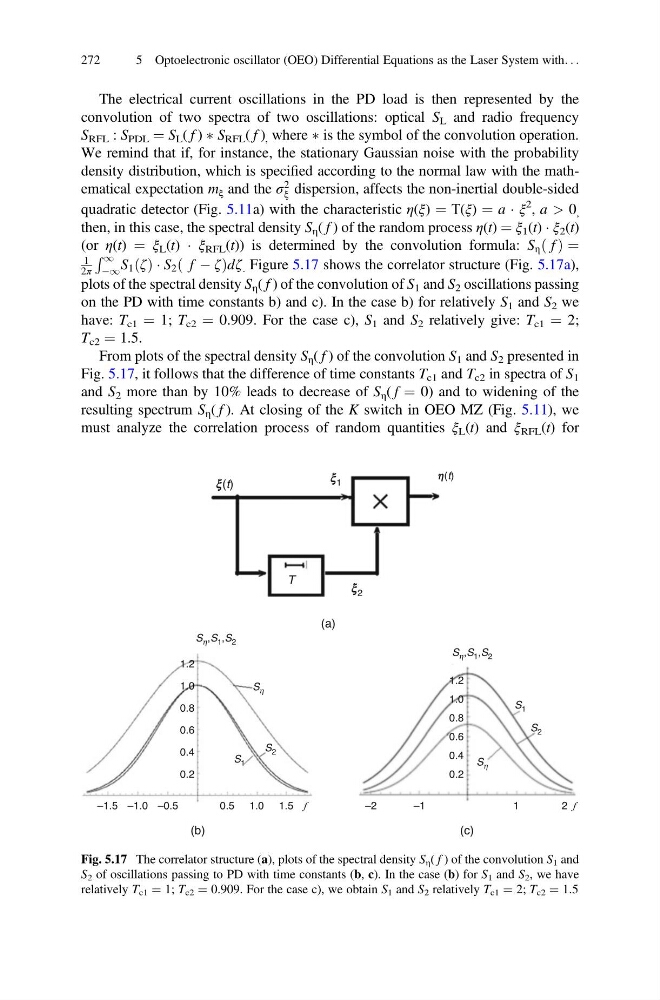
Þdζ . Figure 5.17 shows the correlator structure (Fig. 5.17a),
plots of the spectral density S η ( f ) of the convolution of S 1 and S 2 oscillations passing
on the PD with time constants b) and c). In the case b) for relatively S 1 and S 2 we
have: T c1 ¼ 1; T c2 ¼ 0.909. For the case c), S 1 and S 2 relatively give: T c1 ¼ 2;
T c2 ¼ 1.5.
From plots of the spectral density S η ( f ) of the convolution S 1 and S 2 presented in
Fig. 5.17, it follows that the difference of time constants T c1 and T c2 in spectra of S 1
and S 2 more than by 10% leads to decrease of S η ( f ¼ 0) and to widening of the
resulting spectrum S η ( f ). At closing of the K switch in OEO MZ (Fig. 5.11), we
must analyze the correlation process of random quantities ξ L (t) and ξ RFL (t) for
–1.5 –1.0 –0.5
0.5
1.0
0.8
0.6
0.4
0.2
1.2
S η ,S 1 ,S 2
ξ(t)
η(t)
ξ 1
ξ 2
S 1
S η
T
(a)
(b)
(c)
ƒ
1.0 1.5
S 2
2
1
–2
–1
1.0
0.8
0.6
0.4
0.2
1.2
S η ,S 1 ,S 2
S 1
S η
ƒ
S 2
Fig. 5.17 The correlator structure (a), plots of the spectral density S η ( f ) of the convolution S 1 and
S 2 of oscillations passing to PD with time constants (b, c). In the case (b) for S 1 and S 2 , we have
relatively T c1 ¼ 1; T c2 ¼ 0.909. For the case c), we obtain S 1 and S 2 relatively T c1 ¼ 2; T c2 ¼ 1.5
272
5 Optoelectronic oscillator (OEO) Differential Equations as the Laser System with. . .
convolution of two spectra of two oscillations: optical S L and radio frequency
S RFL : S PDL ¼ S L ( f ) à S RFL ( f ) , where à is the symbol of the convolution operation.
We remind that if, for instance, the stationary Gaussian noise with the probability
density distribution, which is specified according to the normal law with the mathematical expectation m ξ and the σ
2
ξ dispersion, affects the non-inertial double-sided
quadratic detector (Fig. 5.11a) with the characteristic η(ξ) ¼ Τ(ξ) ¼ a Á ξ
2 , a > 0 ,
then, in this case, the spectral density S η ( f ) of the random process η(t) ¼ ξ 1 (t) Á ξ 2 (t)
(or η(t) ¼ ξ L (t) Á ξ RFL (t)) is determined by the convolution formula: S η f
ð Þ ¼
1
2π
R 1
À1 S 1 ζ
ð Þ Á S 2 f À ζ
ð
Þdζ . Figure 5.17 shows the correlator structure (Fig. 5.17a),
plots of the spectral density S η ( f ) of the convolution of S 1 and S 2 oscillations passing
on the PD with time constants b) and c). In the case b) for relatively S 1 and S 2 we
have: T c1 ¼ 1; T c2 ¼ 0.909. For the case c), S 1 and S 2 relatively give: T c1 ¼ 2;
T c2 ¼ 1.5.
From plots of the spectral density S η ( f ) of the convolution S 1 and S 2 presented in
Fig. 5.17, it follows that the difference of time constants T c1 and T c2 in spectra of S 1
and S 2 more than by 10% leads to decrease of S η ( f ¼ 0) and to widening of the
resulting spectrum S η ( f ). At closing of the K switch in OEO MZ (Fig. 5.11), we
must analyze the correlation process of random quantities ξ L (t) and ξ RFL (t) for
–1.5 –1.0 –0.5
0.5
1.0
0.8
0.6
0.4
0.2
1.2
S η ,S 1 ,S 2
ξ(t)
η(t)
ξ 1
ξ 2
S 1
S η
T
(a)
(b)
(c)
ƒ
1.0 1.5
S 2
2
1
–2
–1
1.0
0.8
0.6
0.4
0.2
1.2
S η ,S 1 ,S 2
S 1
S η
ƒ
S 2
Fig. 5.17 The correlator structure (a), plots of the spectral density S η ( f ) of the convolution S 1 and
S 2 of oscillations passing to PD with time constants (b, c). In the case (b) for S 1 and S 2 , we have
relatively T c1 ¼ 1; T c2 ¼ 0.909. For the case c), we obtain S 1 and S 2 relatively T c1 ¼ 2; T c2 ¼ 1.5
272
5 Optoelectronic oscillator (OEO) Differential Equations as the Laser System with. . .