

characteristic of the RF amplifier. In Chap. 2 of this book, we studied the selfexcitation conditions of OEO MZ on the base of symbolic equations.
The nonlinear characteristic of the RF amplifier must, as minimum, compensate
the quadratic nonlinearity “CX
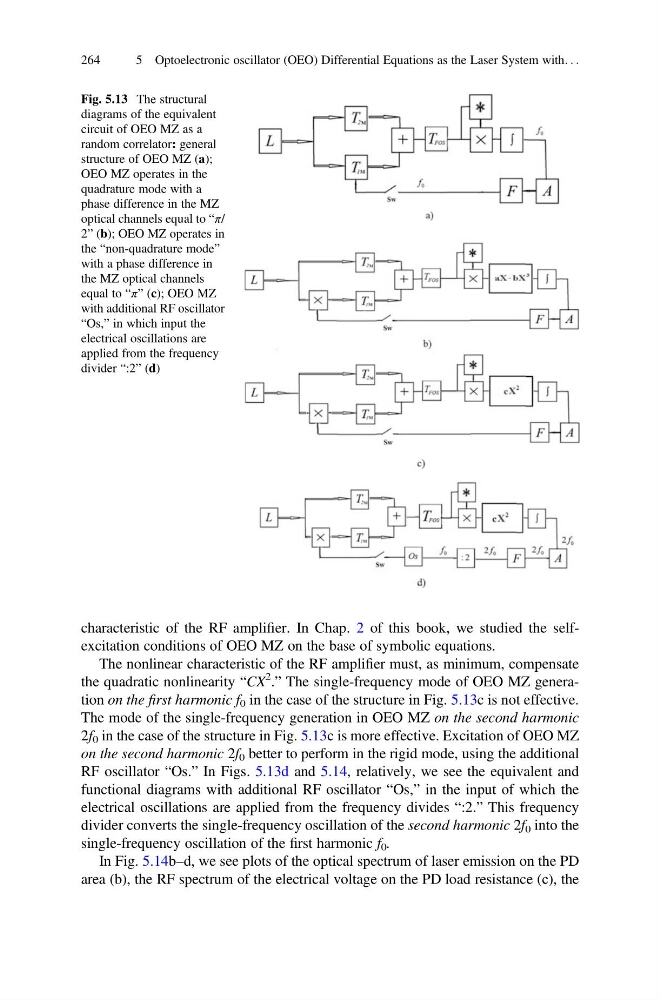
2 .” The single-frequency mode of OEO MZ generation on the first harmonic f 0 in the case of the structure in Fig. 5.13c is not effective.
The mode of the single-frequency generation in OEO MZ on the second harmonic
2f 0 in the case of the structure in Fig. 5.13c is more effective. Excitation of OEO MZ
on the second harmonic 2f 0 better to perform in the rigid mode, using the additional
RF oscillator “Os.” In Figs. 5.13d and 5.14, relatively, we see the equivalent and
functional diagrams with additional RF oscillator “Os,” in the input of which the
electrical oscillations are applied from the frequency divides “:2.” This frequency
divider converts the single-frequency oscillation of the second harmonic 2f 0 into the
single-frequency oscillation of the first harmonic f 0 .
In Fig. 5.14b–d, we see plots of the optical spectrum of laser emission on the PD
area (b), the RF spectrum of the electrical voltage on the PD load resistance (с), the
Fig. 5.13 The structural
diagrams of the equivalent
circuit of OEO MZ as a
random correlator: general
structure of OEO MZ (a);
OEO MZ operates in the
quadrature mode with a
phase difference in the MZ
optical channels equal to “π/
2” (b); OEO MZ operates in
the “non-quadrature mode”
with a phase difference in
the MZ optical channels
equal to “π” (c); OEO MZ
with additional RF oscillator
“Os,” in which input the
electrical oscillations are
applied from the frequency
divider “:2” (d)
264
5 Optoelectronic oscillator (OEO) Differential Equations as the Laser System with. . .
The nonlinear characteristic of the RF amplifier must, as minimum, compensate
the quadratic nonlinearity “CX
2 .” The single-frequency mode of OEO MZ generation on the first harmonic f 0 in the case of the structure in Fig. 5.13c is not effective.
The mode of the single-frequency generation in OEO MZ on the second harmonic
2f 0 in the case of the structure in Fig. 5.13c is more effective. Excitation of OEO MZ
on the second harmonic 2f 0 better to perform in the rigid mode, using the additional
RF oscillator “Os.” In Figs. 5.13d and 5.14, relatively, we see the equivalent and
functional diagrams with additional RF oscillator “Os,” in the input of which the
electrical oscillations are applied from the frequency divides “:2.” This frequency
divider converts the single-frequency oscillation of the second harmonic 2f 0 into the
single-frequency oscillation of the first harmonic f 0 .
In Fig. 5.14b–d, we see plots of the optical spectrum of laser emission on the PD
area (b), the RF spectrum of the electrical voltage on the PD load resistance (с), the
Fig. 5.13 The structural
diagrams of the equivalent
circuit of OEO MZ as a
random correlator: general
structure of OEO MZ (a);
OEO MZ operates in the
quadrature mode with a
phase difference in the MZ
optical channels equal to “π/
2” (b); OEO MZ operates in
the “non-quadrature mode”
with a phase difference in
the MZ optical channels
equal to “π” (c); OEO MZ
with additional RF oscillator
“Os,” in which input the
electrical oscillations are
applied from the frequency
divider “:2” (d)
264
5 Optoelectronic oscillator (OEO) Differential Equations as the Laser System with. . .