

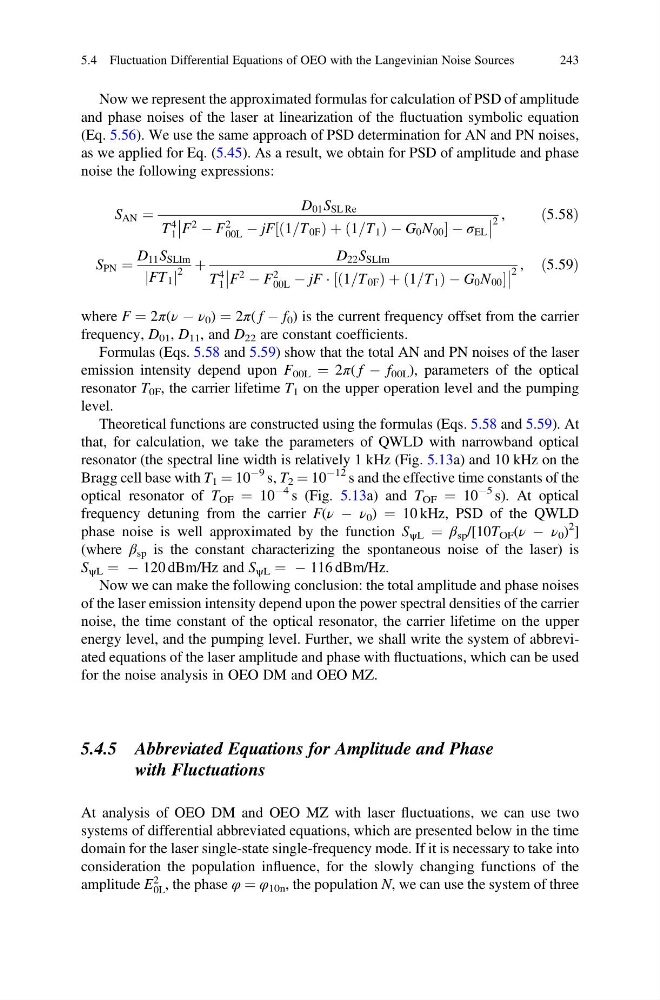
Now we represent the approximated formulas for calculation of PSD of amplitude
and phase noises of the laser at linearization of the fluctuation symbolic equation
(Eq. 5.56). We use the same approach of PSD determination for АN and PN noises,
as we applied for Eq. (5.45). As a result, we obtain for PSD of amplitude and phase
noise the following expressions:
S AN ¼
D 01 S SL Re
T
4
1 F
2
À F
2
00L À jF 1=T 0F
ð
Þþ 1=T 1
ð
ÞÀG 0 N 00
½
À σ EL
2 ,
ð5:58Þ
S PN ¼
D 11 S SLIm
FT 1
j
j
2
þ
D 22 S SLIm
T
4
1 F
2
À F
2
00L À jF Á 1=T 0F
ð
Þþ 1=T 1
ð
ÞÀG 0 N 00
½
2 , ð5:59Þ
where F ¼ 2π(ν À ν 0 ) ¼ 2π( f À f 0 ) is the current frequency offset from the carrier
frequency, D 01 , D 11 , and D 22 are constant coefficients.
Formulas (Eqs. 5.58 and 5.59) show that the total АN and PN noises of the laser
emission intensity depend upon F 00L ¼ 2π( f À f 00L ), parameters of the optical
resonator T 0F , the carrier lifetime T 1 on the upper operation level and the pumping
level.
Theoretical functions are constructed using the formulas (Eqs. 5.58 and 5.59). At
that, for calculation, we take the parameters of QWLD with narrowband optical
resonator (the spectral line width is relatively 1 kHz (Fig. 5.13а) and 10 kHz on the
Bragg cell base with T 1 ¼ 10
À9 s, T 2 ¼ 10
À12 s and the effective time constants of the
optical resonator of T OF ¼ 10
À4 s (Fig. 5.13а) and T OF ¼ 10
À5 s). At optical
frequency detuning from the carrier F(ν À ν 0 ) ¼ 10 kHz, PSD of the QWLD
phase noise is well approximated by the function S ψL ¼ β sp /[10T OF (ν À ν 0 )
2 ]
(where β sp is the constant characterizing the spontaneous noise of the laser) is
S ψL ¼ À 120 dBm/Hz and S ψL ¼ À 116 dBm/Hz.
Now we can make the following conclusion: the total amplitude and phase noises
of the laser emission intensity depend upon the power spectral densities of the carrier
noise, the time constant of the optical resonator, the carrier lifetime on the upper
energy level, and the pumping level. Further, we shall write the system of abbreviated equations of the laser amplitude and phase with fluctuations, which can be used
for the noise analysis in OEO DM and OEO MZ.
5.4.5 Abbreviated Equations for Amplitude and Phase
with Fluctuations
At analysis of OEO DM and OEO MZ with laser fluctuations, we can use two
systems of differential abbreviated equations, which are presented below in the time
domain for the laser single-state single-frequency mode. If it is necessary to take into
consideration the population influence, for the slowly changing functions of the
amplitude E
2
0L , the phase φ ¼ φ 10n , the population N, we can use the system of three
5.4 Fluctuation Differential Equations of OEO with the Langevinian Noise Sources
243
and phase noises of the laser at linearization of the fluctuation symbolic equation
(Eq. 5.56). We use the same approach of PSD determination for АN and PN noises,
as we applied for Eq. (5.45). As a result, we obtain for PSD of amplitude and phase
noise the following expressions:
S AN ¼
D 01 S SL Re
T
4
1 F
2
À F
2
00L À jF 1=T 0F
ð
Þþ 1=T 1
ð
ÞÀG 0 N 00
½
À σ EL
2 ,
ð5:58Þ
S PN ¼
D 11 S SLIm
FT 1
j
j
2
þ
D 22 S SLIm
T
4
1 F
2
À F
2
00L À jF Á 1=T 0F
ð
Þþ 1=T 1
ð
ÞÀG 0 N 00
½
2 , ð5:59Þ
where F ¼ 2π(ν À ν 0 ) ¼ 2π( f À f 0 ) is the current frequency offset from the carrier
frequency, D 01 , D 11 , and D 22 are constant coefficients.
Formulas (Eqs. 5.58 and 5.59) show that the total АN and PN noises of the laser
emission intensity depend upon F 00L ¼ 2π( f À f 00L ), parameters of the optical
resonator T 0F , the carrier lifetime T 1 on the upper operation level and the pumping
level.
Theoretical functions are constructed using the formulas (Eqs. 5.58 and 5.59). At
that, for calculation, we take the parameters of QWLD with narrowband optical
resonator (the spectral line width is relatively 1 kHz (Fig. 5.13а) and 10 kHz on the
Bragg cell base with T 1 ¼ 10
À9 s, T 2 ¼ 10
À12 s and the effective time constants of the
optical resonator of T OF ¼ 10
À4 s (Fig. 5.13а) and T OF ¼ 10
À5 s). At optical
frequency detuning from the carrier F(ν À ν 0 ) ¼ 10 kHz, PSD of the QWLD
phase noise is well approximated by the function S ψL ¼ β sp /[10T OF (ν À ν 0 )
2 ]
(where β sp is the constant characterizing the spontaneous noise of the laser) is
S ψL ¼ À 120 dBm/Hz and S ψL ¼ À 116 dBm/Hz.
Now we can make the following conclusion: the total amplitude and phase noises
of the laser emission intensity depend upon the power spectral densities of the carrier
noise, the time constant of the optical resonator, the carrier lifetime on the upper
energy level, and the pumping level. Further, we shall write the system of abbreviated equations of the laser amplitude and phase with fluctuations, which can be used
for the noise analysis in OEO DM and OEO MZ.
5.4.5 Abbreviated Equations for Amplitude and Phase
with Fluctuations
At analysis of OEO DM and OEO MZ with laser fluctuations, we can use two
systems of differential abbreviated equations, which are presented below in the time
domain for the laser single-state single-frequency mode. If it is necessary to take into
consideration the population influence, for the slowly changing functions of the
amplitude E
2
0L , the phase φ ¼ φ 10n , the population N, we can use the system of three
5.4 Fluctuation Differential Equations of OEO with the Langevinian Noise Sources
243