

normalized values of sin(FT L ) ¼ 0 and cos(FT L ) ¼ 1, the value S 0E ¼ 1, which in the
considered case takes into account that after passing through the laser active element,
the transformation slope of phase fluctuations is equal to 1. From the last expressions, it follows that the laser noises (similar to the noises of the RF autonomous
oscillator) are determined by the time constant of the optical filter T OF or the Q-factor
of the optical resonator and by the oscillation power.
5.4.4.1 Laser PSD with Account of the Relaxation Resonance Peak
Deduced expressions (Eqs. 5.45 and 5.55) for laser PSDs not completely reflect of
the important physical phenomenon in the laser—the presence of the relaxation
resonance (or the photon-electron resonance) on the offset frequency from the carrier
frequency and this offset frequency is equal: ω 00L ¼ 2π f 00L ¼ 2π=T 1
ð
ÞÂ
ffiffiffiffiffiffiffiffiffiffiffiffiffiffiffiffiffiffiffiffiffiffiffiffiffiffi
G 0 α 00L À 1
ð
Þ
p
, where T 1 is the carrier life, G 0 is the gain (saturation coefficient),
α 00L ¼ α N00 Á J 0L is the DC component of pumping.
The transfer function K LD of QWLD with the direct small-signal modulation, the
module of the transfer function of the RF selective filter K F and tvhe first harmonic of
OEO DM RF oscillations, which have the average oscillation frequency about
10 GHz. As it is shown in Chap. 3, K LD is determined by the formula: K LD jω
ð Þ ¼
ω
2
00L
ω 2 Àω 2
00L
Àjωα N00 ÁJ 0L
½
.
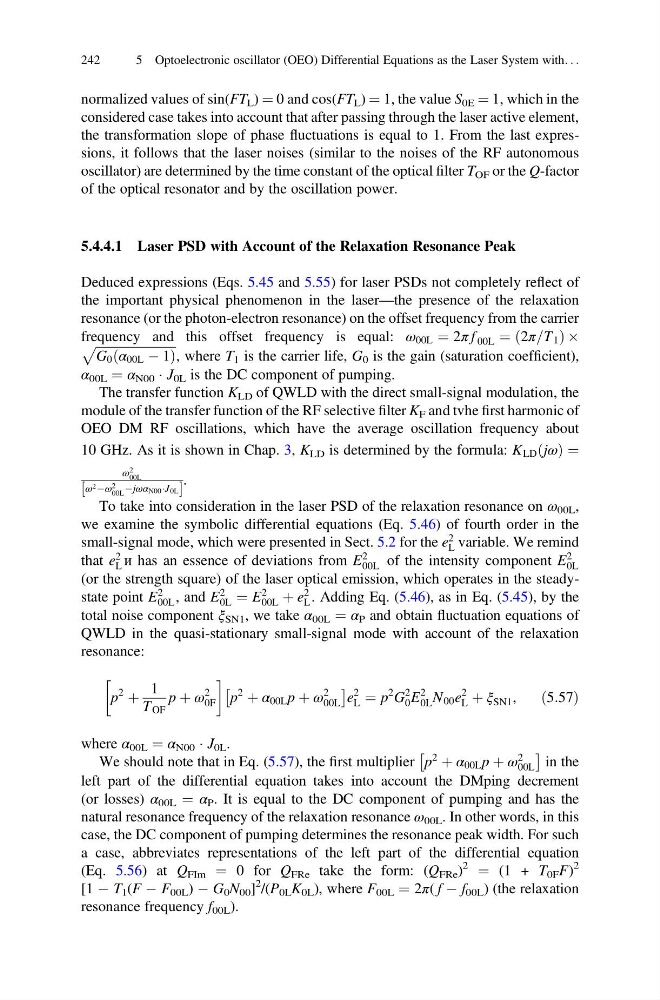
To take into consideration in the laser PSD of the relaxation resonance on ω 00L ,
we examine the symbolic differential equations (Eq. 5.46) of fourth order in the
small-signal mode, which were presented in Sect. 5.2 for the e
2
L variable. We remind
that e
2
L и has an essence of deviations from E
2
00L of the intensity component E
2
0L
(or the strength square) of the laser optical emission, which operates in the steadystate point E
2
00L , and E
2
0L ¼ E
2
00L þ e
2
L . Adding Eq. (5.46), as in Eq. (5.45), by the
total noise component ξ SN1 , we take α 00L ¼ α P and obtain fluctuation equations of
QWLD in the quasi-stationary small-signal mode with account of the relaxation
resonance:
p
2
þ
1
T OF
p þ ω
2
0F
!
p
2
þ α 00L p þ ω
2
00L
Â
Ã
e
2
L ¼ p
2 G
2
0 E
2
0L N 00 e
2
L þ ξ SN1 ,
ð5:57Þ
where α 00L ¼ α N00 Á J 0L .
We should note that in Eq. (5.57), the first multiplier p
2
þ α 00L p þ ω
2
00L
Â
Ã
in the
left part of the differential equation takes into account the DMping decrement
(or losses) α 00L ¼ α P . It is equal to the DC component of pumping and has the
natural resonance frequency of the relaxation resonance ω 00L . In other words, in this
case, the DC component of pumping determines the resonance peak width. For such
a case, abbreviates representations of the left part of the differential equation
(Eq. 5.56) at Q FIm ¼ 0 for Q FRe take the form: (Q FRe )
2
¼ (1 + T 0F F)
2
[1 À T 1 (F À F 00L ) À G 0 N 00 ]
2 /(P 0L K 0L ), where F 00L ¼ 2π( f À f 00L ) (the relaxation
resonance frequency f 00L ).
242
5 Optoelectronic oscillator (OEO) Differential Equations as the Laser System with. . .
considered case takes into account that after passing through the laser active element,
the transformation slope of phase fluctuations is equal to 1. From the last expressions, it follows that the laser noises (similar to the noises of the RF autonomous
oscillator) are determined by the time constant of the optical filter T OF or the Q-factor
of the optical resonator and by the oscillation power.
5.4.4.1 Laser PSD with Account of the Relaxation Resonance Peak
Deduced expressions (Eqs. 5.45 and 5.55) for laser PSDs not completely reflect of
the important physical phenomenon in the laser—the presence of the relaxation
resonance (or the photon-electron resonance) on the offset frequency from the carrier
frequency and this offset frequency is equal: ω 00L ¼ 2π f 00L ¼ 2π=T 1
ð
ÞÂ
ffiffiffiffiffiffiffiffiffiffiffiffiffiffiffiffiffiffiffiffiffiffiffiffiffiffi
G 0 α 00L À 1
ð
Þ
p
, where T 1 is the carrier life, G 0 is the gain (saturation coefficient),
α 00L ¼ α N00 Á J 0L is the DC component of pumping.
The transfer function K LD of QWLD with the direct small-signal modulation, the
module of the transfer function of the RF selective filter K F and tvhe first harmonic of
OEO DM RF oscillations, which have the average oscillation frequency about
10 GHz. As it is shown in Chap. 3, K LD is determined by the formula: K LD jω
ð Þ ¼
ω
2
00L
ω 2 Àω 2
00L
Àjωα N00 ÁJ 0L
½
.
To take into consideration in the laser PSD of the relaxation resonance on ω 00L ,
we examine the symbolic differential equations (Eq. 5.46) of fourth order in the
small-signal mode, which were presented in Sect. 5.2 for the e
2
L variable. We remind
that e
2
L и has an essence of deviations from E
2
00L of the intensity component E
2
0L
(or the strength square) of the laser optical emission, which operates in the steadystate point E
2
00L , and E
2
0L ¼ E
2
00L þ e
2
L . Adding Eq. (5.46), as in Eq. (5.45), by the
total noise component ξ SN1 , we take α 00L ¼ α P and obtain fluctuation equations of
QWLD in the quasi-stationary small-signal mode with account of the relaxation
resonance:
p
2
þ
1
T OF
p þ ω
2
0F
!
p
2
þ α 00L p þ ω
2
00L
Â
Ã
e
2
L ¼ p
2 G
2
0 E
2
0L N 00 e
2
L þ ξ SN1 ,
ð5:57Þ
where α 00L ¼ α N00 Á J 0L .
We should note that in Eq. (5.57), the first multiplier p
2
þ α 00L p þ ω
2
00L
Â
Ã
in the
left part of the differential equation takes into account the DMping decrement
(or losses) α 00L ¼ α P . It is equal to the DC component of pumping and has the
natural resonance frequency of the relaxation resonance ω 00L . In other words, in this
case, the DC component of pumping determines the resonance peak width. For such
a case, abbreviates representations of the left part of the differential equation
(Eq. 5.56) at Q FIm ¼ 0 for Q FRe take the form: (Q FRe )
2
¼ (1 + T 0F F)
2
[1 À T 1 (F À F 00L ) À G 0 N 00 ]
2 /(P 0L K 0L ), where F 00L ¼ 2π( f À f 00L ) (the relaxation
resonance frequency f 00L ).
242
5 Optoelectronic oscillator (OEO) Differential Equations as the Laser System with. . .