

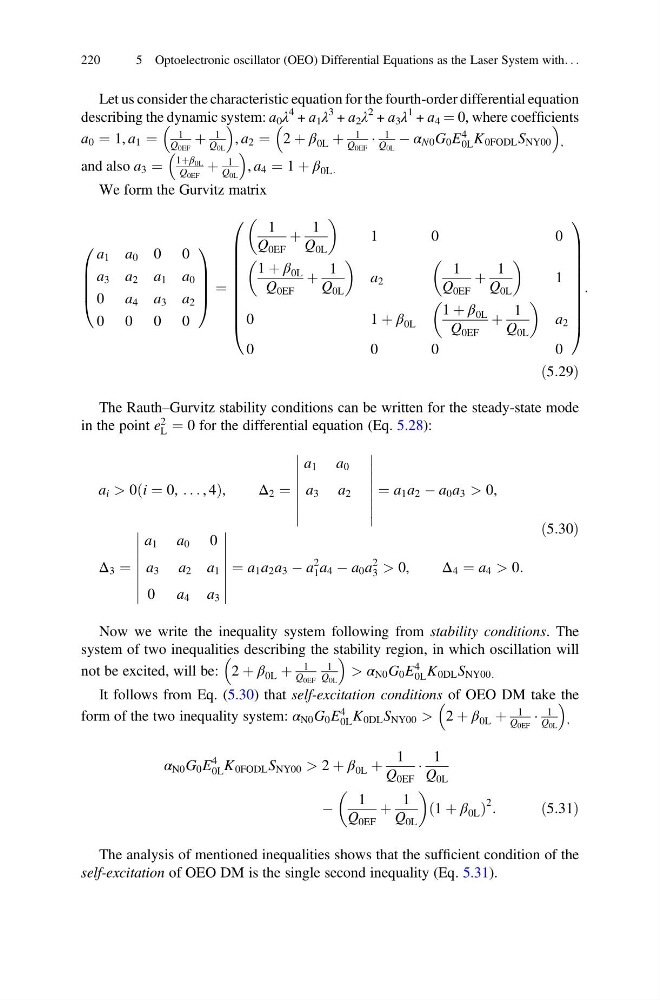
Let us consider the characteristic equation for the fourth-order differential equation
describing the dynamic system: а 0 λ
4 + а 1 λ
3 + а 2 λ
2 + а 3 λ
1 + а 4 ¼ 0, where coefficients
а 0 ¼ 1, a 1 ¼
1
Q 0EF
þ
1
Q 0L
, a 2 ¼ 2 þ β 0L þ
1
Q 0EF
Á
1
Q 0L
À α N0 G 0 E
4
0L K 0FODL S NY00
,
and also a 3 ¼
1þβ 0L
Q 0EF
þ
1
Q 0L
, a 4 ¼ 1 þ β 0L.
We form the Gurvitz matrix
a 1 a 0 0 0
a 3 a 2 a 1 a 0
0 a 4 a 3 a 2
0 0 0 0
0
B
B
B
@
1
C
C
C
A
¼
1
Q 0EF
þ
1
Q 0L
1
0
0
1 þ β 0L
Q 0EF
þ
1
Q 0L
a 2
1
Q 0EF
þ
1
Q 0L
1
0
1 þ β 0L
1 þ β 0L
Q 0EF
þ
1
Q 0L
a 2
0
0
0
0
0
B
B
B
B
B
B
B
B
B
@
1
C
C
C
C
C
C
C
C
C
A
:
ð5:29Þ
The Rauth–Gurvitz stability conditions can be written for the steady-state mode
in the point e
2
L ¼ 0 for the differential equation (Eq. 5.28):
a i > 0 i ¼ 0, . . . , 4
ð
Þ ,
Δ 2 ¼
a 1 a 0
a 3 a 2
¼ a 1 a 2 À a 0 a 3 > 0,
Δ 3 ¼
a 1 a 0 0
a 3 a 2 a 1
0 a 4 a 3
¼ a 1 a 2 a 3 À a
2
1 a 4 À a 0 a
2
3 > 0,
Δ 4 ¼ a 4 > 0:
ð5:30Þ
Now we write the inequality system following from stability conditions. The
system of two inequalities describing the stability region, in which oscillation will
not be excited, will be: 2 þ β 0L þ
1
Q 0EF
1
Q 0L
> α N0 G 0 E
4
0L K 0DL S NY00.
It follows from Eq. (5.30) that self-excitation conditions of OEO DM take the
form of the two inequality system: α N0 G 0 E
4
0L K 0DL S NY00 > 2 þ β 0L þ
1
Q 0EF
Á
1
Q 0L
,
α N0 G 0 E
4
0L K 0FODL S NY00 > 2 þ β 0L þ
1
Q 0EF
Á
1
Q 0L
À
1
Q 0EF
þ
1
Q 0L
1 þ β 0L
ð
Þ
2 :
ð5:31Þ
The analysis of mentioned inequalities shows that the sufficient condition of the
self-excitation of OEO DM is the single second inequality (Eq. 5.31).
220
5 Optoelectronic oscillator (OEO) Differential Equations as the Laser System with. . .
describing the dynamic system: а 0 λ
4 + а 1 λ
3 + а 2 λ
2 + а 3 λ
1 + а 4 ¼ 0, where coefficients
а 0 ¼ 1, a 1 ¼
1
Q 0EF
þ
1
Q 0L
, a 2 ¼ 2 þ β 0L þ
1
Q 0EF
Á
1
Q 0L
À α N0 G 0 E
4
0L K 0FODL S NY00
,
and also a 3 ¼
1þβ 0L
Q 0EF
þ
1
Q 0L
, a 4 ¼ 1 þ β 0L.
We form the Gurvitz matrix
a 1 a 0 0 0
a 3 a 2 a 1 a 0
0 a 4 a 3 a 2
0 0 0 0
0
B
B
B
@
1
C
C
C
A
¼
1
Q 0EF
þ
1
Q 0L
1
0
0
1 þ β 0L
Q 0EF
þ
1
Q 0L
a 2
1
Q 0EF
þ
1
Q 0L
1
0
1 þ β 0L
1 þ β 0L
Q 0EF
þ
1
Q 0L
a 2
0
0
0
0
0
B
B
B
B
B
B
B
B
B
@
1
C
C
C
C
C
C
C
C
C
A
:
ð5:29Þ
The Rauth–Gurvitz stability conditions can be written for the steady-state mode
in the point e
2
L ¼ 0 for the differential equation (Eq. 5.28):
a i > 0 i ¼ 0, . . . , 4
ð
Þ ,
Δ 2 ¼
a 1 a 0
a 3 a 2
¼ a 1 a 2 À a 0 a 3 > 0,
Δ 3 ¼
a 1 a 0 0
a 3 a 2 a 1
0 a 4 a 3
¼ a 1 a 2 a 3 À a
2
1 a 4 À a 0 a
2
3 > 0,
Δ 4 ¼ a 4 > 0:
ð5:30Þ
Now we write the inequality system following from stability conditions. The
system of two inequalities describing the stability region, in which oscillation will
not be excited, will be: 2 þ β 0L þ
1
Q 0EF
1
Q 0L
> α N0 G 0 E
4
0L K 0DL S NY00.
It follows from Eq. (5.30) that self-excitation conditions of OEO DM take the
form of the two inequality system: α N0 G 0 E
4
0L K 0DL S NY00 > 2 þ β 0L þ
1
Q 0EF
Á
1
Q 0L
,
α N0 G 0 E
4
0L K 0FODL S NY00 > 2 þ β 0L þ
1
Q 0EF
Á
1
Q 0L
À
1
Q 0EF
þ
1
Q 0L
1 þ β 0L
ð
Þ
2 :
ð5:31Þ
The analysis of mentioned inequalities shows that the sufficient condition of the
self-excitation of OEO DM is the single second inequality (Eq. 5.31).
220
5 Optoelectronic oscillator (OEO) Differential Equations as the Laser System with. . .