

the optical fiber and the photodetector. The first term can be added by a multiplier,
which takes into account the delay in the optical fiber. The second term in the right
part of Eq. (5.26) takes into consideration the action of the multiplicative
nonlinearity of the laser. By analogy with autonomous oscillators on transistors,
the second term of the right part of Eq. (5.26) reflects the gain of the base current in
the transistor connected with the common emitter circuit of the grid current (in tube
oscillator). At examination of stability problems, we can neglect by this term due to
its smallness, which is similar to the tube or transistor oscillator at discussing of
stability problems for the influence of grid or based current.
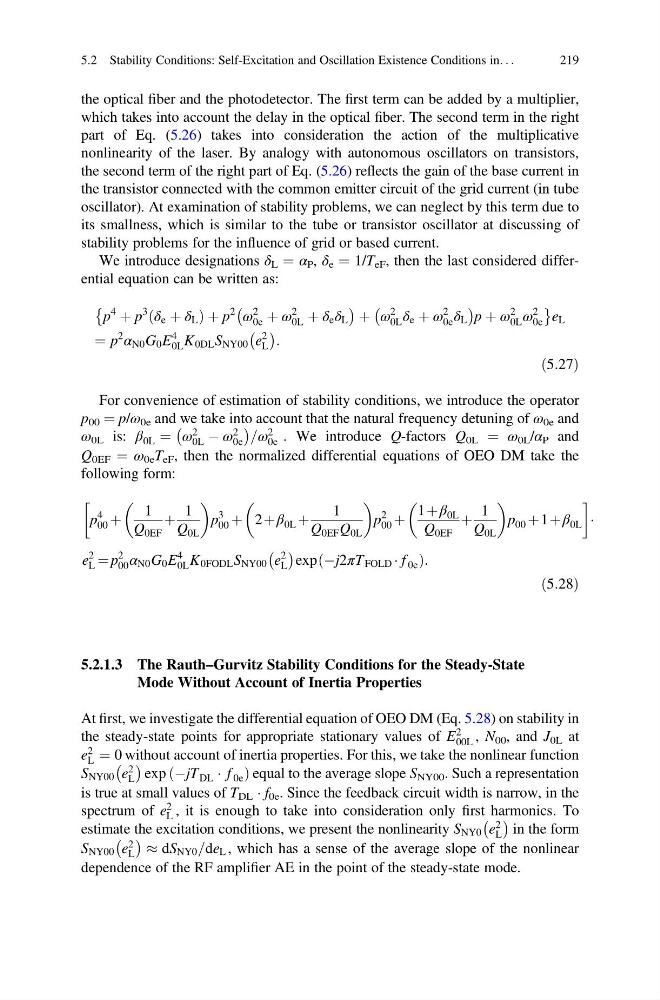
We introduce designations δ L ¼ α P , δ e ¼ 1/T eF , then the last considered differential equation can be written as:
p
4
þ p
3
δ e þ δ L
ð
Þþp
2
ω
2
0e þ ω
2
0L þ δ e δ L
À
Á þ ω
2
0L δ e þ ω
2
0e δ L
À
Á
p þ ω
2
0L ω
2
0e
È
É
e L
¼ p
2
α N0 G 0 E
4
0L K 0DL S NY00 e
2
L
À Á :
ð5:27Þ
For convenience of estimation of stability conditions, we introduce the operator
p 00 ¼ p/ω 0e and we take into account that the natural frequency detuning of ω 0e and
ω 0L is: β 0L ¼ ω
2
0L À ω
2
0e
À
Á =ω
2
0e . We introduce Q-factors Q 0L ¼ ω 0L /α P and
Q 0EF ¼ ω 0e T eF , then the normalized differential equations of OEO DM take the
following form:
p
4
00 þ
1
Q 0EF
þ
1
Q 0L
p
3
00 þ 2þβ 0L þ
1
Q 0EF Q 0L
p
2
00 þ
1þβ 0L
Q 0EF
þ
1
Q 0L
p 00 þ1þβ 0L
!
Á
e
2
L ¼ p
2
00 α N0 G 0 E
4
0L K 0FODL S NY00 e
2
L
À Á
exp Àj2πT FOLD Á f 0e
ð
Þ :
ð5:28Þ
5.2.1.3 The Rauth–Gurvitz Stability Conditions for the Steady-State
Mode Without Account of Inertia Properties
At first, we investigate the differential equation of OEO DM (Eq. 5.28) on stability in
the steady-state points for appropriate stationary values of E
2
00L , N 00 , and J 0L at
e
2
L ¼ 0 without account of inertia properties. For this, we take the nonlinear function
S NY00 e
2
L
À Á
exp ÀjT DL Á f 0e
ð
Þequal to the average slope S NY00 . Such a representation
is true at small values of T DL Á f 0e . Since the feedback circuit width is narrow, in the
spectrum of e
2
L , it is enough to take into consideration only first harmonics. To
estimate the excitation conditions, we present the nonlinearity S NY0 e
2
L
À Á
in the form
S NY00 e
2
L
À Á % dS NY0 =de L , which has a sense of the average slope of the nonlinear
dependence of the RF amplifier AE in the point of the steady-state mode.
5.2 Stability Conditions: Self-Excitation and Oscillation Existence Conditions in. . .
219
which takes into account the delay in the optical fiber. The second term in the right
part of Eq. (5.26) takes into consideration the action of the multiplicative
nonlinearity of the laser. By analogy with autonomous oscillators on transistors,
the second term of the right part of Eq. (5.26) reflects the gain of the base current in
the transistor connected with the common emitter circuit of the grid current (in tube
oscillator). At examination of stability problems, we can neglect by this term due to
its smallness, which is similar to the tube or transistor oscillator at discussing of
stability problems for the influence of grid or based current.
We introduce designations δ L ¼ α P , δ e ¼ 1/T eF , then the last considered differential equation can be written as:
p
4
þ p
3
δ e þ δ L
ð
Þþp
2
ω
2
0e þ ω
2
0L þ δ e δ L
À
Á þ ω
2
0L δ e þ ω
2
0e δ L
À
Á
p þ ω
2
0L ω
2
0e
È
É
e L
¼ p
2
α N0 G 0 E
4
0L K 0DL S NY00 e
2
L
À Á :
ð5:27Þ
For convenience of estimation of stability conditions, we introduce the operator
p 00 ¼ p/ω 0e and we take into account that the natural frequency detuning of ω 0e and
ω 0L is: β 0L ¼ ω
2
0L À ω
2
0e
À
Á =ω
2
0e . We introduce Q-factors Q 0L ¼ ω 0L /α P and
Q 0EF ¼ ω 0e T eF , then the normalized differential equations of OEO DM take the
following form:
p
4
00 þ
1
Q 0EF
þ
1
Q 0L
p
3
00 þ 2þβ 0L þ
1
Q 0EF Q 0L
p
2
00 þ
1þβ 0L
Q 0EF
þ
1
Q 0L
p 00 þ1þβ 0L
!
Á
e
2
L ¼ p
2
00 α N0 G 0 E
4
0L K 0FODL S NY00 e
2
L
À Á
exp Àj2πT FOLD Á f 0e
ð
Þ :
ð5:28Þ
5.2.1.3 The Rauth–Gurvitz Stability Conditions for the Steady-State
Mode Without Account of Inertia Properties
At first, we investigate the differential equation of OEO DM (Eq. 5.28) on stability in
the steady-state points for appropriate stationary values of E
2
00L , N 00 , and J 0L at
e
2
L ¼ 0 without account of inertia properties. For this, we take the nonlinear function
S NY00 e
2
L
À Á
exp ÀjT DL Á f 0e
ð
Þequal to the average slope S NY00 . Such a representation
is true at small values of T DL Á f 0e . Since the feedback circuit width is narrow, in the
spectrum of e
2
L , it is enough to take into consideration only first harmonics. To
estimate the excitation conditions, we present the nonlinearity S NY0 e
2
L
À Á
in the form
S NY00 e
2
L
À Á % dS NY0 =de L , which has a sense of the average slope of the nonlinear
dependence of the RF amplifier AE in the point of the steady-state mode.
5.2 Stability Conditions: Self-Excitation and Oscillation Existence Conditions in. . .
219