

factor, 3—QWLD with the high Q-factor of the Bragg resonator) are presented in
Fig. 3.17c (in Chap. 3).
We consider the laser model in the dipole approximation. Symbolic equations
coincide with equations of the double-circuit RF oscillator with the inertial
nonlinearity with the soft oscillation characteristics, which permit to analyze the
steady-state mode stability of the laser model not only using AFC and PCF but with
utilization of the Nyquist locus method.
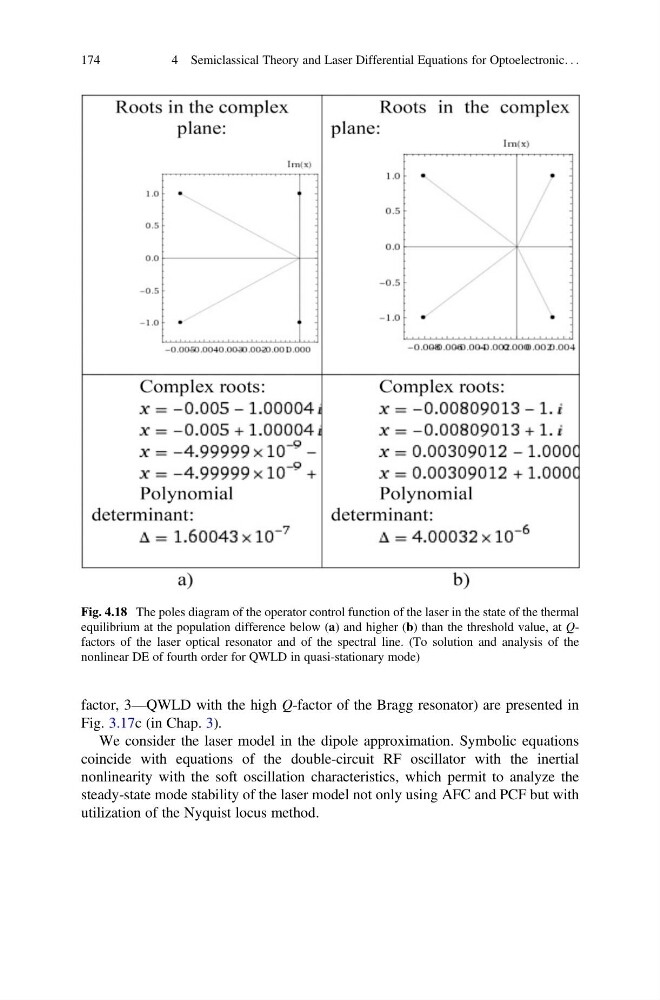
Fig. 4.18 The poles diagram of the operator control function of the laser in the state of the thermal
equilibrium at the population difference below (a) and higher (b) than the threshold value, at Qfactors of the laser optical resonator and of the spectral line. (To solution and analysis of the
nonlinear DE of fourth order for QWLD in quasi-stationary mode)
174
4 Semiclassical Theory and Laser Differential Equations for Optoelectronic. . .
Fig. 3.17c (in Chap. 3).
We consider the laser model in the dipole approximation. Symbolic equations
coincide with equations of the double-circuit RF oscillator with the inertial
nonlinearity with the soft oscillation characteristics, which permit to analyze the
steady-state mode stability of the laser model not only using AFC and PCF but with
utilization of the Nyquist locus method.
Fig. 4.18 The poles diagram of the operator control function of the laser in the state of the thermal
equilibrium at the population difference below (a) and higher (b) than the threshold value, at Qfactors of the laser optical resonator and of the spectral line. (To solution and analysis of the
nonlinear DE of fourth order for QWLD in quasi-stationary mode)
174
4 Semiclassical Theory and Laser Differential Equations for Optoelectronic. . .