

Y p 00
ð ÞE n ¼ K 00 N n E n :
ð4:36Þ
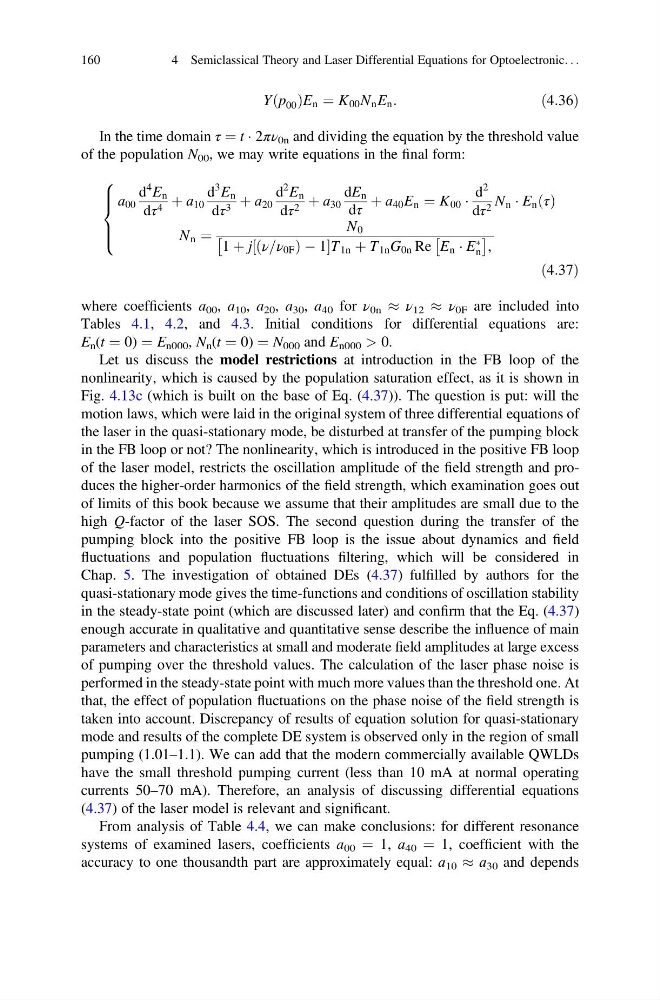
In the time domain τ ¼ t Á 2πν 0n and dividing the equation by the threshold value
of the population N 00 , we may write equations in the final form:
а 00
d
4 E n
dτ 4 þ а 10
d
3 E n
dτ 3 þ а 20
d
2 E n
dτ 2 þ а 30
dE n
dτ
þ а 40 E n ¼ K 00 Á
d
2
dτ 2 N n Á E n τ
ð Þ
N n ¼
N 0
1 þ j ν=ν 0F
ð
ÞÀ1
½
T 1n þ T 1n G 0n Re E n Á E
Ã
n
Â
Ã
Â
,
8
> > <
> > :
ð4:37Þ
where coefficients а 00 , a 10 , a 20 , a 30 , a 40 for ν 0n % ν 12 % ν 0F are included into
Tables 4.1, 4.2, and 4.3. Initial conditions for differential equations are:
E n (t ¼ 0) ¼ E n000 , N n (t ¼ 0) ¼ N 000 and E n000 > 0.
Let us discuss the model restrictions at introduction in the FB loop of the
nonlinearity, which is caused by the population saturation effect, as it is shown in
Fig. 4.13c (which is built on the base of Eq. (4.37)). The question is put: will the
motion laws, which were laid in the original system of three differential equations of
the laser in the quasi-stationary mode, be disturbed at transfer of the pumping block
in the FB loop or not? The nonlinearity, which is introduced in the positive FB loop
of the laser model, restricts the oscillation amplitude of the field strength and produces the higher-order harmonics of the field strength, which examination goes out
of limits of this book because we assume that their amplitudes are small due to the
high Q-factor of the laser SOS. The second question during the transfer of the
pumping block into the positive FB loop is the issue about dynamics and field
fluctuations and population fluctuations filtering, which will be considered in
Chap. 5. The investigation of obtained DEs (4.37) fulfilled by authors for the
quasi-stationary mode gives the time-functions and conditions of oscillation stability
in the steady-state point (which are discussed later) and confirm that the Eq. (4.37)
enough accurate in qualitative and quantitative sense describe the influence of main
parameters and characteristics at small and moderate field amplitudes at large excess
of pumping over the threshold values. The calculation of the laser phase noise is
performed in the steady-state point with much more values than the threshold one. At
that, the effect of population fluctuations on the phase noise of the field strength is
taken into account. Discrepancy of results of equation solution for quasi-stationary
mode and results of the complete DE system is observed only in the region of small
pumping (1.01–1.1). We can add that the modern commercially available QWLDs
have the small threshold pumping current (less than 10 mA at normal operating
currents 50–70 mA). Therefore, an analysis of discussing differential equations
(4.37) of the laser model is relevant and significant.
From analysis of Table 4.4, we can make conclusions: for different resonance
systems of examined lasers, coefficients а 00 ¼ 1, а 40 ¼ 1, coefficient with the
accuracy to one thousandth part are approximately equal: а 10 % а 30 and depends
160
4 Semiclassical Theory and Laser Differential Equations for Optoelectronic. . .
ð ÞE n ¼ K 00 N n E n :
ð4:36Þ
In the time domain τ ¼ t Á 2πν 0n and dividing the equation by the threshold value
of the population N 00 , we may write equations in the final form:
а 00
d
4 E n
dτ 4 þ а 10
d
3 E n
dτ 3 þ а 20
d
2 E n
dτ 2 þ а 30
dE n
dτ
þ а 40 E n ¼ K 00 Á
d
2
dτ 2 N n Á E n τ
ð Þ
N n ¼
N 0
1 þ j ν=ν 0F
ð
ÞÀ1
½
T 1n þ T 1n G 0n Re E n Á E
Ã
n
Â
Ã
Â
,
8
> > <
> > :
ð4:37Þ
where coefficients а 00 , a 10 , a 20 , a 30 , a 40 for ν 0n % ν 12 % ν 0F are included into
Tables 4.1, 4.2, and 4.3. Initial conditions for differential equations are:
E n (t ¼ 0) ¼ E n000 , N n (t ¼ 0) ¼ N 000 and E n000 > 0.
Let us discuss the model restrictions at introduction in the FB loop of the
nonlinearity, which is caused by the population saturation effect, as it is shown in
Fig. 4.13c (which is built on the base of Eq. (4.37)). The question is put: will the
motion laws, which were laid in the original system of three differential equations of
the laser in the quasi-stationary mode, be disturbed at transfer of the pumping block
in the FB loop or not? The nonlinearity, which is introduced in the positive FB loop
of the laser model, restricts the oscillation amplitude of the field strength and produces the higher-order harmonics of the field strength, which examination goes out
of limits of this book because we assume that their amplitudes are small due to the
high Q-factor of the laser SOS. The second question during the transfer of the
pumping block into the positive FB loop is the issue about dynamics and field
fluctuations and population fluctuations filtering, which will be considered in
Chap. 5. The investigation of obtained DEs (4.37) fulfilled by authors for the
quasi-stationary mode gives the time-functions and conditions of oscillation stability
in the steady-state point (which are discussed later) and confirm that the Eq. (4.37)
enough accurate in qualitative and quantitative sense describe the influence of main
parameters and characteristics at small and moderate field amplitudes at large excess
of pumping over the threshold values. The calculation of the laser phase noise is
performed in the steady-state point with much more values than the threshold one. At
that, the effect of population fluctuations on the phase noise of the field strength is
taken into account. Discrepancy of results of equation solution for quasi-stationary
mode and results of the complete DE system is observed only in the region of small
pumping (1.01–1.1). We can add that the modern commercially available QWLDs
have the small threshold pumping current (less than 10 mA at normal operating
currents 50–70 mA). Therefore, an analysis of discussing differential equations
(4.37) of the laser model is relevant and significant.
From analysis of Table 4.4, we can make conclusions: for different resonance
systems of examined lasers, coefficients а 00 ¼ 1, а 40 ¼ 1, coefficient with the
accuracy to one thousandth part are approximately equal: а 10 % а 30 and depends
160
4 Semiclassical Theory and Laser Differential Equations for Optoelectronic. . .