

4.2.4 Abbreviated Equations of QWLD
The laser of the mentioned DE system (4.17) we represent as SOS, in which
oscillations are close to harmonic that is defined by high Q-factors of the resonator
and the amplification line. Methods of the approximate analysis developed in the
nonlinear oscillation theory include the method of abbreviated equation, which can
be used for the QWLD analysis. Using the described in [9] Evtianov method, we can
obtain the abbreviated DEs from Eq. (4.22) for the first harmonic of slowly changing
amplitudes of P 10n and E 10n : for the EMF strength E n (t) ¼ E 0n (t) cos [2πν n t + φ Ln (t)],
for the polarization P n (t) ¼ P 10n (t) cos [2πν n t + φ Ln (t)].
According to the Evtianov method, we must find the biased differential operator
by choosing the optical frequency 2πν 0n as the reference frequency. After normalization of DEs, replacing p 00 by j2πν 0n + p 001 , we group equation terms in smallness
order keeping only the terms of the first smallness order, we obtain the expression for
abbreviated OTF in the first approximation [9]. At that, we neglect by the small
detuning β ¼ [(ν 0n À ν 12 )/ν 12 ]
2
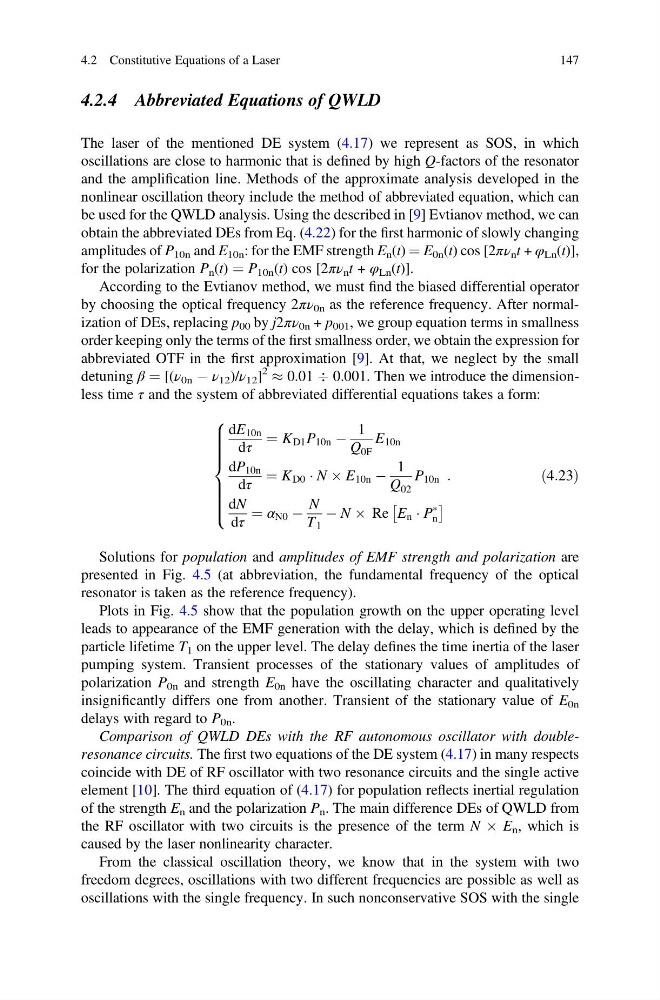
% 0.01 Ä 0.001. Then we introduce the dimensionless time τ and the system of abbreviated differential equations takes a form:
dE 10n
dτ
¼ K D1 P 10n À
1
Q 0F
E 10n
dP 10n
dτ
¼ K D0 Á N Â E 10n À
1
Q 02
P 10n
dN
dτ
¼ α N0 À
N
T 1
À N Â Re E n Á P
Ã
n
Â
Ã
8
> > > > > > <
> > > > > > :
:
ð4:23Þ
Solutions for population and amplitudes of EMF strength and polarization are
presented in Fig. 4.5 (at abbreviation, the fundamental frequency of the optical
resonator is taken as the reference frequency).
Plots in Fig. 4.5 show that the population growth on the upper operating level
leads to appearance of the EMF generation with the delay, which is defined by the
particle lifetime T 1 on the upper level. The delay defines the time inertia of the laser
pumping system. Transient processes of the stationary values of amplitudes of
polarization P 0n and strength E 0n have the oscillating character and qualitatively
insignificantly differs one from another. Transient of the stationary value of E 0n
delays with regard to P 0n .
Comparison of QWLD DEs with the RF autonomous oscillator with doubleresonance circuits. The first two equations of the DE system (4.17) in many respects
coincide with DE of RF oscillator with two resonance circuits and the single active
element [10]. The third equation of (4.17) for population reflects inertial regulation
of the strength E n and the polarization P n . The main difference DEs of QWLD from
the RF oscillator with two circuits is the presence of the term N Â E n , which is
caused by the laser nonlinearity character.
From the classical oscillation theory, we know that in the system with two
freedom degrees, oscillations with two different frequencies are possible as well as
oscillations with the single frequency. In such nonconservative SOS with the single
4.2 Constitutive Equations of a Laser
147
The laser of the mentioned DE system (4.17) we represent as SOS, in which
oscillations are close to harmonic that is defined by high Q-factors of the resonator
and the amplification line. Methods of the approximate analysis developed in the
nonlinear oscillation theory include the method of abbreviated equation, which can
be used for the QWLD analysis. Using the described in [9] Evtianov method, we can
obtain the abbreviated DEs from Eq. (4.22) for the first harmonic of slowly changing
amplitudes of P 10n and E 10n : for the EMF strength E n (t) ¼ E 0n (t) cos [2πν n t + φ Ln (t)],
for the polarization P n (t) ¼ P 10n (t) cos [2πν n t + φ Ln (t)].
According to the Evtianov method, we must find the biased differential operator
by choosing the optical frequency 2πν 0n as the reference frequency. After normalization of DEs, replacing p 00 by j2πν 0n + p 001 , we group equation terms in smallness
order keeping only the terms of the first smallness order, we obtain the expression for
abbreviated OTF in the first approximation [9]. At that, we neglect by the small
detuning β ¼ [(ν 0n À ν 12 )/ν 12 ]
2
% 0.01 Ä 0.001. Then we introduce the dimensionless time τ and the system of abbreviated differential equations takes a form:
dE 10n
dτ
¼ K D1 P 10n À
1
Q 0F
E 10n
dP 10n
dτ
¼ K D0 Á N Â E 10n À
1
Q 02
P 10n
dN
dτ
¼ α N0 À
N
T 1
À N Â Re E n Á P
Ã
n
Â
Ã
8
> > > > > > <
> > > > > > :
:
ð4:23Þ
Solutions for population and amplitudes of EMF strength and polarization are
presented in Fig. 4.5 (at abbreviation, the fundamental frequency of the optical
resonator is taken as the reference frequency).
Plots in Fig. 4.5 show that the population growth on the upper operating level
leads to appearance of the EMF generation with the delay, which is defined by the
particle lifetime T 1 on the upper level. The delay defines the time inertia of the laser
pumping system. Transient processes of the stationary values of amplitudes of
polarization P 0n and strength E 0n have the oscillating character and qualitatively
insignificantly differs one from another. Transient of the stationary value of E 0n
delays with regard to P 0n .
Comparison of QWLD DEs with the RF autonomous oscillator with doubleresonance circuits. The first two equations of the DE system (4.17) in many respects
coincide with DE of RF oscillator with two resonance circuits and the single active
element [10]. The third equation of (4.17) for population reflects inertial regulation
of the strength E n and the polarization P n . The main difference DEs of QWLD from
the RF oscillator with two circuits is the presence of the term N Â E n , which is
caused by the laser nonlinearity character.
From the classical oscillation theory, we know that in the system with two
freedom degrees, oscillations with two different frequencies are possible as well as
oscillations with the single frequency. In such nonconservative SOS with the single
4.2 Constitutive Equations of a Laser
147