

4.2.3 Q-Factors of Spectral Lines of Amplification
of Quantum-Well Laser Diodes
On the example of examination of two types of lasers, we prove that the Q-factor of
the spectral line of the active medium in QWLD is commensurable on the value of
the Q-factor of the optical resonator.
Q-factors of the spectral line of QWLD amplification are defined by the structure
of the semiconductor. In the modern semiconductor lasers, the materials on the base
of the quantum-well structures with three and several quantum wells (or the
quantum-dimension zones) are used. At creation of quantum zones in the junction,
the laser demonstrates the new qualitative properties: the selection rules in states at
junction begin to be performed and the gain of QWLD has the typical peak-shaped
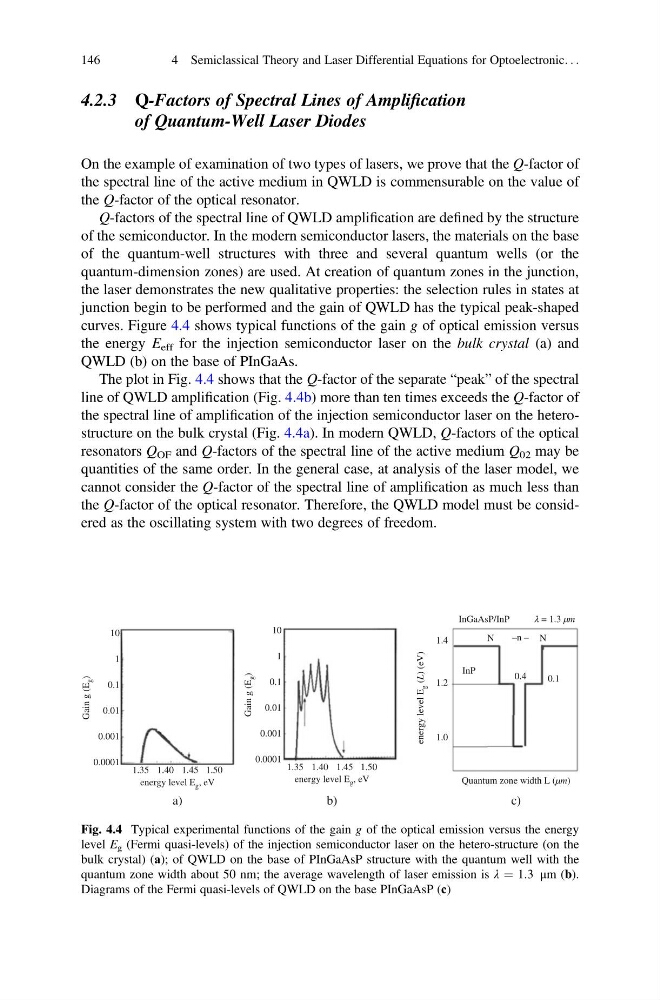
curves. Figure 4.4 shows typical functions of the gain g of optical emission versus
the energy E eff for the injection semiconductor laser on the bulk crystal (a) and
QWLD (b) on the base of PInGaAs.
The plot in Fig. 4.4 shows that the Q-factor of the separate “peak” of the spectral
line of QWLD amplification (Fig. 4.4b) more than ten times exceeds the Q-factor of
the spectral line of amplification of the injection semiconductor laser on the heterostructure on the bulk crystal (Fig. 4.4a). In modern QWLD, Q-factors of the optical
resonators Q OF and Q-factors of the spectral line of the active medium Q 02 may be
quantities of the same order. In the general case, at analysis of the laser model, we
cannot consider the Q-factor of the spectral line of amplification as much less than
the Q-factor of the optical resonator. Therefore, the QWLD model must be considered as the oscillating system with two degrees of freedom.
10
1
0.1
0.01
0.001
Gain g (E
g )
0.0001
1.35 1.40
a)
b)
c)
energy level E g , eV
1.45 1.50
10
1.4
1.2
InP
0.4
0.1
N
N
InGaAsP/InP
–n –
l = 1.3 µm
1.0
1
0.1
0.01
0.001
Gain g (E
g )
0.0001
1.35 1.40
Quantum zone width L (µm)
energy level E g , eV
energy level E
g (L) (eV)
1.45 1.50
Fig. 4.4 Typical experimental functions of the gain g of the optical emission versus the energy
level E g (Fermi quasi-levels) of the injection semiconductor laser on the hetero-structure (on the
bulk crystal) (а); of QWLD on the base of PInGaAsP structure with the quantum well with the
quantum zone width about 50 nm; the average wavelength of laser emission is λ ¼ 1.3 μm (b).
Diagrams of the Fermi quasi-levels of QWLD on the base PInGaAsP (с)
146
4 Semiclassical Theory and Laser Differential Equations for Optoelectronic. . .
of Quantum-Well Laser Diodes
On the example of examination of two types of lasers, we prove that the Q-factor of
the spectral line of the active medium in QWLD is commensurable on the value of
the Q-factor of the optical resonator.
Q-factors of the spectral line of QWLD amplification are defined by the structure
of the semiconductor. In the modern semiconductor lasers, the materials on the base
of the quantum-well structures with three and several quantum wells (or the
quantum-dimension zones) are used. At creation of quantum zones in the junction,
the laser demonstrates the new qualitative properties: the selection rules in states at
junction begin to be performed and the gain of QWLD has the typical peak-shaped
curves. Figure 4.4 shows typical functions of the gain g of optical emission versus
the energy E eff for the injection semiconductor laser on the bulk crystal (a) and
QWLD (b) on the base of PInGaAs.
The plot in Fig. 4.4 shows that the Q-factor of the separate “peak” of the spectral
line of QWLD amplification (Fig. 4.4b) more than ten times exceeds the Q-factor of
the spectral line of amplification of the injection semiconductor laser on the heterostructure on the bulk crystal (Fig. 4.4a). In modern QWLD, Q-factors of the optical
resonators Q OF and Q-factors of the spectral line of the active medium Q 02 may be
quantities of the same order. In the general case, at analysis of the laser model, we
cannot consider the Q-factor of the spectral line of amplification as much less than
the Q-factor of the optical resonator. Therefore, the QWLD model must be considered as the oscillating system with two degrees of freedom.
10
1
0.1
0.01
0.001
Gain g (E
g )
0.0001
1.35 1.40
a)
b)
c)
energy level E g , eV
1.45 1.50
10
1.4
1.2
InP
0.4
0.1
N
N
InGaAsP/InP
–n –
l = 1.3 µm
1.0
1
0.1
0.01
0.001
Gain g (E
g )
0.0001
1.35 1.40
Quantum zone width L (µm)
energy level E g , eV
energy level E
g (L) (eV)
1.45 1.50
Fig. 4.4 Typical experimental functions of the gain g of the optical emission versus the energy
level E g (Fermi quasi-levels) of the injection semiconductor laser on the hetero-structure (on the
bulk crystal) (а); of QWLD on the base of PInGaAsP structure with the quantum well with the
quantum zone width about 50 nm; the average wavelength of laser emission is λ ¼ 1.3 μm (b).
Diagrams of the Fermi quasi-levels of QWLD on the base PInGaAsP (с)
146
4 Semiclassical Theory and Laser Differential Equations for Optoelectronic. . .