

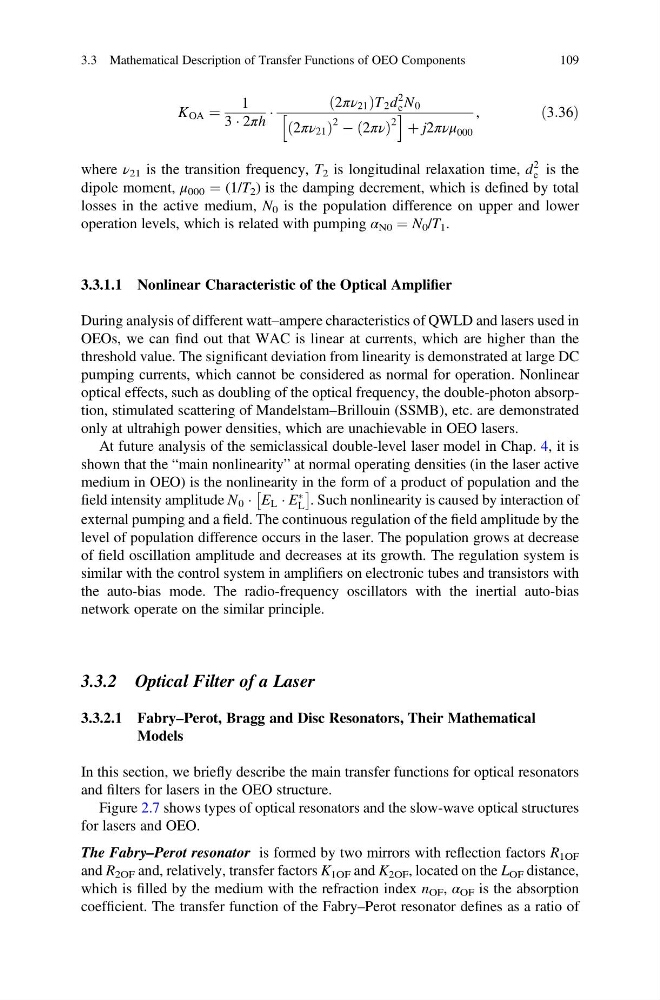
K OA ¼
1
3 Á 2πh
Á
2πν 21
ð
ÞT 2 d
2
e N 0
2πν 21
ð
Þ
2 À 2πν
ð
Þ
2
h
i
þ j2πνμ 000
,
ð3:36Þ
where ν 21 is the transition frequency, T 2 is longitudinal relaxation time, d
2
e is the
dipole moment, μ 000 ¼ (1/T 2 ) is the damping decrement, which is defined by total
losses in the active medium, N 0 is the population difference on upper and lower
operation levels, which is related with pumping α N0 ¼ N 0 /T 1 .
3.3.1.1 Nonlinear Characteristic of the Optical Amplifier
During analysis of different watt–ampere characteristics of QWLD and lasers used in
OEOs, we can find out that WAC is linear at currents, which are higher than the
threshold value. The significant deviation from linearity is demonstrated at large DC
pumping currents, which cannot be considered as normal for operation. Nonlinear
optical effects, such as doubling of the optical frequency, the double-photon absorption, stimulated scattering of Mandelstam–Brillouin (SSMB), etc. are demonstrated
only at ultrahigh power densities, which are unachievable in OEO lasers.
At future analysis of the semiclassical double-level laser model in Chap. 4, it is
shown that the “main nonlinearity” at normal operating densities (in the laser active
medium in OEO) is the nonlinearity in the form of a product of population and the
field intensity amplitude N 0 Á E L Á E
Ã
L
Â
Ã
. Such nonlinearity is caused by interaction of
external pumping and a field. The continuous regulation of the field amplitude by the
level of population difference occurs in the laser. The population grows at decrease
of field oscillation amplitude and decreases at its growth. The regulation system is
similar with the control system in amplifiers on electronic tubes and transistors with
the auto-bias mode. The radio-frequency oscillators with the inertial auto-bias
network operate on the similar principle.
3.3.2 Optical Filter of a Laser
3.3.2.1 Fabry–Perot, Bragg and Disc Resonators, Their Mathematical
Models
In this section, we briefly describe the main transfer functions for optical resonators
and filters for lasers in the OEO structure.
Figure 2.7 shows types of optical resonators and the slow-wave optical structures
for lasers and OEO.
The Fabry–Perot resonator is formed by two mirrors with reflection factors R 1OF
and R 2OF and, relatively, transfer factors K 1OF and K 2OF , located on the L OF distance,
which is filled by the medium with the refraction index n OF , α OF is the absorption
coefficient. The transfer function of the Fabry–Perot resonator defines as a ratio of
3.3 Mathematical Description of Transfer Functions of OEO Components
109
1
3 Á 2πh
Á
2πν 21
ð
ÞT 2 d
2
e N 0
2πν 21
ð
Þ
2 À 2πν
ð
Þ
2
h
i
þ j2πνμ 000
,
ð3:36Þ
where ν 21 is the transition frequency, T 2 is longitudinal relaxation time, d
2
e is the
dipole moment, μ 000 ¼ (1/T 2 ) is the damping decrement, which is defined by total
losses in the active medium, N 0 is the population difference on upper and lower
operation levels, which is related with pumping α N0 ¼ N 0 /T 1 .
3.3.1.1 Nonlinear Characteristic of the Optical Amplifier
During analysis of different watt–ampere characteristics of QWLD and lasers used in
OEOs, we can find out that WAC is linear at currents, which are higher than the
threshold value. The significant deviation from linearity is demonstrated at large DC
pumping currents, which cannot be considered as normal for operation. Nonlinear
optical effects, such as doubling of the optical frequency, the double-photon absorption, stimulated scattering of Mandelstam–Brillouin (SSMB), etc. are demonstrated
only at ultrahigh power densities, which are unachievable in OEO lasers.
At future analysis of the semiclassical double-level laser model in Chap. 4, it is
shown that the “main nonlinearity” at normal operating densities (in the laser active
medium in OEO) is the nonlinearity in the form of a product of population and the
field intensity amplitude N 0 Á E L Á E
Ã
L
Â
Ã
. Such nonlinearity is caused by interaction of
external pumping and a field. The continuous regulation of the field amplitude by the
level of population difference occurs in the laser. The population grows at decrease
of field oscillation amplitude and decreases at its growth. The regulation system is
similar with the control system in amplifiers on electronic tubes and transistors with
the auto-bias mode. The radio-frequency oscillators with the inertial auto-bias
network operate on the similar principle.
3.3.2 Optical Filter of a Laser
3.3.2.1 Fabry–Perot, Bragg and Disc Resonators, Their Mathematical
Models
In this section, we briefly describe the main transfer functions for optical resonators
and filters for lasers in the OEO structure.
Figure 2.7 shows types of optical resonators and the slow-wave optical structures
for lasers and OEO.
The Fabry–Perot resonator is formed by two mirrors with reflection factors R 1OF
and R 2OF and, relatively, transfer factors K 1OF and K 2OF , located on the L OF distance,
which is filled by the medium with the refraction index n OF , α OF is the absorption
coefficient. The transfer function of the Fabry–Perot resonator defines as a ratio of
3.3 Mathematical Description of Transfer Functions of OEO Components
109