

1 3
Topics in Current Chemistry (2020) 378:40
It is worth mentioning that the targeted strategy for cancer diagnosis was
described before the untargeted strategy. Reimer et al. [273] described in 1990 the
diagnosis of liver cancer after the intravenous administration of IONPs-arabinogalactan conjugates, in both heterotopic and orthotopic models.
IONPs have been functionalized with epithelial growth factor (EGFR) antibodies for the diagnosis of breast cancer [274], pancreatic/stomach cancer [275] and
brain cancer [276]. Because there is an established relationship between mutations
involving overexpression or overactivity of EGFR and various types of cancer, this
receptor is currently one of the most important targets in cancer research [277–279].
Similarly, PSCA (prostate stem cell antigen) antibody was bound to IONPs for diagnosis of prostate cancer [280].
Integrins receptor, especially α 5 β 3 , has been found to be differentially overexpressed in tumors, playing a vital role in tumor angiogenesis [281–283]. Integrins
are recognized mainly by short peptide sequences, such as Arg–Gly–Asp (RGD).
Therefore, some NPs functionalized with RGD have been proposed for the diagnosis
of brain cancer [284], colon cancer [285] or fibrosarcoma [286], among others.
Among other functionalization molecules for targeted diagnosis, it is worth highlighting the use of aptamers for kidney [287] and liver cancer [288], peptides for
prostate and liver cancer [289, 290], and flavin adenine dinucleotide (FAD) for prostate cancer [291].
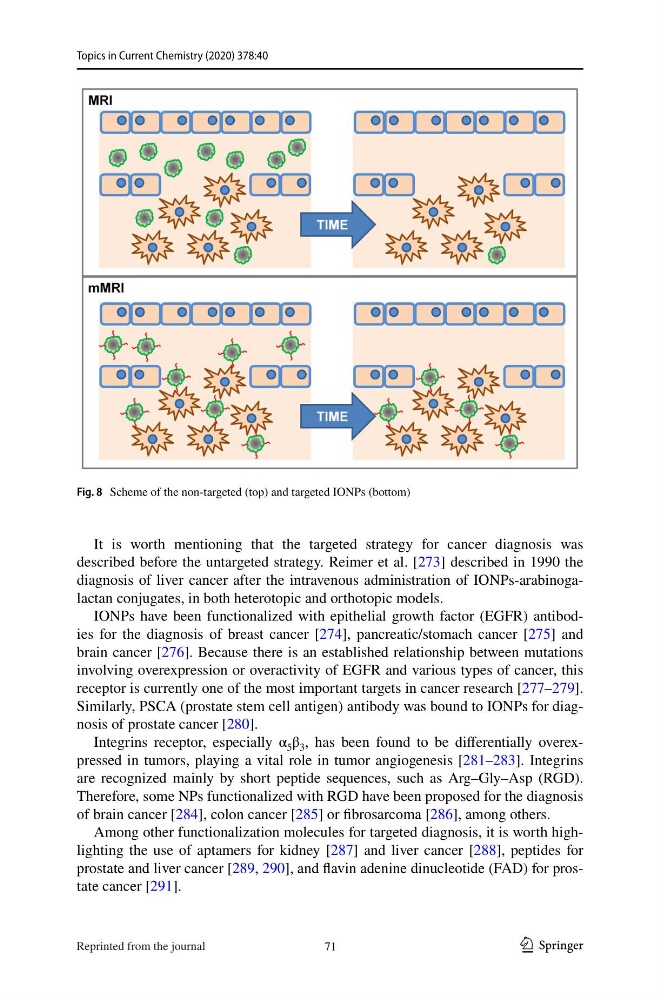
Fig. 8 Scheme of the non-targeted (top) and targeted IONPs (bottom)
71
Reprinted from the journal
Topics in Current Chemistry (2020) 378:40
It is worth mentioning that the targeted strategy for cancer diagnosis was
described before the untargeted strategy. Reimer et al. [273] described in 1990 the
diagnosis of liver cancer after the intravenous administration of IONPs-arabinogalactan conjugates, in both heterotopic and orthotopic models.
IONPs have been functionalized with epithelial growth factor (EGFR) antibodies for the diagnosis of breast cancer [274], pancreatic/stomach cancer [275] and
brain cancer [276]. Because there is an established relationship between mutations
involving overexpression or overactivity of EGFR and various types of cancer, this
receptor is currently one of the most important targets in cancer research [277–279].
Similarly, PSCA (prostate stem cell antigen) antibody was bound to IONPs for diagnosis of prostate cancer [280].
Integrins receptor, especially α 5 β 3 , has been found to be differentially overexpressed in tumors, playing a vital role in tumor angiogenesis [281–283]. Integrins
are recognized mainly by short peptide sequences, such as Arg–Gly–Asp (RGD).
Therefore, some NPs functionalized with RGD have been proposed for the diagnosis
of brain cancer [284], colon cancer [285] or fibrosarcoma [286], among others.
Among other functionalization molecules for targeted diagnosis, it is worth highlighting the use of aptamers for kidney [287] and liver cancer [288], peptides for
prostate and liver cancer [289, 290], and flavin adenine dinucleotide (FAD) for prostate cancer [291].
Fig. 8 Scheme of the non-targeted (top) and targeted IONPs (bottom)
71
Reprinted from the journal