

1 3
Topics in Current Chemistry (2020) 378:40
3.2 Inorganic Coverage
Mesoporous silica is the most important inorganic coating material for IONPs due to
the ease of functionalization, high stability, and vast surface area and pore volume to
host large number molecules. These characteristics make hybrid mesoporous silicaIONPs excellent nanocarriers for controlled drug release therapies [242, 243].
Based on this, Vallet-Regí et al. [244] designed a responsive silica matrix nanocarrier for tumor therapy based on magnetic NPs that combine the heat release
mediated by magnetic hyperthermia and doxorubicin release through a thermoresponsive polymer. The as-prepared OA-capped IONPs are transferred into aqueous solution with CTAB, which helps the growth of the silica matrix by addition of
tetraethyl orthosilicate (TEOS) as a silica precursor. Then, the silica-matrix-coated
IONPs are functionalized with a methacrylate molecule as a polymer precursor to
perform, using N-isopropylacrylamide (NIPAM), N-(hydroxymethyl)acrylamide
(NHMA), and N,N′-methylenebis(acrylamide) (MBA) monomers, the synthesis of a
thermoresponsive polymer surrounding the mesoporous silica-coated IONP (Fig. 6).
Direct injection into the tumor site of Doxo-loaded mesoporous silica NPs, together
with the application of amplified magnetic fields, provoked a synergistic effect
between magnetic hyperthermia and chemotherapy that led to significant tumor
growth inhibition and low toxicity [244].
Hurley et al. [245] demonstrated that the inclusion of functionalized mesoporous
silica coating in IONPs cores results in stable NPs with high heat capacity and high
MRI contrast. The anionic surfactants capped IONPs (a commercially available
IONP called EMG-308) required pre-functionalization with polyvinylpyrrolidone
(PVP) prior to silica condensation with the TEOS precursor. Finally, the functionalization with PEG and trimethyl silane derivates yields colloidal stable NPs with the
same magnetic character that un-functionalized IONPs and minimal toxicity toward
human skin fibroblasts. Furthermore, a direct injection into LNCaP prostate cancer
tumours implanted in nude mice showed that these hybrid mesoporous silica-IONPs
can improve the heating and imaging contrast of IONPs [245].
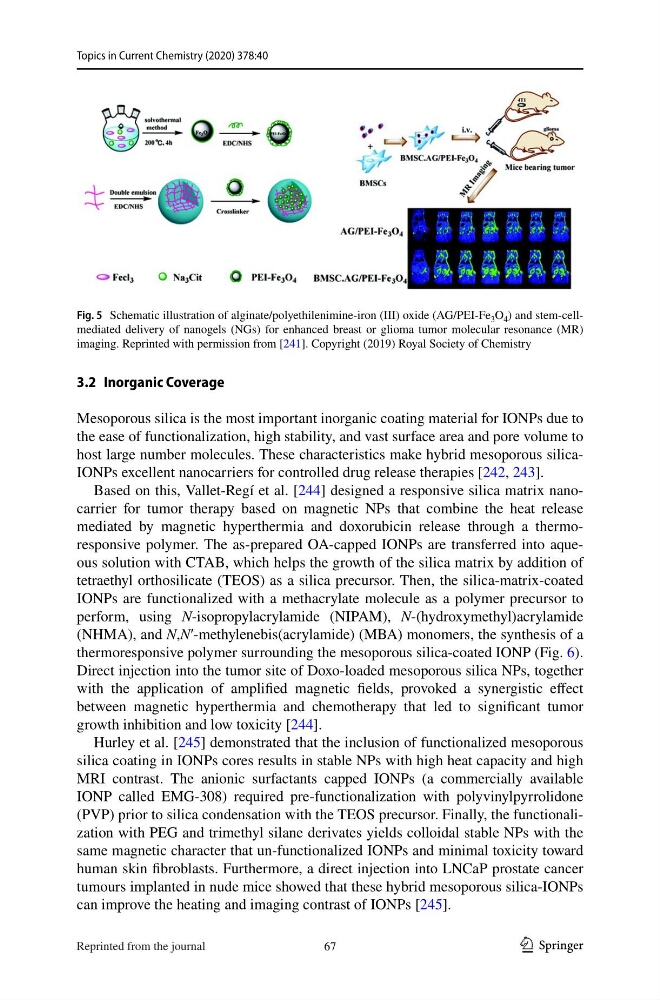
Fig. 5 Schematic illustration of alginate/polyethilenimine-iron (III) oxide (AG/PEI-Fe 3 O 4 ) and stem-cellmediated delivery of nanogels (NGs) for enhanced breast or glioma tumor molecular resonance (MR)
imaging. Reprinted with permission from [241]. Copyright (2019) Royal Society of Chemistry
67
Reprinted from the journal
Topics in Current Chemistry (2020) 378:40
3.2 Inorganic Coverage
Mesoporous silica is the most important inorganic coating material for IONPs due to
the ease of functionalization, high stability, and vast surface area and pore volume to
host large number molecules. These characteristics make hybrid mesoporous silicaIONPs excellent nanocarriers for controlled drug release therapies [242, 243].
Based on this, Vallet-Regí et al. [244] designed a responsive silica matrix nanocarrier for tumor therapy based on magnetic NPs that combine the heat release
mediated by magnetic hyperthermia and doxorubicin release through a thermoresponsive polymer. The as-prepared OA-capped IONPs are transferred into aqueous solution with CTAB, which helps the growth of the silica matrix by addition of
tetraethyl orthosilicate (TEOS) as a silica precursor. Then, the silica-matrix-coated
IONPs are functionalized with a methacrylate molecule as a polymer precursor to
perform, using N-isopropylacrylamide (NIPAM), N-(hydroxymethyl)acrylamide
(NHMA), and N,N′-methylenebis(acrylamide) (MBA) monomers, the synthesis of a
thermoresponsive polymer surrounding the mesoporous silica-coated IONP (Fig. 6).
Direct injection into the tumor site of Doxo-loaded mesoporous silica NPs, together
with the application of amplified magnetic fields, provoked a synergistic effect
between magnetic hyperthermia and chemotherapy that led to significant tumor
growth inhibition and low toxicity [244].
Hurley et al. [245] demonstrated that the inclusion of functionalized mesoporous
silica coating in IONPs cores results in stable NPs with high heat capacity and high
MRI contrast. The anionic surfactants capped IONPs (a commercially available
IONP called EMG-308) required pre-functionalization with polyvinylpyrrolidone
(PVP) prior to silica condensation with the TEOS precursor. Finally, the functionalization with PEG and trimethyl silane derivates yields colloidal stable NPs with the
same magnetic character that un-functionalized IONPs and minimal toxicity toward
human skin fibroblasts. Furthermore, a direct injection into LNCaP prostate cancer
tumours implanted in nude mice showed that these hybrid mesoporous silica-IONPs
can improve the heating and imaging contrast of IONPs [245].
Fig. 5 Schematic illustration of alginate/polyethilenimine-iron (III) oxide (AG/PEI-Fe 3 O 4 ) and stem-cellmediated delivery of nanogels (NGs) for enhanced breast or glioma tumor molecular resonance (MR)
imaging. Reprinted with permission from [241]. Copyright (2019) Royal Society of Chemistry
67
Reprinted from the journal