

Topics in Current Chemistry (2020) 378:40
1 3
2.2 Thermal Decomposition
In this method of synthesis, high temperatures are exploited to break down the
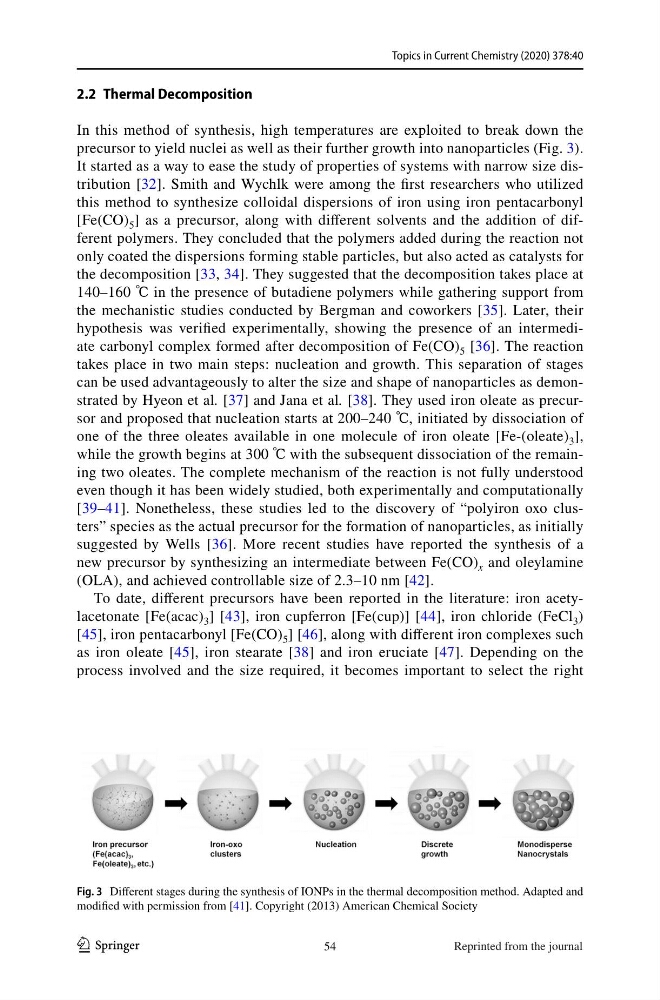
precursor to yield nuclei as well as their further growth into nanoparticles (Fig. 3).
It started as a way to ease the study of properties of systems with narrow size distribution [32]. Smith and Wychlk were among the first researchers who utilized
this method to synthesize colloidal dispersions of iron using iron pentacarbonyl
[Fe(CO) 5 ] as a precursor, along with different solvents and the addition of different polymers. They concluded that the polymers added during the reaction not
only coated the dispersions forming stable particles, but also acted as catalysts for
the decomposition [33, 34]. They suggested that the decomposition takes place at
140–160 ℃ in the presence of butadiene polymers while gathering support from
the mechanistic studies conducted by Bergman and coworkers [35]. Later, their
hypothesis was verified experimentally, showing the presence of an intermediate carbonyl complex formed after decomposition of Fe(CO) 5 [36]. The reaction
takes place in two main steps: nucleation and growth. This separation of stages
can be used advantageously to alter the size and shape of nanoparticles as demonstrated by Hyeon et al. [37] and Jana et al. [38]. They used iron oleate as precursor and proposed that nucleation starts at 200–240 ℃, initiated by dissociation of
one of the three oleates available in one molecule of iron oleate [Fe-(oleate) 3 ],
while the growth begins at 300 ℃ with the subsequent dissociation of the remaining two oleates. The complete mechanism of the reaction is not fully understood
even though it has been widely studied, both experimentally and computationally
[39–41]. Nonetheless, these studies led to the discovery of “polyiron oxo clusters” species as the actual precursor for the formation of nanoparticles, as initially
suggested by Wells [36]. More recent studies have reported the synthesis of a
new precursor by synthesizing an intermediate between Fe(CO) x and oleylamine
(OLA), and achieved controllable size of 2.3–10 nm [42].
To date, different precursors have been reported in the literature: iron acetylacetonate [Fe(acac) 3 ] [43], iron cupferron [Fe(cup)] [44], iron chloride (FeCl 3 )
[45], iron pentacarbonyl [Fe(CO) 5 ] [46], along with different iron complexes such
as iron oleate [45], iron stearate [38] and iron eruciate [47]. Depending on the
process involved and the size required, it becomes important to select the right
Fig. 3 Different stages during the synthesis of IONPs in the thermal decomposition method. Adapted and
modified with permission from [41]. Copyright (2013) American Chemical Society
54
Reprinted from the journal
1 3
2.2 Thermal Decomposition
In this method of synthesis, high temperatures are exploited to break down the
precursor to yield nuclei as well as their further growth into nanoparticles (Fig. 3).
It started as a way to ease the study of properties of systems with narrow size distribution [32]. Smith and Wychlk were among the first researchers who utilized
this method to synthesize colloidal dispersions of iron using iron pentacarbonyl
[Fe(CO) 5 ] as a precursor, along with different solvents and the addition of different polymers. They concluded that the polymers added during the reaction not
only coated the dispersions forming stable particles, but also acted as catalysts for
the decomposition [33, 34]. They suggested that the decomposition takes place at
140–160 ℃ in the presence of butadiene polymers while gathering support from
the mechanistic studies conducted by Bergman and coworkers [35]. Later, their
hypothesis was verified experimentally, showing the presence of an intermediate carbonyl complex formed after decomposition of Fe(CO) 5 [36]. The reaction
takes place in two main steps: nucleation and growth. This separation of stages
can be used advantageously to alter the size and shape of nanoparticles as demonstrated by Hyeon et al. [37] and Jana et al. [38]. They used iron oleate as precursor and proposed that nucleation starts at 200–240 ℃, initiated by dissociation of
one of the three oleates available in one molecule of iron oleate [Fe-(oleate) 3 ],
while the growth begins at 300 ℃ with the subsequent dissociation of the remaining two oleates. The complete mechanism of the reaction is not fully understood
even though it has been widely studied, both experimentally and computationally
[39–41]. Nonetheless, these studies led to the discovery of “polyiron oxo clusters” species as the actual precursor for the formation of nanoparticles, as initially
suggested by Wells [36]. More recent studies have reported the synthesis of a
new precursor by synthesizing an intermediate between Fe(CO) x and oleylamine
(OLA), and achieved controllable size of 2.3–10 nm [42].
To date, different precursors have been reported in the literature: iron acetylacetonate [Fe(acac) 3 ] [43], iron cupferron [Fe(cup)] [44], iron chloride (FeCl 3 )
[45], iron pentacarbonyl [Fe(CO) 5 ] [46], along with different iron complexes such
as iron oleate [45], iron stearate [38] and iron eruciate [47]. Depending on the
process involved and the size required, it becomes important to select the right
Fig. 3 Different stages during the synthesis of IONPs in the thermal decomposition method. Adapted and
modified with permission from [41]. Copyright (2013) American Chemical Society
54
Reprinted from the journal