

1 3
Topics in Current Chemistry (2020) 378:40
spherical, clusters or necklace like, can be synthesized by varying their aging
conditions [25–27]. Itoh et al. [26] synthesized ellipsoidal and spherical hematite nanoparticles by aging them in phosphate ions and nitriloacetic acid (NTA),
respectively. The relationship between shape/size and the electrostatic surface
density of particles is linked to the interfacial tension between the oxide and the
solution, which causes a decrease in the surface energy, thus modulating shape
and size [28]. If a modern method like ultrasonication is used with coprecipitation, it can yield narrowly distributed particles, as shown by Bui et al. [31],
who compared their modified version of the coprecipitation method (using ultrasonication instead of stirring) to the solvothermal method, and found the former
to yield more homogeneous and small sized nanoparticles. However, the comparison between their method and the conventional coprecipitation method (with
stirring) is missing. The major advantages of the coprecipitation method are its
time saving facile nature, with no requirement of high temperature or pressure,
and the production of particles with high yield and easily scalable to large quantities. However, the particles synthesized with this method generally lack homogeneity and form single and also multicore nanoparticles. Particles thus synthesized also tend to form aggregates, which leads to an undesired assortment of
blocking temperatures. Another disadvantage of this method is that the pH of
the resultant solution is too high, thus requiring neutralization before they can
be used for biological applications.
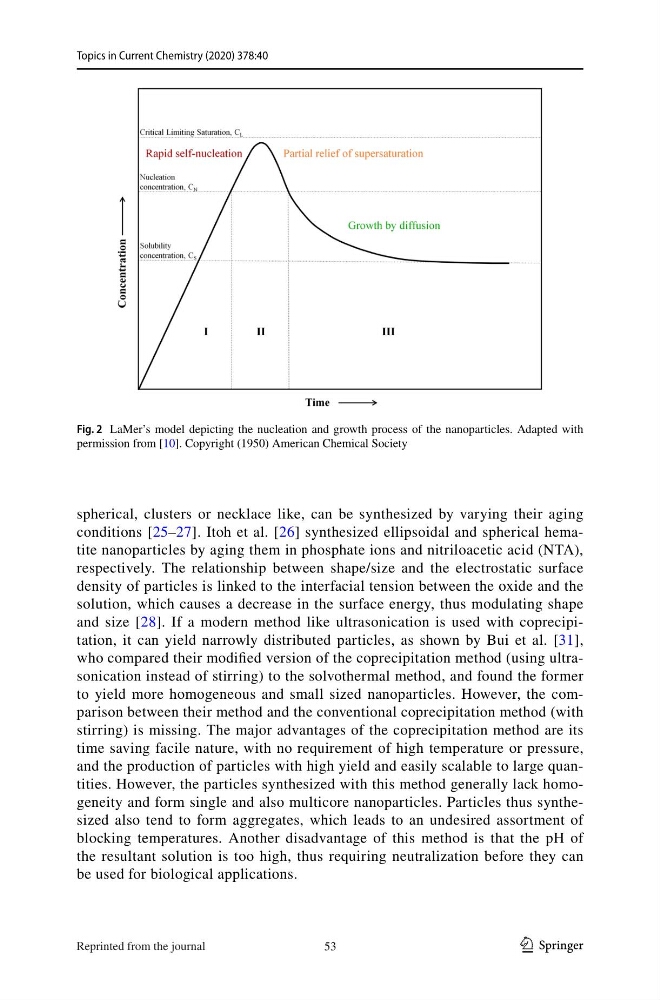
Fig. 2 LaMer’s model depicting the nucleation and growth process of the nanoparticles. Adapted with
permission from [10]. Copyright (1950) American Chemical Society
53
Reprinted from the journal
Topics in Current Chemistry (2020) 378:40
spherical, clusters or necklace like, can be synthesized by varying their aging
conditions [25–27]. Itoh et al. [26] synthesized ellipsoidal and spherical hematite nanoparticles by aging them in phosphate ions and nitriloacetic acid (NTA),
respectively. The relationship between shape/size and the electrostatic surface
density of particles is linked to the interfacial tension between the oxide and the
solution, which causes a decrease in the surface energy, thus modulating shape
and size [28]. If a modern method like ultrasonication is used with coprecipitation, it can yield narrowly distributed particles, as shown by Bui et al. [31],
who compared their modified version of the coprecipitation method (using ultrasonication instead of stirring) to the solvothermal method, and found the former
to yield more homogeneous and small sized nanoparticles. However, the comparison between their method and the conventional coprecipitation method (with
stirring) is missing. The major advantages of the coprecipitation method are its
time saving facile nature, with no requirement of high temperature or pressure,
and the production of particles with high yield and easily scalable to large quantities. However, the particles synthesized with this method generally lack homogeneity and form single and also multicore nanoparticles. Particles thus synthesized also tend to form aggregates, which leads to an undesired assortment of
blocking temperatures. Another disadvantage of this method is that the pH of
the resultant solution is too high, thus requiring neutralization before they can
be used for biological applications.
Fig. 2 LaMer’s model depicting the nucleation and growth process of the nanoparticles. Adapted with
permission from [10]. Copyright (1950) American Chemical Society
53
Reprinted from the journal