

1 3
Topics in Current Chemistry (2020) 378:13
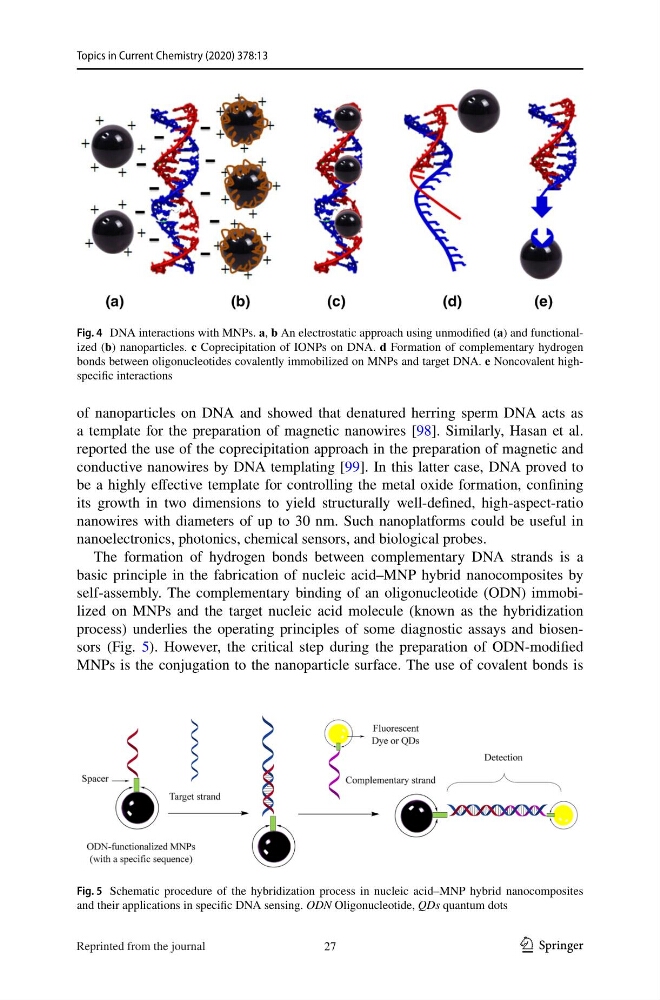
of nanoparticles on DNA and showed that denatured herring sperm DNA acts as
a template for the preparation of magnetic nanowires [98]. Similarly, Hasan et al.
reported the use of the coprecipitation approach in the preparation of magnetic and
conductive nanowires by DNA templating [99]. In this latter case, DNA proved to
be a highly effective template for controlling the metal oxide formation, confining
its growth in two dimensions to yield structurally well-defined, high-aspect-ratio
nanowires with diameters of up to 30 nm. Such nanoplatforms could be useful in
nanoelectronics, photonics, chemical sensors, and biological probes.
The formation of hydrogen bonds between complementary DNA strands is a
basic principle in the fabrication of nucleic acid–MNP hybrid nanocomposites by
self-assembly. The complementary binding of an oligonucleotide (ODN) immobilized on MNPs and the target nucleic acid molecule (known as the hybridization
process) underlies the operating principles of some diagnostic assays and biosensors (Fig. 5). However, the critical step during the preparation of ODN-modified
MNPs is the conjugation to the nanoparticle surface. The use of covalent bonds is
Fig. 4 DNA interactions with MNPs. a, b An electrostatic approach using unmodified (a) and functionalized (b) nanoparticles. c Coprecipitation of IONPs on DNA. d Formation of complementary hydrogen
bonds between oligonucleotides covalently immobilized on MNPs and target DNA. e Noncovalent highspecific interactions
Fig. 5 Schematic procedure of the hybridization process in nucleic acid–MNP hybrid nanocomposites
and their applications in specific DNA sensing. ODN Oligonucleotide, QDs quantum dots
27
Reprinted from the journal
Topics in Current Chemistry (2020) 378:13
of nanoparticles on DNA and showed that denatured herring sperm DNA acts as
a template for the preparation of magnetic nanowires [98]. Similarly, Hasan et al.
reported the use of the coprecipitation approach in the preparation of magnetic and
conductive nanowires by DNA templating [99]. In this latter case, DNA proved to
be a highly effective template for controlling the metal oxide formation, confining
its growth in two dimensions to yield structurally well-defined, high-aspect-ratio
nanowires with diameters of up to 30 nm. Such nanoplatforms could be useful in
nanoelectronics, photonics, chemical sensors, and biological probes.
The formation of hydrogen bonds between complementary DNA strands is a
basic principle in the fabrication of nucleic acid–MNP hybrid nanocomposites by
self-assembly. The complementary binding of an oligonucleotide (ODN) immobilized on MNPs and the target nucleic acid molecule (known as the hybridization
process) underlies the operating principles of some diagnostic assays and biosensors (Fig. 5). However, the critical step during the preparation of ODN-modified
MNPs is the conjugation to the nanoparticle surface. The use of covalent bonds is
Fig. 4 DNA interactions with MNPs. a, b An electrostatic approach using unmodified (a) and functionalized (b) nanoparticles. c Coprecipitation of IONPs on DNA. d Formation of complementary hydrogen
bonds between oligonucleotides covalently immobilized on MNPs and target DNA. e Noncovalent highspecific interactions
Fig. 5 Schematic procedure of the hybridization process in nucleic acid–MNP hybrid nanocomposites
and their applications in specific DNA sensing. ODN Oligonucleotide, QDs quantum dots
27
Reprinted from the journal