

1 3
Topics in Current Chemistry (2020) 378:13
IONPs are not the only iron-containing materials with important magnetic properties. Spinel ferrites are, in general, complex systems derived from iron oxides
that are chemically combined with one or more metallic elements to improve their
magnetic response. Such nanostructures have a common component and formula,
MFe 2 O 4 , where M can be Co
2+
, Mn
2+
, Ni
2+
, Zn
2+
, and others divalent metal ions
[15, 57]. Metal-doped iron oxides with a spinel structure have been prepared by a
high-temperature reaction between corresponding divalent metal chloride and iron
tris-2,4-pentadioate [58], but various other synthetic methods have been reported,
such as electrospinning [57], coprecipitation [59], and polyol [15].
In addition to preventing agglomeration and enhance colloidal stability, the
functionalization of IONPs allows higher water compatibility and better magnetic
control. Surface modification is also necessary to the conjugation of biologically
active substances, an important process for nanomaterial applications to biology and
medicine. Chemical modification methods for the surface of MNPs can be conditionally divided into two groups, noncovalent (or nonspecific) and covalent modification [60]. Such processes encompass ligand addition [61], ligand exchange [62],
and encapsulation of diverse materials, including small molecules [63], organic or
polymeric ligands [64, 65], dense polymer matrix [66], and inorganic materials [67].
In general, so-called core–shell structures representing a magnetic core grafted
with a layer of a polymer or inorganic material are the most widely used MNPs.
They combine the properties of both materials in a single smart and multifunctional system [68, 69]. The coating method is dependent on the nature of the grafting materials and the intended final application. Surface modification of IONPs is
normally achieved in a single step during the synthesis procedure or subsequently
in a post-synthesis protocol. In the former case, the coating process starts as soon
as nucleation occurs, preventing further particle growth. Several ligands have been
used for direct functionalization, including carboxylates [70], phosphonates [71],
thiol [72], or amino groups [52]. Molecules such as citrate and amino acids may
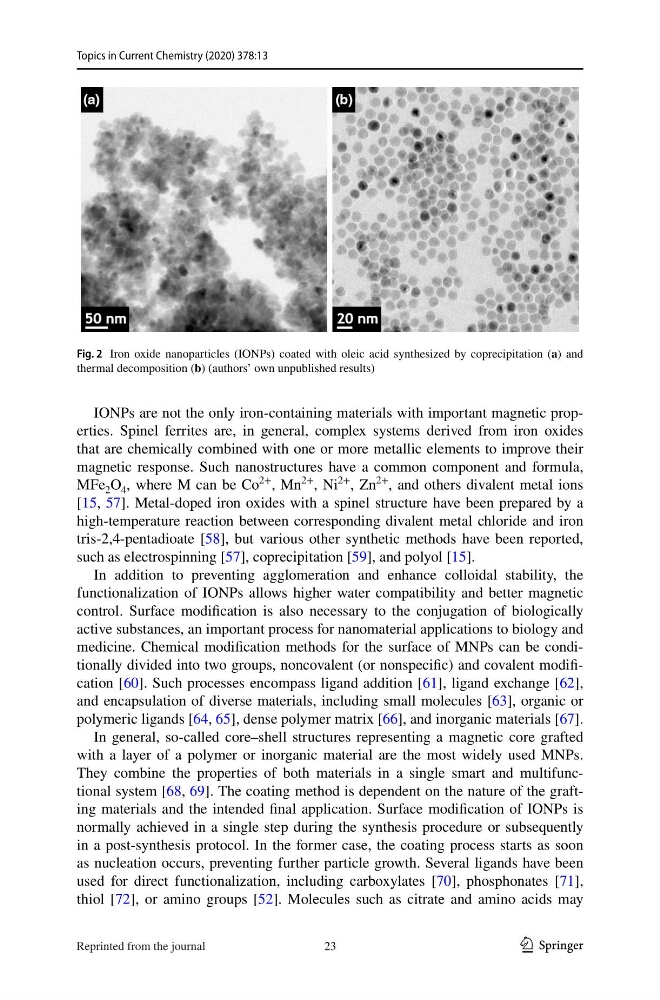
Fig. 2 Iron oxide nanoparticles (IONPs) coated with oleic acid synthesized by coprecipitation (a) and
thermal decomposition (b) (authors’ own unpublished results)
23
Reprinted from the journal
Topics in Current Chemistry (2020) 378:13
IONPs are not the only iron-containing materials with important magnetic properties. Spinel ferrites are, in general, complex systems derived from iron oxides
that are chemically combined with one or more metallic elements to improve their
magnetic response. Such nanostructures have a common component and formula,
MFe 2 O 4 , where M can be Co
2+
, Mn
2+
, Ni
2+
, Zn
2+
, and others divalent metal ions
[15, 57]. Metal-doped iron oxides with a spinel structure have been prepared by a
high-temperature reaction between corresponding divalent metal chloride and iron
tris-2,4-pentadioate [58], but various other synthetic methods have been reported,
such as electrospinning [57], coprecipitation [59], and polyol [15].
In addition to preventing agglomeration and enhance colloidal stability, the
functionalization of IONPs allows higher water compatibility and better magnetic
control. Surface modification is also necessary to the conjugation of biologically
active substances, an important process for nanomaterial applications to biology and
medicine. Chemical modification methods for the surface of MNPs can be conditionally divided into two groups, noncovalent (or nonspecific) and covalent modification [60]. Such processes encompass ligand addition [61], ligand exchange [62],
and encapsulation of diverse materials, including small molecules [63], organic or
polymeric ligands [64, 65], dense polymer matrix [66], and inorganic materials [67].
In general, so-called core–shell structures representing a magnetic core grafted
with a layer of a polymer or inorganic material are the most widely used MNPs.
They combine the properties of both materials in a single smart and multifunctional system [68, 69]. The coating method is dependent on the nature of the grafting materials and the intended final application. Surface modification of IONPs is
normally achieved in a single step during the synthesis procedure or subsequently
in a post-synthesis protocol. In the former case, the coating process starts as soon
as nucleation occurs, preventing further particle growth. Several ligands have been
used for direct functionalization, including carboxylates [70], phosphonates [71],
thiol [72], or amino groups [52]. Molecules such as citrate and amino acids may
Fig. 2 Iron oxide nanoparticles (IONPs) coated with oleic acid synthesized by coprecipitation (a) and
thermal decomposition (b) (authors’ own unpublished results)
23
Reprinted from the journal