

Topics in Current Chemistry (2020) 378:13
1 3
[48, 49]; and (3) microbial methods, which ensure good reproducibility and scalability at a low cost and moderate preparation temperatures [50, 51].
Among the chemical routes, coprecipitation is considered to be the simplest,
cheapest and most environmentally friendly procedure. This route involves the
simultaneous precipitation of Fe
2+
and Fe
3+
ions in basic aqueous media. The reaction temperature is limited by the boiling point of water, and the IONPs synthesized
under these conditions usually exhibit a low degree of crystallinity and large polydispersity [52, 53]. Because of the large number of possible synthesis parameters,
the coprecipitation method makes it possible to study how the final properties of
IONPs can be controlled by various factors, such as the nature of the starting reagents, molar ratio of Fe
2+
to Fe
3+
, alkali type, pH, stirring, ionic strength, surfactant,
and temperature [54]. For example, the slow addition of an ammonia solution typically results in an increased size of nanoparticles, whereas the fast addition leads to
slightly smaller ones.
Compared with coprecipitation, thermal decomposition is a useful technique by
which to prepare colloidally stable nanoparticles with a narrow particle size distribution (Fig. 2). In this methodology, the reaction mixture typically consists of an
organometallic precursor as a metal source, surfactants, and an organic solvent with
a high boiling point [55]. Airless synthetic techniques are often required when this
pathway is employed due to the use of air-sensitive molecular precursors, and the
method cannot be regarded as the most environmentally friendly one due to the use
of often toxic chemicals during synthesis [55, 56]. However, the high temperatures
at which the reactions take place and the presence of amphiphilic surfactant molecules in a non-polar medium limit the use of nanoparticles produced in this way in
most biomedical applications unless modification occurs.
The hydrothermal or solvothermal technique is also considered to be employ
high-temperature pathways to obtain magnetic nanocolloids. This method is dominated by the classical synthesis of nanoparticles via coprecipitation, followed by the
growth of the particles under hydrothermal conditions, which ensures a high crystallinity degree as well as magnetization values. However, the use of a sealed Teflon
container and the heating treatment above the boiling temperature of the water allow
the production of IONPs with a broader particle size distribution in comparison to
thermal decomposition products [54, 56].
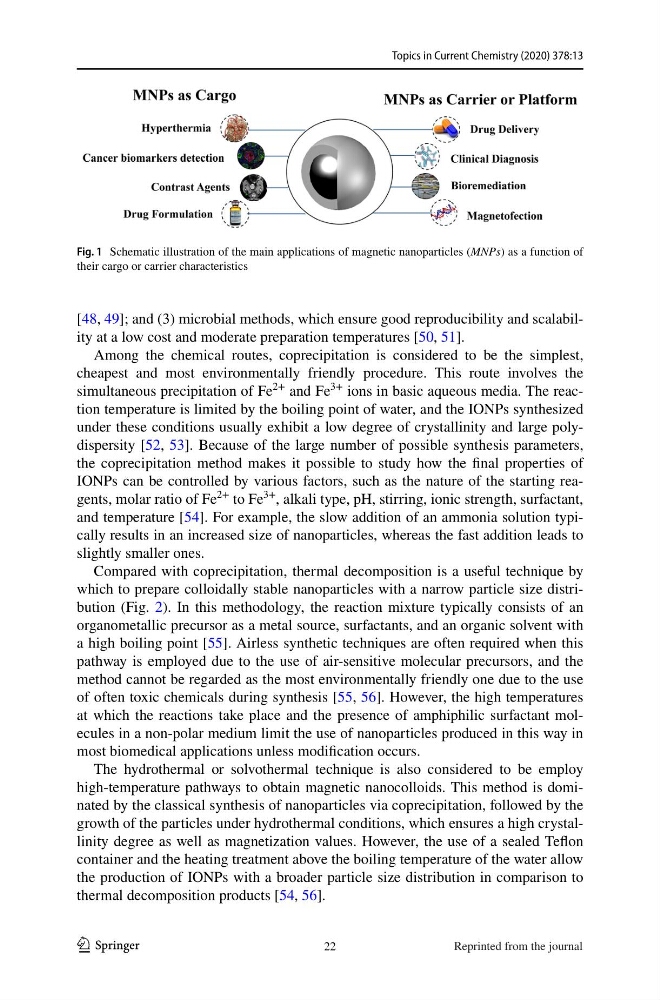
Fig. 1 Schematic illustration of the main applications of magnetic nanoparticles (MNPs) as a function of
their cargo or carrier characteristics
22
Reprinted from the journal
1 3
[48, 49]; and (3) microbial methods, which ensure good reproducibility and scalability at a low cost and moderate preparation temperatures [50, 51].
Among the chemical routes, coprecipitation is considered to be the simplest,
cheapest and most environmentally friendly procedure. This route involves the
simultaneous precipitation of Fe
2+
and Fe
3+
ions in basic aqueous media. The reaction temperature is limited by the boiling point of water, and the IONPs synthesized
under these conditions usually exhibit a low degree of crystallinity and large polydispersity [52, 53]. Because of the large number of possible synthesis parameters,
the coprecipitation method makes it possible to study how the final properties of
IONPs can be controlled by various factors, such as the nature of the starting reagents, molar ratio of Fe
2+
to Fe
3+
, alkali type, pH, stirring, ionic strength, surfactant,
and temperature [54]. For example, the slow addition of an ammonia solution typically results in an increased size of nanoparticles, whereas the fast addition leads to
slightly smaller ones.
Compared with coprecipitation, thermal decomposition is a useful technique by
which to prepare colloidally stable nanoparticles with a narrow particle size distribution (Fig. 2). In this methodology, the reaction mixture typically consists of an
organometallic precursor as a metal source, surfactants, and an organic solvent with
a high boiling point [55]. Airless synthetic techniques are often required when this
pathway is employed due to the use of air-sensitive molecular precursors, and the
method cannot be regarded as the most environmentally friendly one due to the use
of often toxic chemicals during synthesis [55, 56]. However, the high temperatures
at which the reactions take place and the presence of amphiphilic surfactant molecules in a non-polar medium limit the use of nanoparticles produced in this way in
most biomedical applications unless modification occurs.
The hydrothermal or solvothermal technique is also considered to be employ
high-temperature pathways to obtain magnetic nanocolloids. This method is dominated by the classical synthesis of nanoparticles via coprecipitation, followed by the
growth of the particles under hydrothermal conditions, which ensures a high crystallinity degree as well as magnetization values. However, the use of a sealed Teflon
container and the heating treatment above the boiling temperature of the water allow
the production of IONPs with a broader particle size distribution in comparison to
thermal decomposition products [54, 56].
Fig. 1 Schematic illustration of the main applications of magnetic nanoparticles (MNPs) as a function of
their cargo or carrier characteristics
22
Reprinted from the journal