

Topics in Current Chemistry (2020) 378:8
1 3
conjugated AuNPs containing a cell-penetrating TAT peptide and the cationic
PEI that could compact the pDNAs into cationic nanocomplexes (i.e., zeta-potential ~ +35 mV). They demonstrated that the resulting plasmonic bioconjugates
can penetrate through the intact stratum corneum without any additional physical
enhancement method. This study proposed a novel topical gene therapy strategy
for skin cancer with great priority to reverse both the progression and metastasis
of advanced melanoma. Chen et al. [70] fabricated a biocongugate plasmonic NP
for the transdermal delivery of vascular endothelial growth factor (VEGF) in wound
repair. To that end, they performed the bioconjugation of AuNP-PEG-COOH with
VEGF through carbodiimide bonds, obtaining a negative surface charged nanosystem, whose absorption capability was evaluated by a mouse skin model. After treatment, they observed not only the presence of VEGF in the dermis but also its effect
for promoting angiogenesis, demonstrating that, in this case, the binding of protein
biological factors to AuNPs could preserve the activity of the protein. Another study
was reported by Safwat et al., who fabricated AuNPs capped with benzalkonium
chloride and with PEI for enhanced loading and skin permeability of 5-fluorouracil (i.e., 5-FU/BC-AuNPs and 5-FU/PEI-AuNPs, respectively) [71]. They performed
ex vivo permeability studies of different 5-FU preparations using mice skin, demonstrating that the permeability of 5-FU was significantly higher for drug-loaded
AuNPs compared with the other tested 5-FU samples. This same research group also
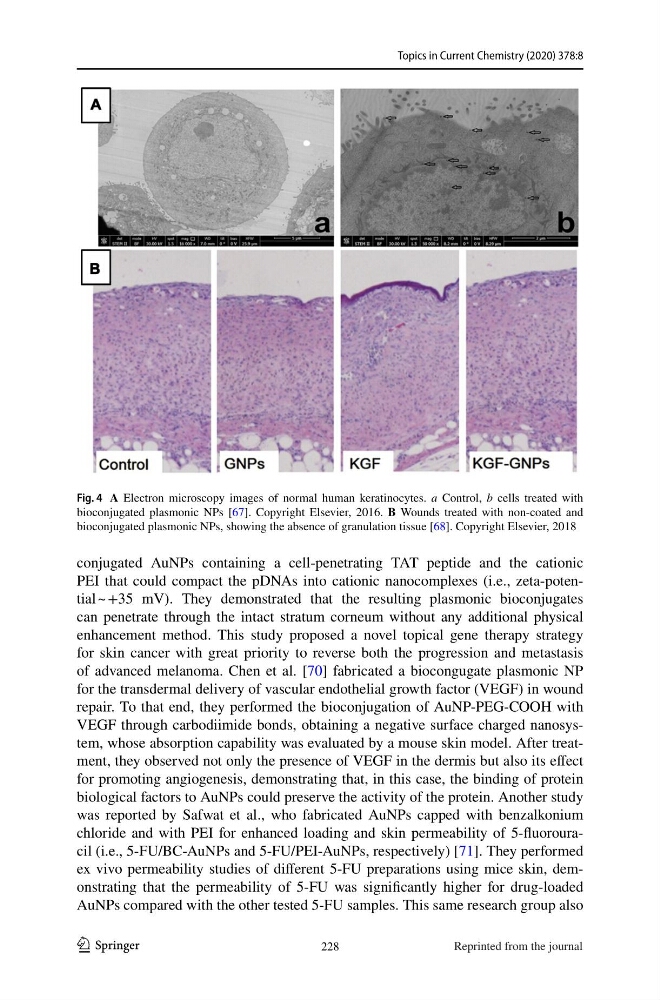
Fig. 4 A Electron microscopy images of normal human keratinocytes. a Control, b cells treated with
bioconjugated plasmonic NPs [67]. Copyright Elsevier, 2016. B Wounds treated with non-coated and
bioconjugated plasmonic NPs, showing the absence of granulation tissue [68]. Copyright Elsevier, 2018
228
Reprinted from the journal
1 3
conjugated AuNPs containing a cell-penetrating TAT peptide and the cationic
PEI that could compact the pDNAs into cationic nanocomplexes (i.e., zeta-potential ~ +35 mV). They demonstrated that the resulting plasmonic bioconjugates
can penetrate through the intact stratum corneum without any additional physical
enhancement method. This study proposed a novel topical gene therapy strategy
for skin cancer with great priority to reverse both the progression and metastasis
of advanced melanoma. Chen et al. [70] fabricated a biocongugate plasmonic NP
for the transdermal delivery of vascular endothelial growth factor (VEGF) in wound
repair. To that end, they performed the bioconjugation of AuNP-PEG-COOH with
VEGF through carbodiimide bonds, obtaining a negative surface charged nanosystem, whose absorption capability was evaluated by a mouse skin model. After treatment, they observed not only the presence of VEGF in the dermis but also its effect
for promoting angiogenesis, demonstrating that, in this case, the binding of protein
biological factors to AuNPs could preserve the activity of the protein. Another study
was reported by Safwat et al., who fabricated AuNPs capped with benzalkonium
chloride and with PEI for enhanced loading and skin permeability of 5-fluorouracil (i.e., 5-FU/BC-AuNPs and 5-FU/PEI-AuNPs, respectively) [71]. They performed
ex vivo permeability studies of different 5-FU preparations using mice skin, demonstrating that the permeability of 5-FU was significantly higher for drug-loaded
AuNPs compared with the other tested 5-FU samples. This same research group also
Fig. 4 A Electron microscopy images of normal human keratinocytes. a Control, b cells treated with
bioconjugated plasmonic NPs [67]. Copyright Elsevier, 2016. B Wounds treated with non-coated and
bioconjugated plasmonic NPs, showing the absence of granulation tissue [68]. Copyright Elsevier, 2018
228
Reprinted from the journal