

Topics in Current Chemistry (2020) 378:8
1 3
1 Introduction
This review is focused on plasmonic nanoparticles (NPs) from among the whole
range of inorganic NPs. Plasmonic NPs are composed of colloidal particles of noble
metals that present a characteristic surface plasmon resonance (SPR) band. The
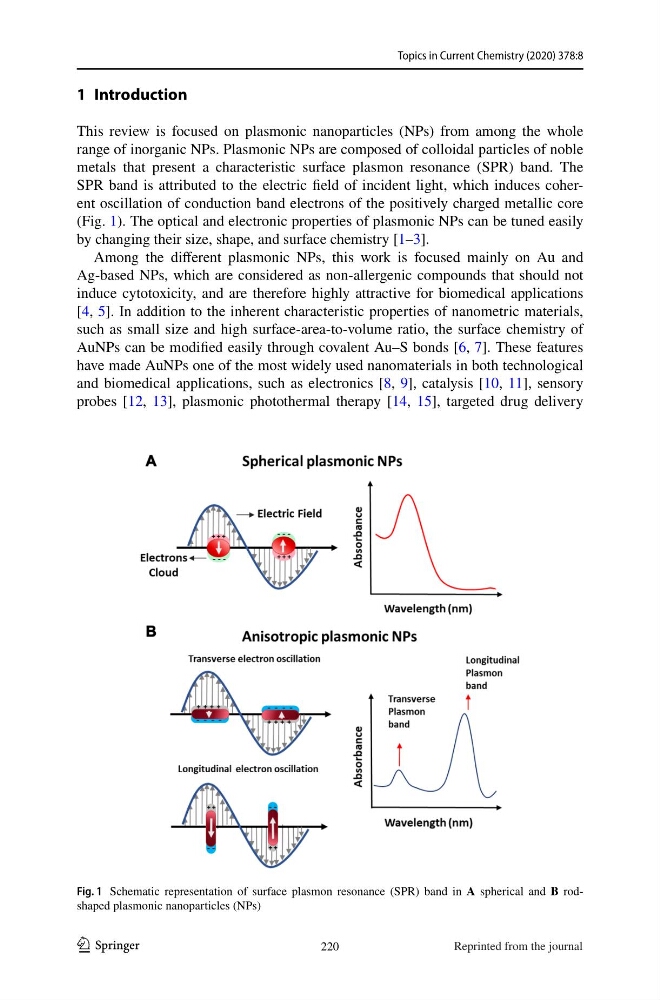
SPR band is attributed to the electric field of incident light, which induces coherent oscillation of conduction band electrons of the positively charged metallic core
(Fig. 1). The optical and electronic properties of plasmonic NPs can be tuned easily
by changing their size, shape, and surface chemistry [1–3].
Among the different plasmonic NPs, this work is focused mainly on Au and
Ag-based NPs, which are considered as non-allergenic compounds that should not
induce cytotoxicity, and are therefore highly attractive for biomedical applications
[4, 5]. In addition to the inherent characteristic properties of nanometric materials,
such as small size and high surface-area-to-volume ratio, the surface chemistry of
AuNPs can be modified easily through covalent Au–S bonds [6, 7]. These features
have made AuNPs one of the most widely used nanomaterials in both technological
and biomedical applications, such as electronics [8, 9], catalysis [10, 11], sensory
probes [12, 13], plasmonic photothermal therapy [14, 15], targeted drug delivery
Fig. 1 Schematic representation of surface plasmon resonance (SPR) band in A spherical and B rodshaped plasmonic nanoparticles (NPs)
220
Reprinted from the journal
1 3
1 Introduction
This review is focused on plasmonic nanoparticles (NPs) from among the whole
range of inorganic NPs. Plasmonic NPs are composed of colloidal particles of noble
metals that present a characteristic surface plasmon resonance (SPR) band. The
SPR band is attributed to the electric field of incident light, which induces coherent oscillation of conduction band electrons of the positively charged metallic core
(Fig. 1). The optical and electronic properties of plasmonic NPs can be tuned easily
by changing their size, shape, and surface chemistry [1–3].
Among the different plasmonic NPs, this work is focused mainly on Au and
Ag-based NPs, which are considered as non-allergenic compounds that should not
induce cytotoxicity, and are therefore highly attractive for biomedical applications
[4, 5]. In addition to the inherent characteristic properties of nanometric materials,
such as small size and high surface-area-to-volume ratio, the surface chemistry of
AuNPs can be modified easily through covalent Au–S bonds [6, 7]. These features
have made AuNPs one of the most widely used nanomaterials in both technological
and biomedical applications, such as electronics [8, 9], catalysis [10, 11], sensory
probes [12, 13], plasmonic photothermal therapy [14, 15], targeted drug delivery
Fig. 1 Schematic representation of surface plasmon resonance (SPR) band in A spherical and B rodshaped plasmonic nanoparticles (NPs)
220
Reprinted from the journal