

1 3
Topics in Current Chemistry (2020) 378:15
4 Biomedical Applications of Carbon Nanotubes
As we anticipated in the previous sections, CNTs present some physical features
very interesting for biomedical applications, including a large surface area [130],
electrical [23] and thermal conductivity [131], and optimal mechanical properties
[132]. Some of these applications are achievable through the CNT’s conjugation
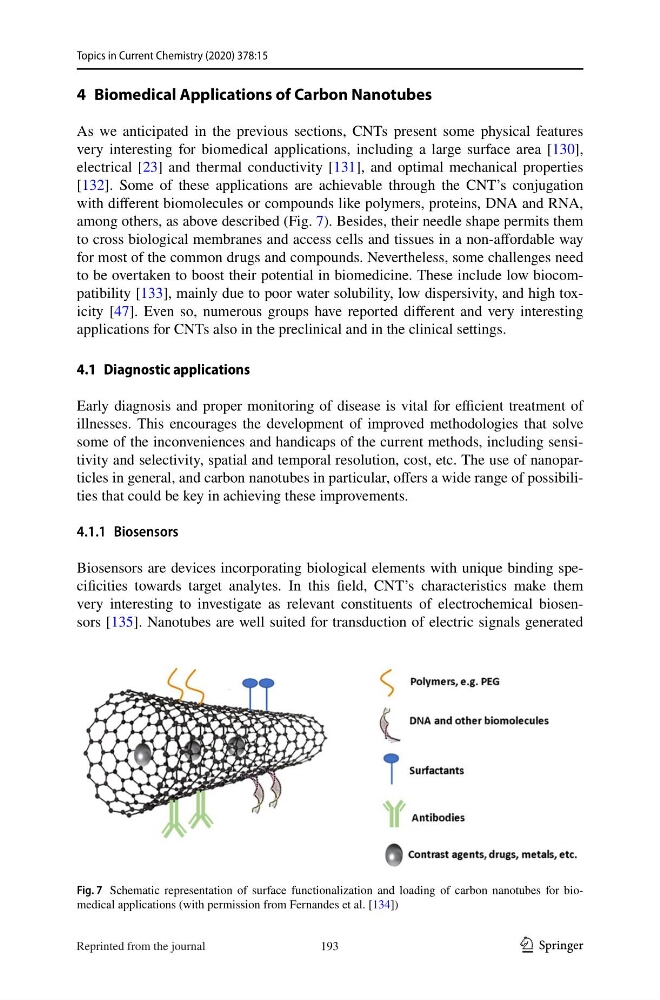
with different biomolecules or compounds like polymers, proteins, DNA and RNA,
among others, as above described (Fig. 7). Besides, their needle shape permits them
to cross biological membranes and access cells and tissues in a non-affordable way
for most of the common drugs and compounds. Nevertheless, some challenges need
to be overtaken to boost their potential in biomedicine. These include low biocompatibility [133], mainly due to poor water solubility, low dispersivity, and high toxicity [47]. Even so, numerous groups have reported different and very interesting
applications for CNTs also in the preclinical and in the clinical settings.
4.1 Diagnostic applications
Early diagnosis and proper monitoring of disease is vital for efficient treatment of
illnesses. This encourages the development of improved methodologies that solve
some of the inconveniences and handicaps of the current methods, including sensitivity and selectivity, spatial and temporal resolution, cost, etc. The use of nanoparticles in general, and carbon nanotubes in particular, offers a wide range of possibilities that could be key in achieving these improvements.
4.1.1 Biosensors
Biosensors are devices incorporating biological elements with unique binding specificities towards target analytes. In this field, CNT’s characteristics make them
very interesting to investigate as relevant constituents of electrochemical biosensors [135]. Nanotubes are well suited for transduction of electric signals generated
Fig. 7 Schematic representation of surface functionalization and loading of carbon nanotubes for biomedical applications (with permission from Fernandes et al. [134])
193
Reprinted from the journal
Topics in Current Chemistry (2020) 378:15
4 Biomedical Applications of Carbon Nanotubes
As we anticipated in the previous sections, CNTs present some physical features
very interesting for biomedical applications, including a large surface area [130],
electrical [23] and thermal conductivity [131], and optimal mechanical properties
[132]. Some of these applications are achievable through the CNT’s conjugation
with different biomolecules or compounds like polymers, proteins, DNA and RNA,
among others, as above described (Fig. 7). Besides, their needle shape permits them
to cross biological membranes and access cells and tissues in a non-affordable way
for most of the common drugs and compounds. Nevertheless, some challenges need
to be overtaken to boost their potential in biomedicine. These include low biocompatibility [133], mainly due to poor water solubility, low dispersivity, and high toxicity [47]. Even so, numerous groups have reported different and very interesting
applications for CNTs also in the preclinical and in the clinical settings.
4.1 Diagnostic applications
Early diagnosis and proper monitoring of disease is vital for efficient treatment of
illnesses. This encourages the development of improved methodologies that solve
some of the inconveniences and handicaps of the current methods, including sensitivity and selectivity, spatial and temporal resolution, cost, etc. The use of nanoparticles in general, and carbon nanotubes in particular, offers a wide range of possibilities that could be key in achieving these improvements.
4.1.1 Biosensors
Biosensors are devices incorporating biological elements with unique binding specificities towards target analytes. In this field, CNT’s characteristics make them
very interesting to investigate as relevant constituents of electrochemical biosensors [135]. Nanotubes are well suited for transduction of electric signals generated
Fig. 7 Schematic representation of surface functionalization and loading of carbon nanotubes for biomedical applications (with permission from Fernandes et al. [134])
193
Reprinted from the journal