

Topics in Current Chemistry (2020) 378:15
1 3
spectra of pristine and oxidized CNTs, where the band due to carbonyl stretching
of carboxylic group is clearly visible at 1691 cm
−1
. The main disadvantages of
this technique include their qualitative nature and that some modifications cannot
be observed due to the weak infrared-associated signals.
3.5 X‑Ray Photoelectron Spectroscopy (XPS)
XPS provides information about the chemical structure of CNT (except for hydrogen) and, most importantly, the structural modifications due to chemical functionalization [129]. This technique irradiates CNTs with X-rays and determines the
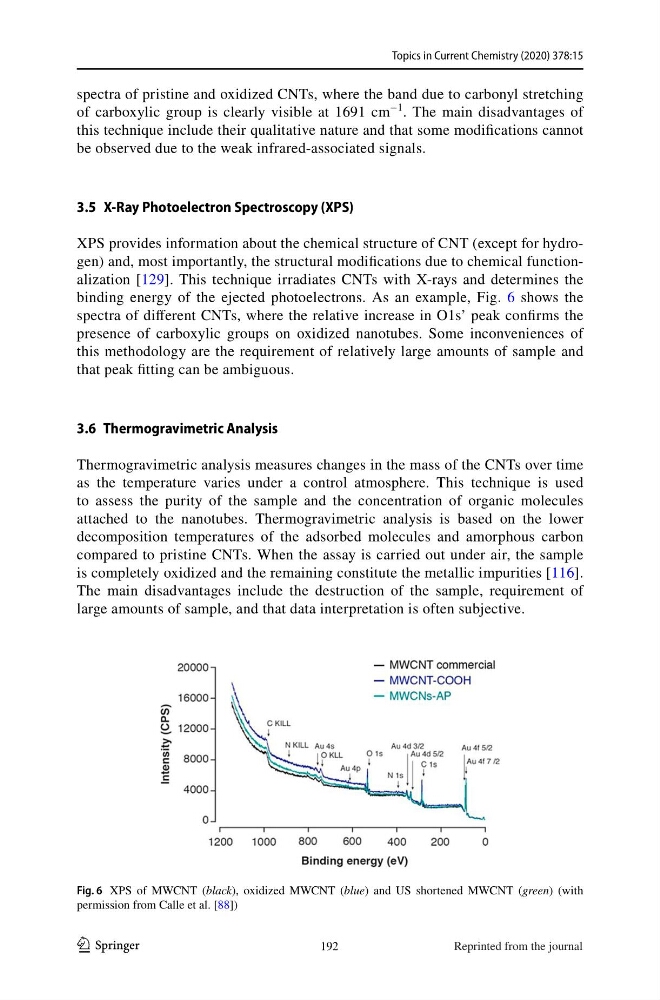
binding energy of the ejected photoelectrons. As an example, Fig. 6 shows the
spectra of different CNTs, where the relative increase in O1s’ peak confirms the
presence of carboxylic groups on oxidized nanotubes. Some inconveniences of
this methodology are the requirement of relatively large amounts of sample and
that peak fitting can be ambiguous.
3.6 Thermogravimetric Analysis
Thermogravimetric analysis measures changes in the mass of the CNTs over time
as the temperature varies under a control atmosphere. This technique is used
to assess the purity of the sample and the concentration of organic molecules
attached to the nanotubes. Thermogravimetric analysis is based on the lower
decomposition temperatures of the adsorbed molecules and amorphous carbon
compared to pristine CNTs. When the assay is carried out under air, the sample
is completely oxidized and the remaining constitute the metallic impurities [116].
The main disadvantages include the destruction of the sample, requirement of
large amounts of sample, and that data interpretation is often subjective.
Fig. 6 XPS of MWCNT (black), oxidized MWCNT (blue) and US shortened MWCNT (green) (with
permission from Calle et al. [88])
192
Reprinted from the journal
1 3
spectra of pristine and oxidized CNTs, where the band due to carbonyl stretching
of carboxylic group is clearly visible at 1691 cm
−1
. The main disadvantages of
this technique include their qualitative nature and that some modifications cannot
be observed due to the weak infrared-associated signals.
3.5 X‑Ray Photoelectron Spectroscopy (XPS)
XPS provides information about the chemical structure of CNT (except for hydrogen) and, most importantly, the structural modifications due to chemical functionalization [129]. This technique irradiates CNTs with X-rays and determines the
binding energy of the ejected photoelectrons. As an example, Fig. 6 shows the
spectra of different CNTs, where the relative increase in O1s’ peak confirms the
presence of carboxylic groups on oxidized nanotubes. Some inconveniences of
this methodology are the requirement of relatively large amounts of sample and
that peak fitting can be ambiguous.
3.6 Thermogravimetric Analysis
Thermogravimetric analysis measures changes in the mass of the CNTs over time
as the temperature varies under a control atmosphere. This technique is used
to assess the purity of the sample and the concentration of organic molecules
attached to the nanotubes. Thermogravimetric analysis is based on the lower
decomposition temperatures of the adsorbed molecules and amorphous carbon
compared to pristine CNTs. When the assay is carried out under air, the sample
is completely oxidized and the remaining constitute the metallic impurities [116].
The main disadvantages include the destruction of the sample, requirement of
large amounts of sample, and that data interpretation is often subjective.
Fig. 6 XPS of MWCNT (black), oxidized MWCNT (blue) and US shortened MWCNT (green) (with
permission from Calle et al. [88])
192
Reprinted from the journal