

1 3
Topics in Current Chemistry (2020) 378:15
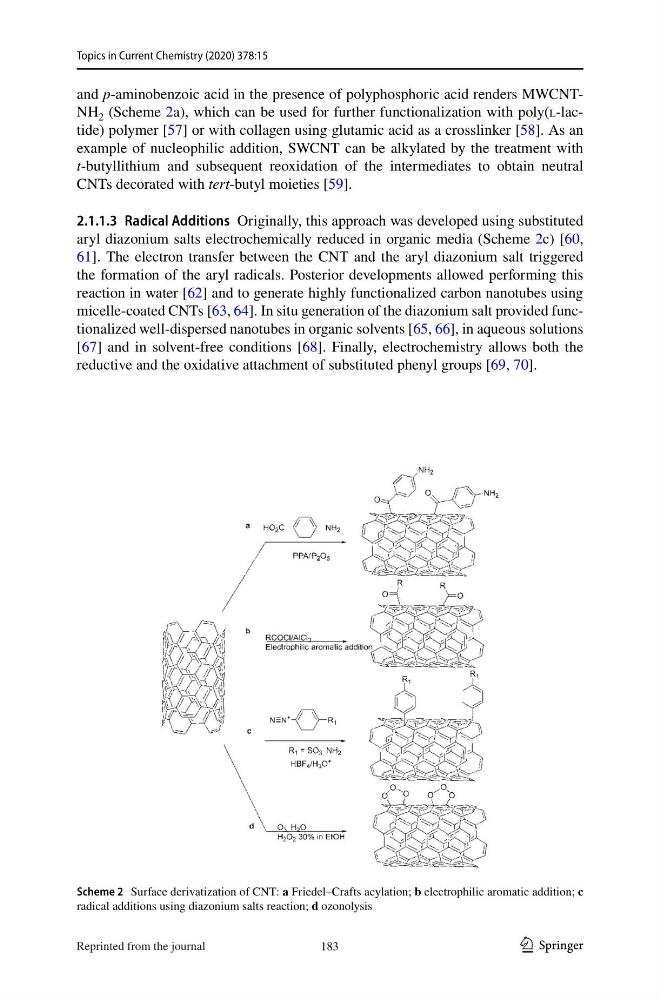
and p-aminobenzoic acid in the presence of polyphosphoric acid renders MWCNTNH 2 (Scheme 2a), which can be used for further functionalization with poly(l-lactide) polymer [57] or with collagen using glutamic acid as a crosslinker [58]. As an
example of nucleophilic addition, SWCNT can be alkylated by the treatment with
t-butyllithium and subsequent reoxidation of the intermediates to obtain neutral
CNTs decorated with tert-butyl moieties [59].
2.1.1.3 Radical Additions Originally, this approach was developed using substituted
aryl diazonium salts electrochemically reduced in organic media (Scheme 2c) [60,
61]. The electron transfer between the CNT and the aryl diazonium salt triggered
the formation of the aryl radicals. Posterior developments allowed performing this
reaction in water [62] and to generate highly functionalized carbon nanotubes using
micelle-coated CNTs [63, 64]. In situ generation of the diazonium salt provided functionalized well-dispersed nanotubes in organic solvents [65, 66], in aqueous solutions
[67] and in solvent-free conditions [68]. Finally, electrochemistry allows both the
reductive and the oxidative attachment of substituted phenyl groups [69, 70].
Scheme 2 Surface derivatization of CNT: a Friedel–Crafts acylation; b electrophilic aromatic addition; c
radical additions using diazonium salts reaction; d ozonolysis
183
Reprinted from the journal
Topics in Current Chemistry (2020) 378:15
and p-aminobenzoic acid in the presence of polyphosphoric acid renders MWCNTNH 2 (Scheme 2a), which can be used for further functionalization with poly(l-lactide) polymer [57] or with collagen using glutamic acid as a crosslinker [58]. As an
example of nucleophilic addition, SWCNT can be alkylated by the treatment with
t-butyllithium and subsequent reoxidation of the intermediates to obtain neutral
CNTs decorated with tert-butyl moieties [59].
2.1.1.3 Radical Additions Originally, this approach was developed using substituted
aryl diazonium salts electrochemically reduced in organic media (Scheme 2c) [60,
61]. The electron transfer between the CNT and the aryl diazonium salt triggered
the formation of the aryl radicals. Posterior developments allowed performing this
reaction in water [62] and to generate highly functionalized carbon nanotubes using
micelle-coated CNTs [63, 64]. In situ generation of the diazonium salt provided functionalized well-dispersed nanotubes in organic solvents [65, 66], in aqueous solutions
[67] and in solvent-free conditions [68]. Finally, electrochemistry allows both the
reductive and the oxidative attachment of substituted phenyl groups [69, 70].
Scheme 2 Surface derivatization of CNT: a Friedel–Crafts acylation; b electrophilic aromatic addition; c
radical additions using diazonium salts reaction; d ozonolysis
183
Reprinted from the journal