

Topics in Current Chemistry (2020) 378:15
1 3
than non-covalent functionalization, can be done in organic solvent or even without
solvent, and offers a huge plethora of functional groups that can be used [44]. All
these benefits highly assist the potential use of carbon nanotubes in biomedicine.
Briefly, covalent functionalization can be classified depending on whether the
modifications are performed at the sidewalls or in defect sites.
2.1.1 Side Wall Functionalization
The sidewalls of carbon nanotubes are considered to be very inert, so their direct
functionalization will only occur if a highly reactive agent is used [45]. Singh
et al. [46] widely describe the main side-wall derivatization strategies in SWCNTs,
including halogenation, arylation, nucleophilic addition, radical addition, cycloadditions, and carboxyl chemistry reactions. Here we present the most commonly used
strategies in preparing CNTs in order to increase their solubility and dispersivity
[34], decrease the inherent toxicity [47], and improve their biocompatibility with
biomedical purposes.
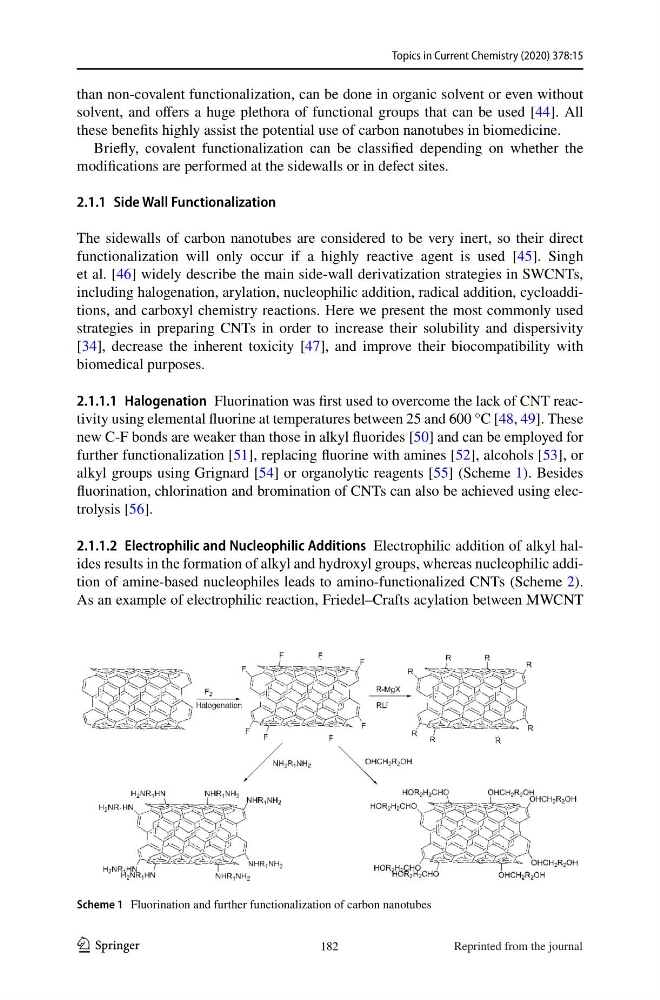
2.1.1.1 Halogenation Fluorination was first used to overcome the lack of CNT reactivity using elemental fluorine at temperatures between 25 and 600 °C [48, 49]. These
new C-F bonds are weaker than those in alkyl fluorides [50] and can be employed for
further functionalization [51], replacing fluorine with amines [52], alcohols [53], or
alkyl groups using Grignard [54] or organolytic reagents [55] (Scheme 1). Besides
fluorination, chlorination and bromination of CNTs can also be achieved using electrolysis [56].
2.1.1.2 Electrophilic and Nucleophilic Additions Electrophilic addition of alkyl halides results in the formation of alkyl and hydroxyl groups, whereas nucleophilic addition of amine-based nucleophiles leads to amino-functionalized CNTs (Scheme 2).
As an example of electrophilic reaction, Friedel–Crafts acylation between MWCNT
Scheme 1 Fluorination and further functionalization of carbon nanotubes
182
Reprinted from the journal
1 3
than non-covalent functionalization, can be done in organic solvent or even without
solvent, and offers a huge plethora of functional groups that can be used [44]. All
these benefits highly assist the potential use of carbon nanotubes in biomedicine.
Briefly, covalent functionalization can be classified depending on whether the
modifications are performed at the sidewalls or in defect sites.
2.1.1 Side Wall Functionalization
The sidewalls of carbon nanotubes are considered to be very inert, so their direct
functionalization will only occur if a highly reactive agent is used [45]. Singh
et al. [46] widely describe the main side-wall derivatization strategies in SWCNTs,
including halogenation, arylation, nucleophilic addition, radical addition, cycloadditions, and carboxyl chemistry reactions. Here we present the most commonly used
strategies in preparing CNTs in order to increase their solubility and dispersivity
[34], decrease the inherent toxicity [47], and improve their biocompatibility with
biomedical purposes.
2.1.1.1 Halogenation Fluorination was first used to overcome the lack of CNT reactivity using elemental fluorine at temperatures between 25 and 600 °C [48, 49]. These
new C-F bonds are weaker than those in alkyl fluorides [50] and can be employed for
further functionalization [51], replacing fluorine with amines [52], alcohols [53], or
alkyl groups using Grignard [54] or organolytic reagents [55] (Scheme 1). Besides
fluorination, chlorination and bromination of CNTs can also be achieved using electrolysis [56].
2.1.1.2 Electrophilic and Nucleophilic Additions Electrophilic addition of alkyl halides results in the formation of alkyl and hydroxyl groups, whereas nucleophilic addition of amine-based nucleophiles leads to amino-functionalized CNTs (Scheme 2).
As an example of electrophilic reaction, Friedel–Crafts acylation between MWCNT
Scheme 1 Fluorination and further functionalization of carbon nanotubes
182
Reprinted from the journal