

1 3
Topics in Current Chemistry (2020) 378:15
investigates, beyond the molecular level, the design and development of highly
ordered structured materials that offer specific responses when exposed to stimuli.
The development of these nanomaterials has reached a wide use in numerous scientific and technical fields, including water treatment [1, 2], electrocatalysis [3, 4],
catalysis [5–9], materials [10], and biomedical applications from cancer treatment
to regenerative medicine [11–13]. In fact, these structures have become increasingly
useful in two main areas of biomedicine: (1) nanomedicine, with noteworthy applications in imaging, biosensors, drug delivery systems, and photo thermal therapy;
and (2) tissue and implants engineering either as scaffold-based nanomaterials or as
components of biomedical devices.
These nanocompounds can be subcategorized into four wide groups depending
on their composition: carbon-based, inorganic-based, organic-based, and composite-based. Among the carbon-based materials, carbon nanotubes (CNTs)—found by
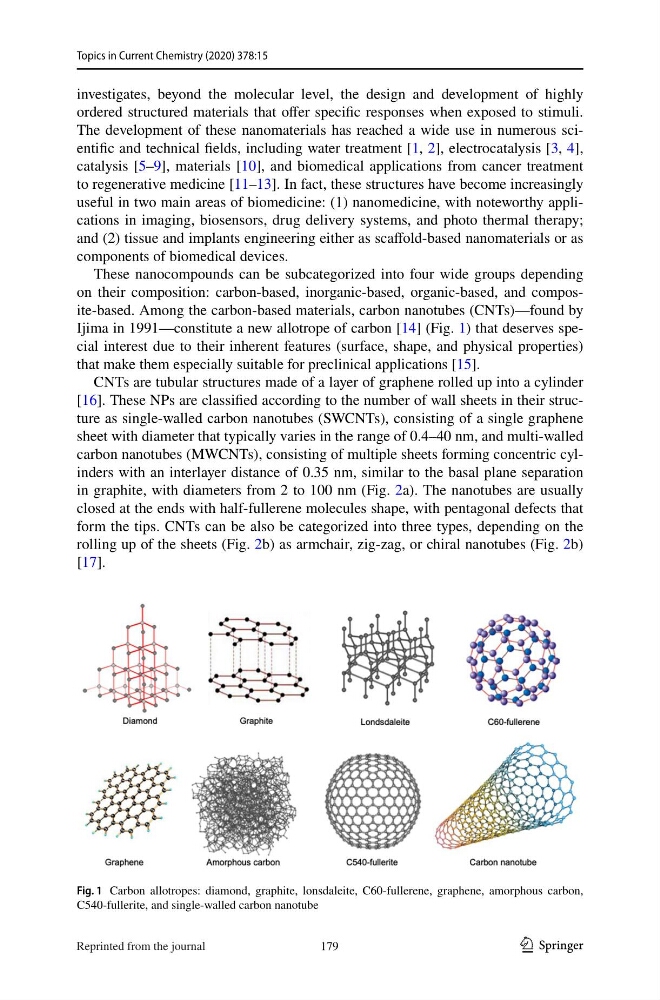
Ijima in 1991—constitute a new allotrope of carbon [14] (Fig. 1) that deserves special interest due to their inherent features (surface, shape, and physical properties)
that make them especially suitable for preclinical applications [15].
CNTs are tubular structures made of a layer of graphene rolled up into a cylinder
[16]. These NPs are classified according to the number of wall sheets in their structure as single-walled carbon nanotubes (SWCNTs), consisting of a single graphene
sheet with diameter that typically varies in the range of 0.4–40 nm, and multi-walled
carbon nanotubes (MWCNTs), consisting of multiple sheets forming concentric cylinders with an interlayer distance of 0.35 nm, similar to the basal plane separation
in graphite, with diameters from 2 to 100 nm (Fig. 2a). The nanotubes are usually
closed at the ends with half-fullerene molecules shape, with pentagonal defects that
form the tips. CNTs can be also be categorized into three types, depending on the
rolling up of the sheets (Fig. 2b) as armchair, zig-zag, or chiral nanotubes (Fig. 2b)
[17].
Fig. 1 Carbon allotropes: diamond, graphite, lonsdaleite, C60-fullerene, graphene, amorphous carbon,
C540-fullerite, and single-walled carbon nanotube
179
Reprinted from the journal
Topics in Current Chemistry (2020) 378:15
investigates, beyond the molecular level, the design and development of highly
ordered structured materials that offer specific responses when exposed to stimuli.
The development of these nanomaterials has reached a wide use in numerous scientific and technical fields, including water treatment [1, 2], electrocatalysis [3, 4],
catalysis [5–9], materials [10], and biomedical applications from cancer treatment
to regenerative medicine [11–13]. In fact, these structures have become increasingly
useful in two main areas of biomedicine: (1) nanomedicine, with noteworthy applications in imaging, biosensors, drug delivery systems, and photo thermal therapy;
and (2) tissue and implants engineering either as scaffold-based nanomaterials or as
components of biomedical devices.
These nanocompounds can be subcategorized into four wide groups depending
on their composition: carbon-based, inorganic-based, organic-based, and composite-based. Among the carbon-based materials, carbon nanotubes (CNTs)—found by
Ijima in 1991—constitute a new allotrope of carbon [14] (Fig. 1) that deserves special interest due to their inherent features (surface, shape, and physical properties)
that make them especially suitable for preclinical applications [15].
CNTs are tubular structures made of a layer of graphene rolled up into a cylinder
[16]. These NPs are classified according to the number of wall sheets in their structure as single-walled carbon nanotubes (SWCNTs), consisting of a single graphene
sheet with diameter that typically varies in the range of 0.4–40 nm, and multi-walled
carbon nanotubes (MWCNTs), consisting of multiple sheets forming concentric cylinders with an interlayer distance of 0.35 nm, similar to the basal plane separation
in graphite, with diameters from 2 to 100 nm (Fig. 2a). The nanotubes are usually
closed at the ends with half-fullerene molecules shape, with pentagonal defects that
form the tips. CNTs can be also be categorized into three types, depending on the
rolling up of the sheets (Fig. 2b) as armchair, zig-zag, or chiral nanotubes (Fig. 2b)
[17].
Fig. 1 Carbon allotropes: diamond, graphite, lonsdaleite, C60-fullerene, graphene, amorphous carbon,
C540-fullerite, and single-walled carbon nanotube
179
Reprinted from the journal