

Topics in Current Chemistry (2020) 378:35
1 3
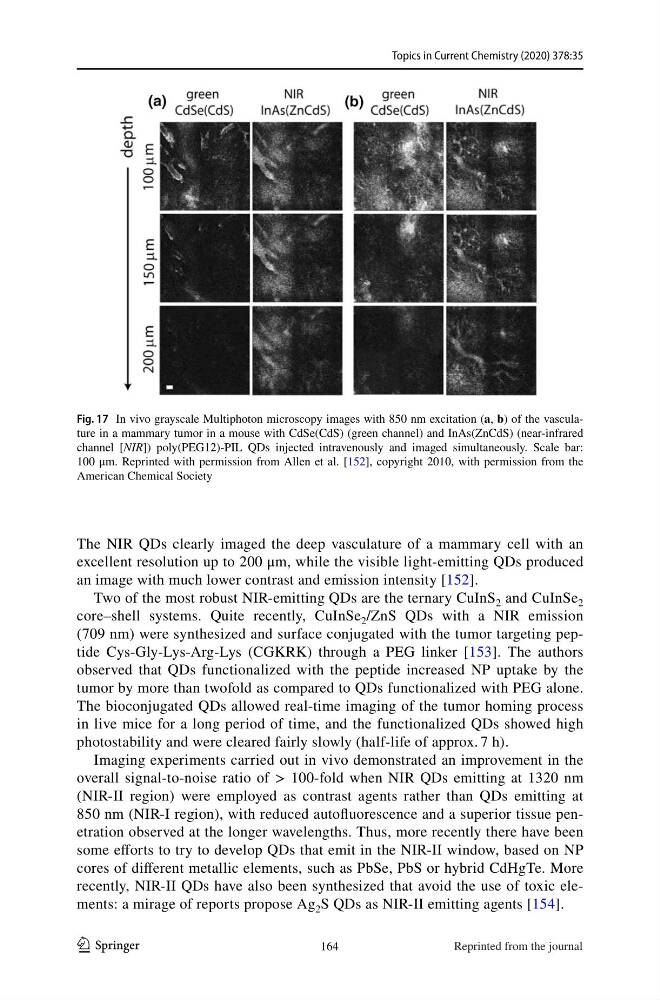
The NIR QDs clearly imaged the deep vasculature of a mammary cell with an
excellent resolution up to 200 μm, while the visible light-emitting QDs produced
an image with much lower contrast and emission intensity [152].
Two of the most robust NIR-emitting QDs are the ternary CuInS 2 and CuInSe 2
core–shell systems. Quite recently, CuInSe 2 /ZnS QDs with a NIR emission
(709 nm) were synthesized and surface conjugated with the tumor targeting peptide Cys-Gly-Lys-Arg-Lys (CGKRK) through a PEG linker [153]. The authors
observed that QDs functionalized with the peptide increased NP uptake by the
tumor by more than twofold as compared to QDs functionalized with PEG alone.
The bioconjugated QDs allowed real-time imaging of the tumor homing process
in live mice for a long period of time, and the functionalized QDs showed high
photostability and were cleared fairly slowly (half-life of approx. 7 h).
Imaging experiments carried out in vivo demonstrated an improvement in the
overall signal-to-noise ratio of > 100-fold when NIR QDs emitting at 1320 nm
(NIR-II region) were employed as contrast agents rather than QDs emitting at
850 nm (NIR-I region), with reduced autofluorescence and a superior tissue penetration observed at the longer wavelengths. Thus, more recently there have been
some efforts to try to develop QDs that emit in the NIR-II window, based on NP
cores of different metallic elements, such as PbSe, PbS or hybrid CdHgTe. More
recently, NIR-II QDs have also been synthesized that avoid the use of toxic elements: a mirage of reports propose Ag 2 S QDs as NIR-II emitting agents [154].
Fig. 17 In vivo grayscale Multiphoton microscopy images with 850 nm excitation (a, b) of the vasculature in a mammary tumor in a mouse with CdSe(CdS) (green channel) and InAs(ZnCdS) (near-infrared
channel [NIR]) poly(PEG12)-PIL QDs injected intravenously and imaged simultaneously. Scale bar:
100 μm. Reprinted with permission from Allen et al. [152], copyright 2010, with permission from the
American Chemical Society
164
Reprinted from the journal
1 3
The NIR QDs clearly imaged the deep vasculature of a mammary cell with an
excellent resolution up to 200 μm, while the visible light-emitting QDs produced
an image with much lower contrast and emission intensity [152].
Two of the most robust NIR-emitting QDs are the ternary CuInS 2 and CuInSe 2
core–shell systems. Quite recently, CuInSe 2 /ZnS QDs with a NIR emission
(709 nm) were synthesized and surface conjugated with the tumor targeting peptide Cys-Gly-Lys-Arg-Lys (CGKRK) through a PEG linker [153]. The authors
observed that QDs functionalized with the peptide increased NP uptake by the
tumor by more than twofold as compared to QDs functionalized with PEG alone.
The bioconjugated QDs allowed real-time imaging of the tumor homing process
in live mice for a long period of time, and the functionalized QDs showed high
photostability and were cleared fairly slowly (half-life of approx. 7 h).
Imaging experiments carried out in vivo demonstrated an improvement in the
overall signal-to-noise ratio of > 100-fold when NIR QDs emitting at 1320 nm
(NIR-II region) were employed as contrast agents rather than QDs emitting at
850 nm (NIR-I region), with reduced autofluorescence and a superior tissue penetration observed at the longer wavelengths. Thus, more recently there have been
some efforts to try to develop QDs that emit in the NIR-II window, based on NP
cores of different metallic elements, such as PbSe, PbS or hybrid CdHgTe. More
recently, NIR-II QDs have also been synthesized that avoid the use of toxic elements: a mirage of reports propose Ag 2 S QDs as NIR-II emitting agents [154].
Fig. 17 In vivo grayscale Multiphoton microscopy images with 850 nm excitation (a, b) of the vasculature in a mammary tumor in a mouse with CdSe(CdS) (green channel) and InAs(ZnCdS) (near-infrared
channel [NIR]) poly(PEG12)-PIL QDs injected intravenously and imaged simultaneously. Scale bar:
100 μm. Reprinted with permission from Allen et al. [152], copyright 2010, with permission from the
American Chemical Society
164
Reprinted from the journal