

1 3
Topics in Current Chemistry (2020) 378:28
as a label for Ab 2 in order to catalyze the hydrolysis of ascorbic acid 2-phosphate to
ascorbic acid, which acted as an electron donor, leading to even more detection sensitivity for CEA. Zhang et al. [31] presented a PEC aptasensor for the supersensitive
detection of CEA based on nonmetal-doped TiO 2 and CdS QDs used as a sensitizer.
In that study, Br and N were codoped into TiO 2 , which narrowed its band gap from
3.2 eV to 2.88 eV. The band gap of the (Br, N)-codoped TiO 2 was well matched
to that of CdS QDs (2.4 eV), meaning that these QDs could be used to intensify
the photocurrent. Exonuclease III (Exo-III)-assisted cycling was also applied in this
strategy to achieve the supersensitive detection of CEA.
The physicochemical properties of TiO 2 semiconductors also depend on their
intrinsic defects and extrinsic impurities. Tang’s group [32] developed TiO 2 with
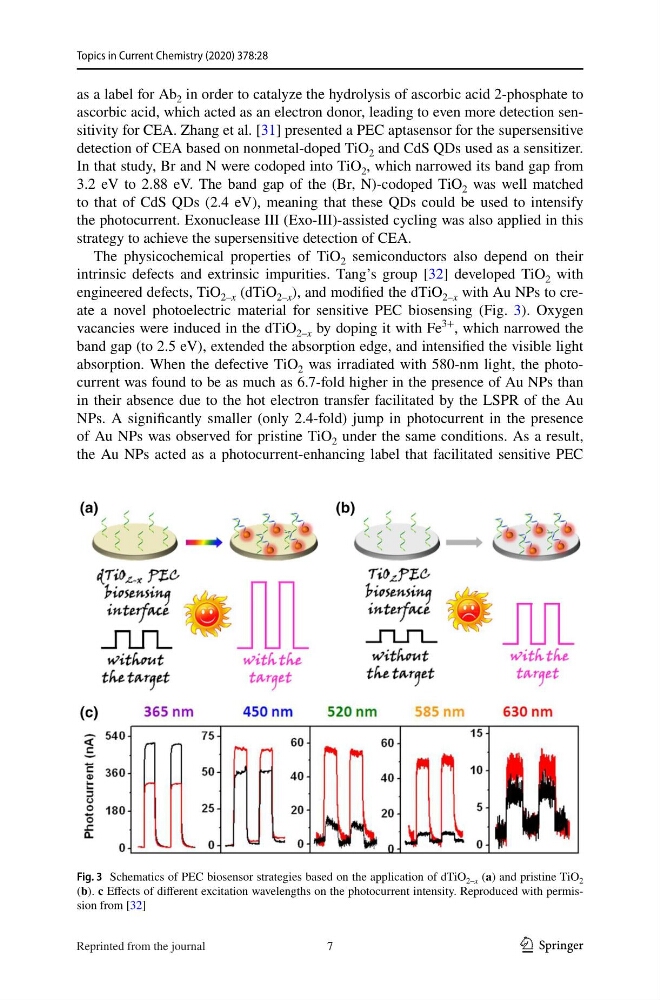
engineered defects, TiO 2–x (dTiO 2–x ), and modified the dTiO 2–x with Au NPs to create a novel photoelectric material for sensitive PEC biosensing (Fig. 3). Oxygen
vacancies were induced in the dTiO 2–x by doping it with Fe
3+
, which narrowed the
band gap (to 2.5 eV), extended the absorption edge, and intensified the visible light
absorption. When the defective TiO 2 was irradiated with 580-nm light, the photocurrent was found to be as much as 6.7-fold higher in the presence of Au NPs than
in their absence due to the hot electron transfer facilitated by the LSPR of the Au
NPs. A significantly smaller (only 2.4-fold) jump in photocurrent in the presence
of Au NPs was observed for pristine TiO 2 under the same conditions. As a result,
the Au NPs acted as a photocurrent-enhancing label that facilitated sensitive PEC
Fig. 3 Schematics of PEC biosensor strategies based on the application of dTiO 2–x (a) and pristine TiO 2
(b). c Effects of different excitation wavelengths on the photocurrent intensity. Reproduced with permission from [32]
7
Reprinted from the journal
Topics in Current Chemistry (2020) 378:28
as a label for Ab 2 in order to catalyze the hydrolysis of ascorbic acid 2-phosphate to
ascorbic acid, which acted as an electron donor, leading to even more detection sensitivity for CEA. Zhang et al. [31] presented a PEC aptasensor for the supersensitive
detection of CEA based on nonmetal-doped TiO 2 and CdS QDs used as a sensitizer.
In that study, Br and N were codoped into TiO 2 , which narrowed its band gap from
3.2 eV to 2.88 eV. The band gap of the (Br, N)-codoped TiO 2 was well matched
to that of CdS QDs (2.4 eV), meaning that these QDs could be used to intensify
the photocurrent. Exonuclease III (Exo-III)-assisted cycling was also applied in this
strategy to achieve the supersensitive detection of CEA.
The physicochemical properties of TiO 2 semiconductors also depend on their
intrinsic defects and extrinsic impurities. Tang’s group [32] developed TiO 2 with
engineered defects, TiO 2–x (dTiO 2–x ), and modified the dTiO 2–x with Au NPs to create a novel photoelectric material for sensitive PEC biosensing (Fig. 3). Oxygen
vacancies were induced in the dTiO 2–x by doping it with Fe
3+
, which narrowed the
band gap (to 2.5 eV), extended the absorption edge, and intensified the visible light
absorption. When the defective TiO 2 was irradiated with 580-nm light, the photocurrent was found to be as much as 6.7-fold higher in the presence of Au NPs than
in their absence due to the hot electron transfer facilitated by the LSPR of the Au
NPs. A significantly smaller (only 2.4-fold) jump in photocurrent in the presence
of Au NPs was observed for pristine TiO 2 under the same conditions. As a result,
the Au NPs acted as a photocurrent-enhancing label that facilitated sensitive PEC
Fig. 3 Schematics of PEC biosensor strategies based on the application of dTiO 2–x (a) and pristine TiO 2
(b). c Effects of different excitation wavelengths on the photocurrent intensity. Reproduced with permission from [32]
7
Reprinted from the journal