

1 3
Topics in Current Chemistry (2020) 378:35
need to be made to design procedures for attaching these “new” functional groups
to the natural BMs, however no difficulties are foreseeable to bind these to the QDs.
In this regard, it has been determined that virtually any functional group can be sitespecifically introduced into peptides and nucleotides as needed during the initial
synthesis or through subsequent modification [56].
5 QD Biosensing Applications: Point‑of‑Care Diagnostics
Quantum dot–BM hybrids (i.e. those bound to antibodies, DNA, aptamers, etc.)
have been used as sensing probes in a wide variety of in vitro bioassays and biosensors for the detection of different clinical relevant BMs. QDs can be used as labels
in a wide spectrum of detection methods (Fig. 10). Most of the reported QD-based
bioassays and biosensors have been developed by using QDs as fluorescence labels
(Fig. 10a) in fluorescence quenching-based (turn-off), fluorescence enhancementbased (turn-on) and—especially—FRET assays [87–92]. FRET is a very sensitive
technology for studying BM interactions that involves the transfer of energy from
N 3
N
N
N
Cu +
Alkyne + Azide (Cu + )
N
N
N N
Norbornene
+
Tetrazine
"CLICK" CHEMISTRY
TETRAZINE LIGATION
O
N
N
H
NH 2
O
O
N
N
H
N
HYDRAZONE LIGATION
Hydrazine
+
Carbonyl
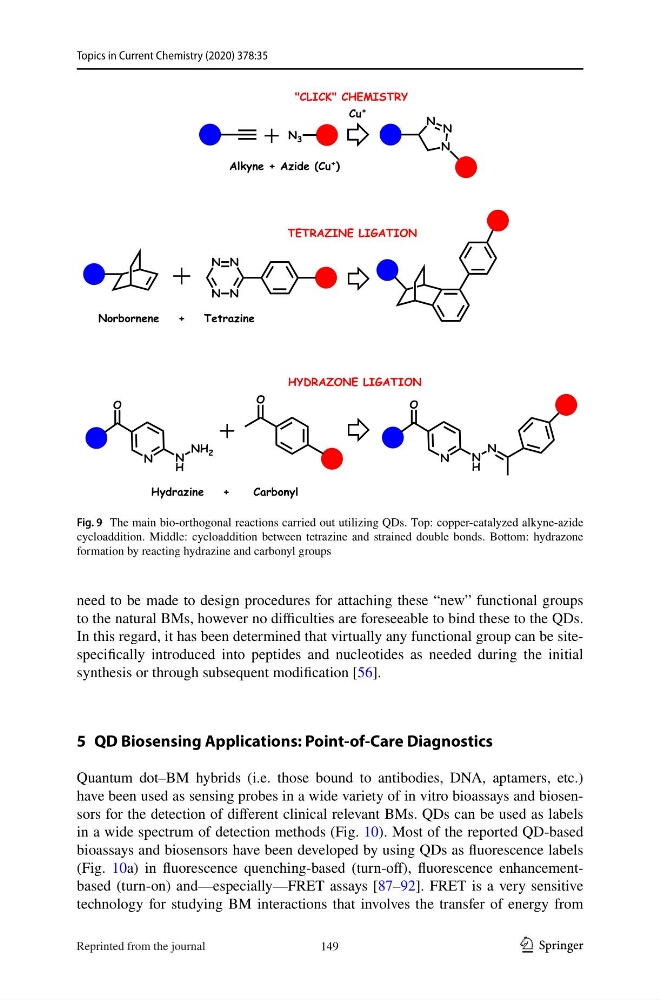
Fig. 9 The main bio-orthogonal reactions carried out utilizing QDs. Top: copper-catalyzed alkyne-azide
cycloaddition. Middle: cycloaddition between tetrazine and strained double bonds. Bottom: hydrazone
formation by reacting hydrazine and carbonyl groups
149
Reprinted from the journal
Topics in Current Chemistry (2020) 378:35
need to be made to design procedures for attaching these “new” functional groups
to the natural BMs, however no difficulties are foreseeable to bind these to the QDs.
In this regard, it has been determined that virtually any functional group can be sitespecifically introduced into peptides and nucleotides as needed during the initial
synthesis or through subsequent modification [56].
5 QD Biosensing Applications: Point‑of‑Care Diagnostics
Quantum dot–BM hybrids (i.e. those bound to antibodies, DNA, aptamers, etc.)
have been used as sensing probes in a wide variety of in vitro bioassays and biosensors for the detection of different clinical relevant BMs. QDs can be used as labels
in a wide spectrum of detection methods (Fig. 10). Most of the reported QD-based
bioassays and biosensors have been developed by using QDs as fluorescence labels
(Fig. 10a) in fluorescence quenching-based (turn-off), fluorescence enhancementbased (turn-on) and—especially—FRET assays [87–92]. FRET is a very sensitive
technology for studying BM interactions that involves the transfer of energy from
N 3
N
N
N
Cu +
Alkyne + Azide (Cu + )
N
N
N N
Norbornene
+
Tetrazine
"CLICK" CHEMISTRY
TETRAZINE LIGATION
O
N
N
H
NH 2
O
O
N
N
H
N
HYDRAZONE LIGATION
Hydrazine
+
Carbonyl
Fig. 9 The main bio-orthogonal reactions carried out utilizing QDs. Top: copper-catalyzed alkyne-azide
cycloaddition. Middle: cycloaddition between tetrazine and strained double bonds. Bottom: hydrazone
formation by reacting hydrazine and carbonyl groups
149
Reprinted from the journal