

Topics in Current Chemistry (2020) 378:12
1 3
biomedical applications [195]. The reaction is practically quantitative, and it is possible
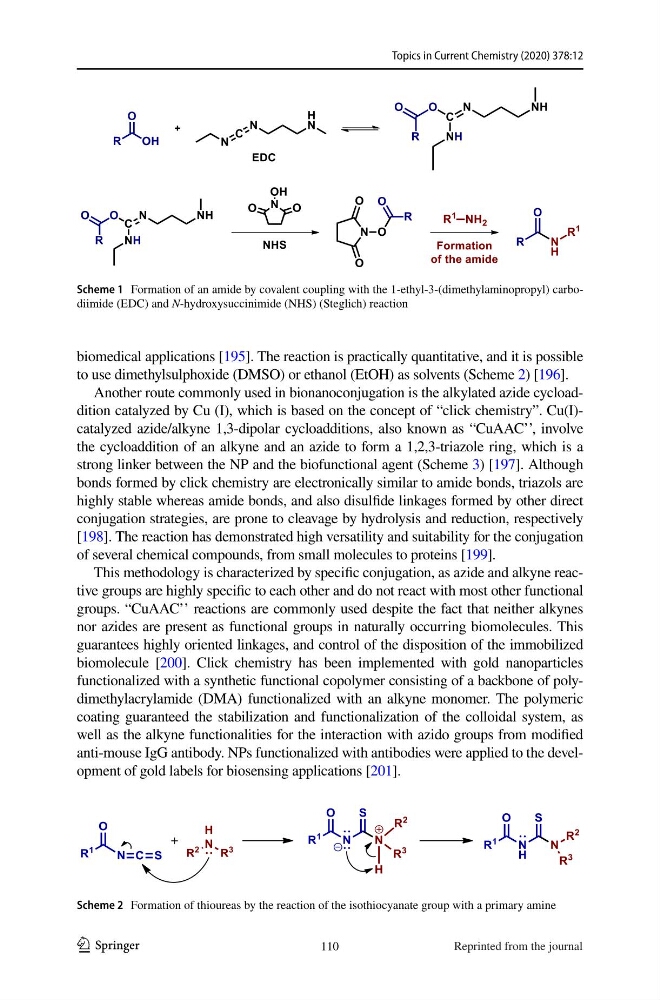
to use dimethylsulphoxide (DMSO) or ethanol (EtOH) as solvents (Scheme 2) [196].
Another route commonly used in bionanoconjugation is the alkylated azide cycloaddition catalyzed by Cu (I), which is based on the concept of “click chemistry”. Cu(I)catalyzed azide/alkyne 1,3-dipolar cycloadditions, also known as “CuAAC’’, involve
the cycloaddition of an alkyne and an azide to form a 1,2,3-triazole ring, which is a
strong linker between the NP and the biofunctional agent (Scheme 3) [197]. Although
bonds formed by click chemistry are electronically similar to amide bonds, triazols are
highly stable whereas amide bonds, and also disulfide linkages formed by other direct
conjugation strategies, are prone to cleavage by hydrolysis and reduction, respectively
[198]. The reaction has demonstrated high versatility and suitability for the conjugation
of several chemical compounds, from small molecules to proteins [199].
This methodology is characterized by specific conjugation, as azide and alkyne reactive groups are highly specific to each other and do not react with most other functional
groups. “CuAAC’’ reactions are commonly used despite the fact that neither alkynes
nor azides are present as functional groups in naturally occurring biomolecules. This
guarantees highly oriented linkages, and control of the disposition of the immobilized
biomolecule [200]. Click chemistry has been implemented with gold nanoparticles
functionalized with a synthetic functional copolymer consisting of a backbone of polydimethylacrylamide (DMA) functionalized with an alkyne monomer. The polymeric
coating guaranteed the stabilization and functionalization of the colloidal system, as
well as the alkyne functionalities for the interaction with azido groups from modified
anti-mouse IgG antibody. NPs functionalized with antibodies were applied to the development of gold labels for biosensing applications [201].
Scheme 1 Formation of an amide by covalent coupling with the 1-ethyl-3-(dimethylaminopropyl) carbodiimide (EDC) and N-hydroxysuccinimide (NHS) (Steglich) reaction
Scheme 2 Formation of thioureas by the reaction of the isothiocyanate group with a primary amine
110
Reprinted from the journal
1 3
biomedical applications [195]. The reaction is practically quantitative, and it is possible
to use dimethylsulphoxide (DMSO) or ethanol (EtOH) as solvents (Scheme 2) [196].
Another route commonly used in bionanoconjugation is the alkylated azide cycloaddition catalyzed by Cu (I), which is based on the concept of “click chemistry”. Cu(I)catalyzed azide/alkyne 1,3-dipolar cycloadditions, also known as “CuAAC’’, involve
the cycloaddition of an alkyne and an azide to form a 1,2,3-triazole ring, which is a
strong linker between the NP and the biofunctional agent (Scheme 3) [197]. Although
bonds formed by click chemistry are electronically similar to amide bonds, triazols are
highly stable whereas amide bonds, and also disulfide linkages formed by other direct
conjugation strategies, are prone to cleavage by hydrolysis and reduction, respectively
[198]. The reaction has demonstrated high versatility and suitability for the conjugation
of several chemical compounds, from small molecules to proteins [199].
This methodology is characterized by specific conjugation, as azide and alkyne reactive groups are highly specific to each other and do not react with most other functional
groups. “CuAAC’’ reactions are commonly used despite the fact that neither alkynes
nor azides are present as functional groups in naturally occurring biomolecules. This
guarantees highly oriented linkages, and control of the disposition of the immobilized
biomolecule [200]. Click chemistry has been implemented with gold nanoparticles
functionalized with a synthetic functional copolymer consisting of a backbone of polydimethylacrylamide (DMA) functionalized with an alkyne monomer. The polymeric
coating guaranteed the stabilization and functionalization of the colloidal system, as
well as the alkyne functionalities for the interaction with azido groups from modified
anti-mouse IgG antibody. NPs functionalized with antibodies were applied to the development of gold labels for biosensing applications [201].
Scheme 1 Formation of an amide by covalent coupling with the 1-ethyl-3-(dimethylaminopropyl) carbodiimide (EDC) and N-hydroxysuccinimide (NHS) (Steglich) reaction
Scheme 2 Formation of thioureas by the reaction of the isothiocyanate group with a primary amine
110
Reprinted from the journal