

3.10 Bones, Ligaments, and Other Structures
67
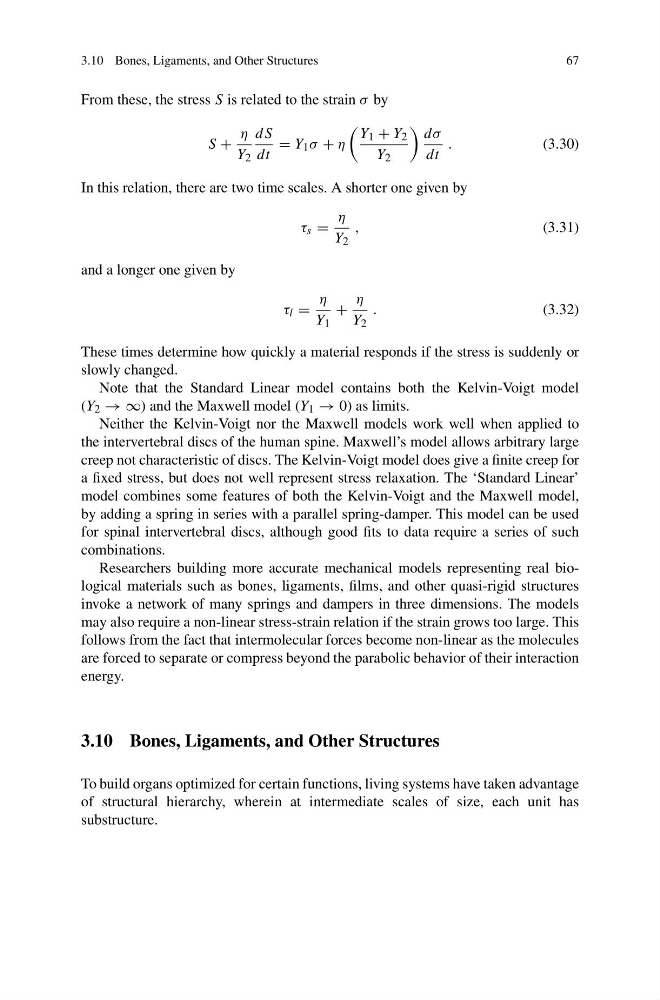
From these, the stress S is related to the strain σ by
S +
η
Y 2
dS
dt
= Y 1 σ + η
Y 1 + Y 2
Y 2
dσ
dt
.
(3.30)
In this relation, there are two time scales. A shorter one given by
τ s =
η
Y 2
,
(3.31)
and a longer one given by
τ l =
η
Y 1
+
η
Y 2
.
(3.32)
These times determine how quickly a material responds if the stress is suddenly or
slowly changed.
Note that the Standard Linear model contains both the Kelvin-Voigt model
(Y 2 → ∞) and the Maxwell model (Y 1 → 0) as limits.
Neither the Kelvin-Voigt nor the Maxwell models work well when applied to
the intervertebral discs of the human spine. Maxwell’s model allows arbitrary large
creep not characteristic of discs. The Kelvin-Voigt model does give a finite creep for
a fixed stress, but does not well represent stress relaxation. The ‘Standard Linear’
model combines some features of both the Kelvin-Voigt and the Maxwell model,
by adding a spring in series with a parallel spring-damper. This model can be used
for spinal intervertebral discs, although good fits to data require a series of such
combinations.
Researchers building more accurate mechanical models representing real biological materials such as bones, ligaments, films, and other quasi-rigid structures
invoke a network of many springs and dampers in three dimensions. The models
may also require a non-linear stress-strain relation if the strain grows too large. This
follows from the fact that intermolecular forces become non-linear as the molecules
are forced to separate or compress beyond the parabolic behavior of their interaction
energy.
3.10 Bones, Ligaments, and Other Structures
To build organs optimized for certain functions, living systems have taken advantage
of structural hierarchy, wherein at intermediate scales of size, each unit has
substructure.
67
From these, the stress S is related to the strain σ by
S +
η
Y 2
dS
dt
= Y 1 σ + η
Y 1 + Y 2
Y 2
dσ
dt
.
(3.30)
In this relation, there are two time scales. A shorter one given by
τ s =
η
Y 2
,
(3.31)
and a longer one given by
τ l =
η
Y 1
+
η
Y 2
.
(3.32)
These times determine how quickly a material responds if the stress is suddenly or
slowly changed.
Note that the Standard Linear model contains both the Kelvin-Voigt model
(Y 2 → ∞) and the Maxwell model (Y 1 → 0) as limits.
Neither the Kelvin-Voigt nor the Maxwell models work well when applied to
the intervertebral discs of the human spine. Maxwell’s model allows arbitrary large
creep not characteristic of discs. The Kelvin-Voigt model does give a finite creep for
a fixed stress, but does not well represent stress relaxation. The ‘Standard Linear’
model combines some features of both the Kelvin-Voigt and the Maxwell model,
by adding a spring in series with a parallel spring-damper. This model can be used
for spinal intervertebral discs, although good fits to data require a series of such
combinations.
Researchers building more accurate mechanical models representing real biological materials such as bones, ligaments, films, and other quasi-rigid structures
invoke a network of many springs and dampers in three dimensions. The models
may also require a non-linear stress-strain relation if the strain grows too large. This
follows from the fact that intermolecular forces become non-linear as the molecules
are forced to separate or compress beyond the parabolic behavior of their interaction
energy.
3.10 Bones, Ligaments, and Other Structures
To build organs optimized for certain functions, living systems have taken advantage
of structural hierarchy, wherein at intermediate scales of size, each unit has
substructure.