

66
3 Mechanical Aspects of Biosystems
be brittle under a rapidly increasing stress, but plastic under a slowly increasing
stress. Silly putty is a good example. It was originally made of a silicone polymer
created in the effort to find rubber substitutes. Rock furnishes another example:
Rock can flow under constant stress, but also it supports elastic sound waves. The
bone around teeth respond to lateral forces by reforming. The bone around the inner
ear is less viscous and more elastic than bone elsewhere, in order to help preserve
the sound energy within.
At a molecular level, a viscoelastic material might consist of long chain
molecules that become tangled, or that have weak side bonds if they are stretched out
next to each other. A quick and impulsive stress will likely cause the entanglement or
weak bonds to stretch, but not necessarily break. However, if the stress is sustained,
the entangled chains can slip and the weak bonds break from thermal action on the
stretched ones. After segments of the chains slip, they can sequentially re-establish
new entanglements or new hydrogen bonding, which, under continued stress, is seen
macroscopically as viscous flow.
3.9.3 Standard Linear Model
A ‘Standard Linear model’ for a material puts a Maxwell element in parallel with
a spring, as shown in Fig. 3.9. For a ‘standard linear’ material, the relationship
between stress and strain can be found from the constraints:
• The force of the material back on the external agent is the sum of the force due
to the first spring, #1 (top one in Fig. 3.9), and the force of the second spring, #2
(bottom one in Fig. 3.9);
• The force of spring #1 is proportional to its compression;
• The force of spring #2 is proportional to its compression;
• the force of the dashpot is proportional to its compressional speed;
• the force of the second spring is the same as that of the dashpot;
• the sum of the displacements of the second spring and the dashpot is the
displacement of spring #1.
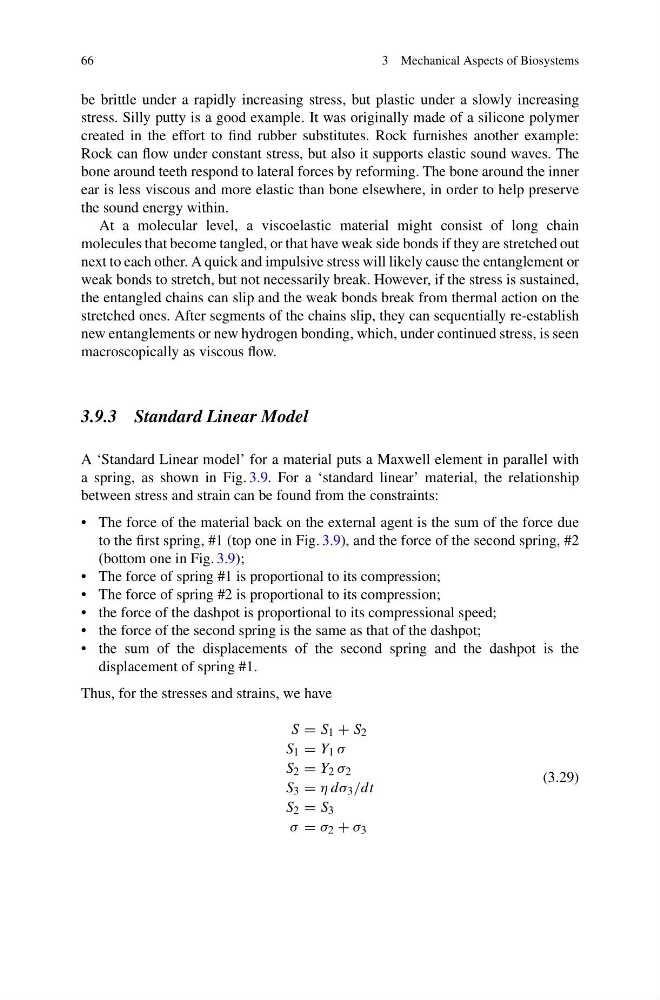
Thus, for the stresses and strains, we have
S = S 1 + S 2
S 1 = Y 1 σ
S 2 = Y 2 σ 2
S 3 = η dσ 3 /dt
S 2 = S 3
σ = σ 2 + σ 3
(3.29)
3 Mechanical Aspects of Biosystems
be brittle under a rapidly increasing stress, but plastic under a slowly increasing
stress. Silly putty is a good example. It was originally made of a silicone polymer
created in the effort to find rubber substitutes. Rock furnishes another example:
Rock can flow under constant stress, but also it supports elastic sound waves. The
bone around teeth respond to lateral forces by reforming. The bone around the inner
ear is less viscous and more elastic than bone elsewhere, in order to help preserve
the sound energy within.
At a molecular level, a viscoelastic material might consist of long chain
molecules that become tangled, or that have weak side bonds if they are stretched out
next to each other. A quick and impulsive stress will likely cause the entanglement or
weak bonds to stretch, but not necessarily break. However, if the stress is sustained,
the entangled chains can slip and the weak bonds break from thermal action on the
stretched ones. After segments of the chains slip, they can sequentially re-establish
new entanglements or new hydrogen bonding, which, under continued stress, is seen
macroscopically as viscous flow.
3.9.3 Standard Linear Model
A ‘Standard Linear model’ for a material puts a Maxwell element in parallel with
a spring, as shown in Fig. 3.9. For a ‘standard linear’ material, the relationship
between stress and strain can be found from the constraints:
• The force of the material back on the external agent is the sum of the force due
to the first spring, #1 (top one in Fig. 3.9), and the force of the second spring, #2
(bottom one in Fig. 3.9);
• The force of spring #1 is proportional to its compression;
• The force of spring #2 is proportional to its compression;
• the force of the dashpot is proportional to its compressional speed;
• the force of the second spring is the same as that of the dashpot;
• the sum of the displacements of the second spring and the dashpot is the
displacement of spring #1.
Thus, for the stresses and strains, we have
S = S 1 + S 2
S 1 = Y 1 σ
S 2 = Y 2 σ 2
S 3 = η dσ 3 /dt
S 2 = S 3
σ = σ 2 + σ 3
(3.29)