

J Useful Biophysical Data
685
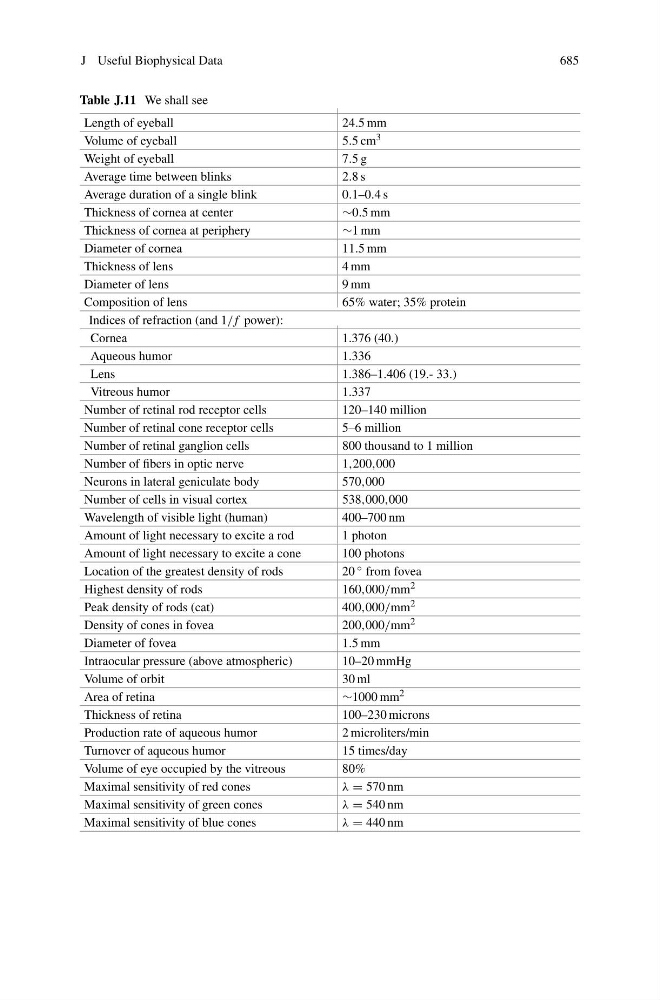
Table J.11 We shall see
Length of eyeball
24.5 mm
Volume of eyeball
5.5 cm 3
Weight of eyeball
7.5 g
Average time between blinks
2.8 s
Average duration of a single blink
0.1–0.4 s
Thickness of cornea at center
∼0.5 mm
Thickness of cornea at periphery
∼1 mm
Diameter of cornea
11.5 mm
Thickness of lens
4 mm
Diameter of lens
9 mm
Composition of lens
65% water; 35% protein
Indices of refraction (and 1/f power):
Cornea
1.376 (40.)
Aqueous humor
1.336
Lens
1.386–1.406 (19.- 33.)
Vitreous humor
1.337
Number of retinal rod receptor cells
120–140 million
Number of retinal cone receptor cells
5–6 million
Number of retinal ganglion cells
800 thousand to 1 million
Number of fibers in optic nerve
1,200,000
Neurons in lateral geniculate body
570,000
Number of cells in visual cortex
538,000,000
Wavelength of visible light (human)
400–700 nm
Amount of light necessary to excite a rod
1 photon
Amount of light necessary to excite a cone
100 photons
Location of the greatest density of rods
20 ◦ from fovea
Highest density of rods
160,000/mm 2
Peak density of rods (cat)
400,000/mm 2
Density of cones in fovea
200,000/mm 2
Diameter of fovea
1.5 mm
Intraocular pressure (above atmospheric)
10–20 mmHg
Volume of orbit
30 ml
Area of retina
∼1000 mm 2
Thickness of retina
100–230 microns
Production rate of aqueous humor
2 microliters/min
Turnover of aqueous humor
15 times/day
Volume of eye occupied by the vitreous
80%
Maximal sensitivity of red cones
λ = 570 nm
Maximal sensitivity of green cones
λ = 540 nm
Maximal sensitivity of blue cones
λ = 440 nm