

666
G Some Tools of Vector Analysis
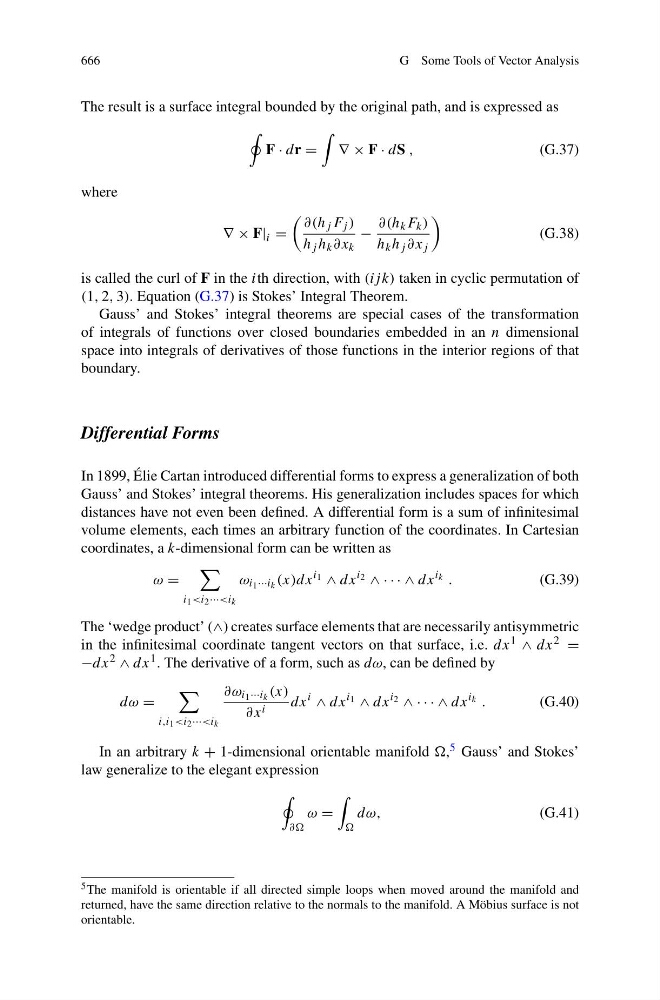
The result is a surface integral bounded by the original path, and is expressed as
F · dr =
∇ × F · dS ,
(G.37)
where
∇ × F| i =
∂(h j F j )
h j h k ∂x k
−
∂(h k F k )
h k h j ∂x j
(G.38)
is called the curl of F in the ith direction, with (ij k) taken in cyclic permutation of
(1, 2, 3). Equation (G.37) is Stokes’ Integral Theorem.
Gauss’ and Stokes’ integral theorems are special cases of the transformation
of integrals of functions over closed boundaries embedded in an n dimensional
space into integrals of derivatives of those functions in the interior regions of that
boundary.
Differential Forms
In 1899, Élie Cartan introduced differential forms to express a generalization of both
Gauss’ and Stokes’ integral theorems. His generalization includes spaces for which
distances have not even been defined. A differential form is a sum of infinitesimal
volume elements, each times an arbitrary function of the coordinates. In Cartesian
coordinates, a k-dimensional form can be written as
ω =
i 1 ω i 1 ···i k (x)dx
i 1 ∧ dx
i 2 ∧ · · · ∧ dx
i k .
(G.39)
The ‘wedge product’ (∧) creates surface elements that are necessarily antisymmetric
in the infinitesimal coordinate tangent vectors on that surface, i.e. dx 1 ∧ dx 2 =
−dx 2 ∧ dx 1 . The derivative of a form, such as dω, can be defined by
dω =
i,i 1 ∂ω i 1 ···i k (x)
∂x i
dx
i
∧ dx
i 1 ∧ dx
i 2 ∧ · · · ∧ dx
i k .
(G.40)
In an arbitrary k + 1-dimensional orientable manifold , 5 Gauss’ and Stokes’
law generalize to the elegant expression
∂∂
ω =
dω,
(G.41)
5 The manifold is orientable if all directed simple loops when moved around the manifold and
returned, have the same direction relative to the normals to the manifold. A Möbius surface is not
orientable.