

664
G Some Tools of Vector Analysis
where dS is a small surface element of area dS with a direction normal n to the
surface, and with a ‘right-hand’ sense: If the surface is coordinated with values of
x 1 , x 2 , then e 1 × e 2 = n. If the surface encloses a simply connected volume, then
the net amount of the entity flowing out of the volume is
dQ
dt
=
A
J · dS .
(G.29)
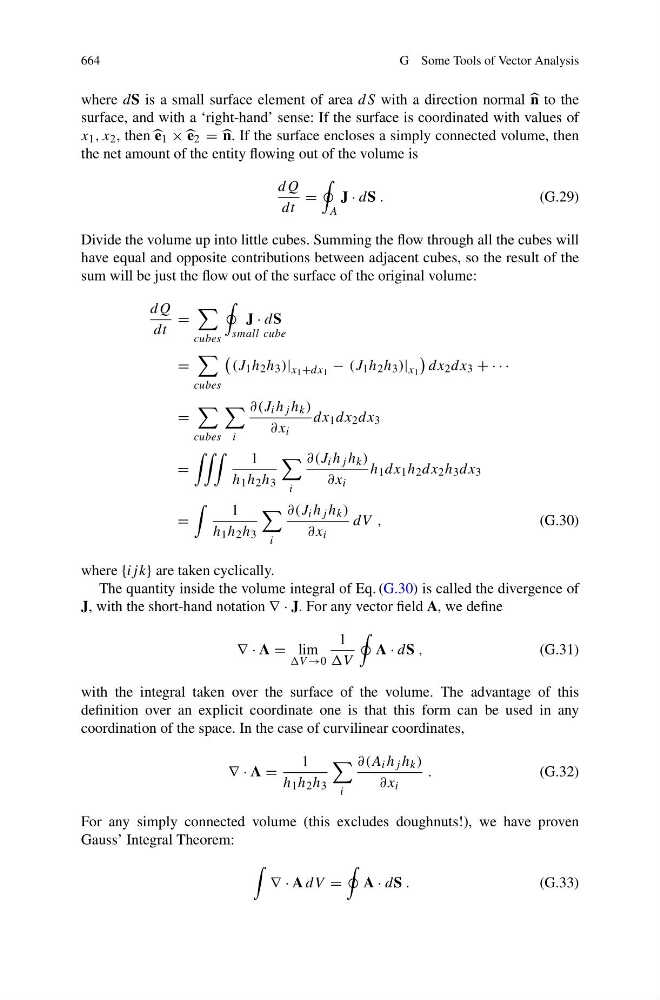
Divide the volume up into little cubes. Summing the flow through all the cubes will
have equal and opposite contributions between adjacent cubes, so the result of the
sum will be just the flow out of the surface of the original volume:
dQ
dt
=
cubes
small cube
J · dS
=
cubes
(J 1 h 2 h 3 )| x 1 +dx 1 − (J 1 h 2 h 3 )| x 1
dx 2 dx 3 + · · ·
=
cubes
i
∂(J i h j h k )
∂x i
dx 1 dx 2 dx 3
=
1
h 1 h 2 h 3
i
∂(J i h j h k )
∂x i
h 1 dx 1 h 2 dx 2 h 3 dx 3
=
1
h 1 h 2 h 3
i
∂(J i h j h k )
∂x i
dV ,
(G.30)
where {ij k} are taken cyclically.
The quantity inside the volume integral of Eq. (G.30) is called the divergence of
J, with the short-hand notation ∇ · J. For any vector field A, we define
∇ · A = lim
V →0
1
V
A · dS ,
(G.31)
with the integral taken over the surface of the volume. The advantage of this
definition over an explicit coordinate one is that this form can be used in any
coordination of the space. In the case of curvilinear coordinates,
∇ · A =
1
h 1 h 2 h 3
i
∂(A i h j h k )
∂x i
.
(G.32)
For any simply connected volume (this excludes doughnuts!), we have proven
Gauss’ Integral Theorem:
∇ · A dV =
A · dS .
(G.33)