

E DNA Splitting by Radiation
649
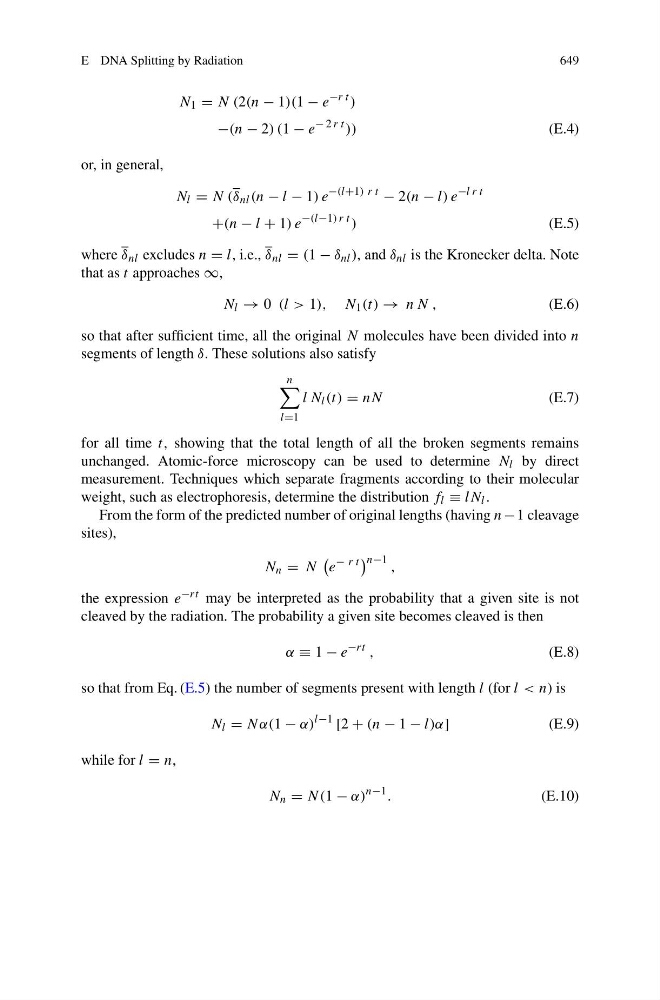
N 1 = N (2(n − 1)(1 − e
−r t )
−(n − 2) (1 − e
− 2 r t ))
(E.4)
or, in general,
N l = N (δ nl (n − l − 1) e
−(l+1) r t
− 2(n − l) e
−l r t
+(n − l + 1) e
−(l−1) r t )
(E.5)
where δ nl excludes n = l, i.e., δ nl = (1 − δ nl ), and δ nl is the Kronecker delta. Note
that as t approaches ∞,
N l → 0 (l > 1), N 1 (t) → n N ,
(E.6)
so that after sufficient time, all the original N molecules have been divided into n
segments of length δ. These solutions also satisfy
n
l=1
l N l (t) = nN
(E.7)
for all time t, showing that the total length of all the broken segments remains
unchanged. Atomic-force microscopy can be used to determine N l by direct
measurement. Techniques which separate fragments according to their molecular
weight, such as electrophoresis, determine the distribution f l ≡ lN l .
From the form of the predicted number of original lengths (having n−1 cleavage
sites),
N n = N
e
− r t
n−1 ,
the expression e −rt may be interpreted as the probability that a given site is not
cleaved by the radiation. The probability a given site becomes cleaved is then
α ≡ 1 − e
−rt ,
(E.8)
so that from Eq. (E.5) the number of segments present with length l (for l < n) is
N l = Nα(1 − α)
l−1 [2 + (n − 1 − l)α]
(E.9)
while for l = n,
N n = N(1 − α)
n−1 .
(E.10)