

648
E DNA Splitting by Radiation
cleavage of the molecules of length i δ will be proportional to the number of possible
cleavage points, i − 1. (For simplicity, fixed length monomers and equal probability
for site breakage is taken. These assumptions can be relaxed without reformulating
the method.) A single cleavage of the molecules of length longer than i δ, say k δ,
will have equal chance to make fragments of length from δ to (k − 1) δ. From the
set of such single-cleavage possibilities of a given molecule, two of this set will
produce segments of length i δ, adding to the number with this length.
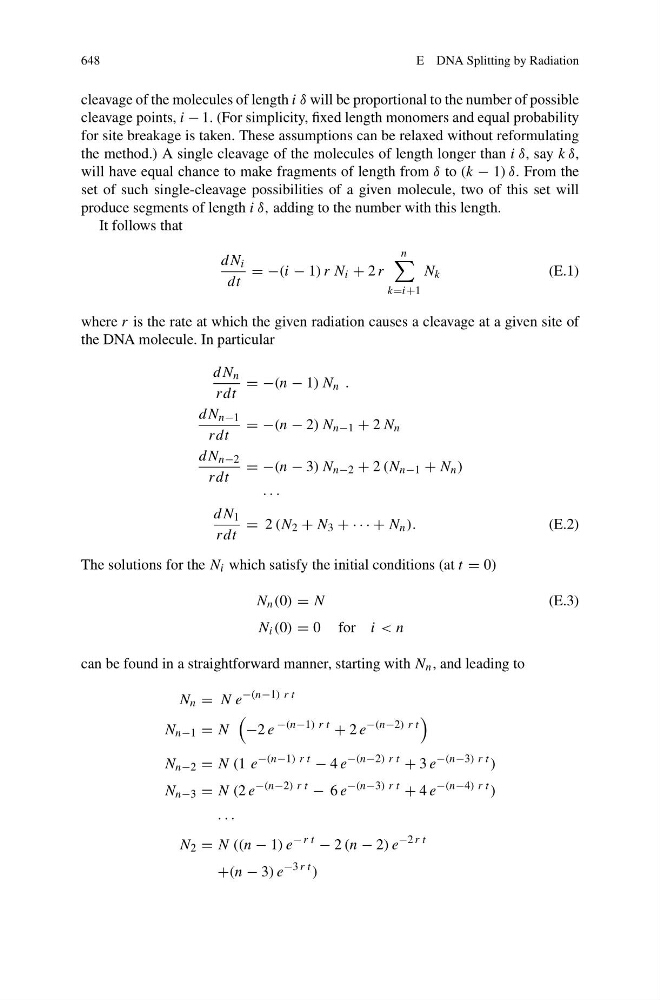
It follows that
dN i
dt
= −(i − 1) r N i + 2 r
n
k=i+1
N k
(E.1)
where r is the rate at which the given radiation causes a cleavage at a given site of
the DNA molecule. In particular
dN n
rdt
= −(n − 1) N n .
dN n−1
rdt
= −(n − 2) N n−1 + 2 N n
dN n−2
rdt
= −(n − 3) N n−2 + 2 (N n−1 + N n )
· · ·
dN 1
rdt
= 2 (N 2 + N 3 + · · · + N n ).
(E.2)
The solutions for the N i which satisfy the initial conditions (at t = 0)
N n (0) = N
(E.3)
N i (0) = 0 for i < n
can be found in a straightforward manner, starting with N n , and leading to
N n = N e
−(n−1) r t
N n−1 = N
−2 e
−(n−1) r t
+ 2 e
−(n−2) r t
N n−2 = N (1 e
−(n−1) r t
− 4 e
−(n−2) r t
+ 3 e
−(n−3) r t )
N n−3 = N (2 e
−(n−2) r t
− 6 e
−(n−3) r t
+ 4 e
−(n−4) r t )
· · ·
N 2 = N ((n − 1) e
− r t
− 2 (n − 2) e
−2 r t
+(n − 3) e
−3 r t )