

3.4 Forces on Materials
49
surface tension of water, making bubbles of air less well attached to the pores of
cloth, and, as we described earlier, emulsify fats in water (See Sect. 2.2.)
Surface tension in water is due to ‘cohesion’ of water molecules with themselves.
The contact angle of a liquid drop of water placed on a horizontal surface is called
the ‘wetting angle’. On hydrophobic surfaces, a contact angle is typically 70 to 90 ◦ .
If the contact angle is even greater, the surfaces are called superhydrophobic (such
as Teflon). Hydrophilic surfaces make the contact angle with surface drops of water
approaches zero.
Surface tension is an important consideration in the inflation of the alveoli
in our lungs. The surrounding mucous tissue fluid in an alveoli has a surface
tension of about 50 dynes/cm. But this value is reduced by a factor from 2 to 15
by surfactants, which are phospholipids, predominantly dipalmitoyl lecithin. The
surfactants are secreted into the fluid coating the interior of each alveolar sac,
with their hydrophobic ends facing the air. With no surfactants, the alveoli would
collapse.
3.4.3 Surfaces Curved by Differential Pressure
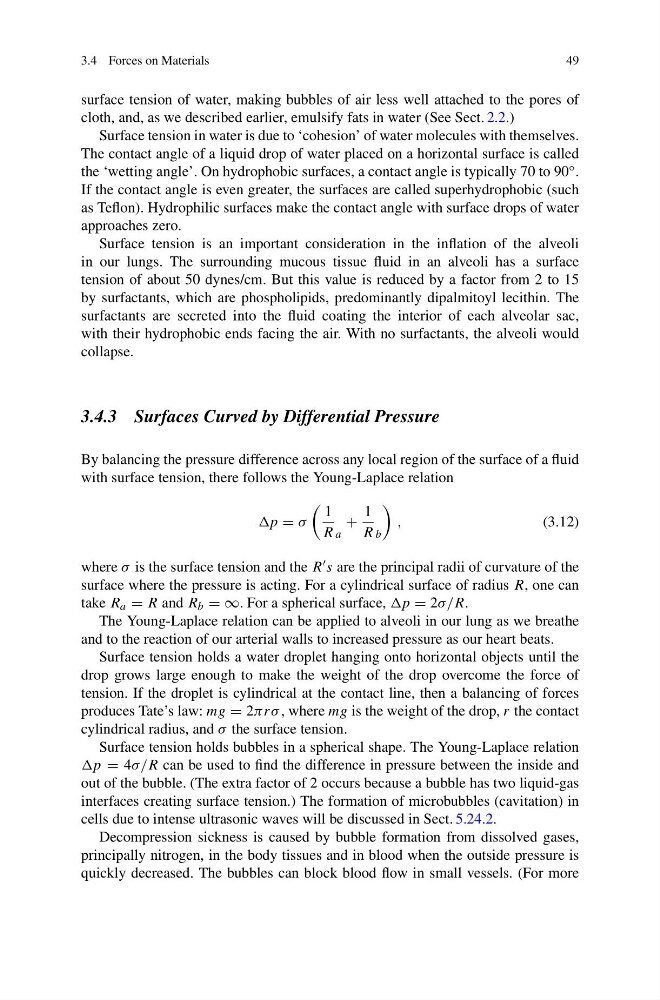
By balancing the pressure difference across any local region of the surface of a fluid
with surface tension, there follows the Young-Laplace relation
p = σ
1
R a
+
1
R b
,
(3.12)
where σ is the surface tension and the R s are the principal radii of curvature of the
surface where the pressure is acting. For a cylindrical surface of radius R, one can
take R a = R and R b = ∞. For a spherical surface, p = 2σ/R.
The Young-Laplace relation can be applied to alveoli in our lung as we breathe
and to the reaction of our arterial walls to increased pressure as our heart beats.
Surface tension holds a water droplet hanging onto horizontal objects until the
drop grows large enough to make the weight of the drop overcome the force of
tension. If the droplet is cylindrical at the contact line, then a balancing of forces
produces Tate’s law: mg = 2πrσ , where mg is the weight of the drop, r the contact
cylindrical radius, and σ the surface tension.
Surface tension holds bubbles in a spherical shape. The Young-Laplace relation
p = 4σ/R can be used to find the difference in pressure between the inside and
out of the bubble. (The extra factor of 2 occurs because a bubble has two liquid-gas
interfaces creating surface tension.) The formation of microbubbles (cavitation) in
cells due to intense ultrasonic waves will be discussed in Sect. 5.24.2.
Decompression sickness is caused by bubble formation from dissolved gases,
principally nitrogen, in the body tissues and in blood when the outside pressure is
quickly decreased. The bubbles can block blood flow in small vessels. (For more
49
surface tension of water, making bubbles of air less well attached to the pores of
cloth, and, as we described earlier, emulsify fats in water (See Sect. 2.2.)
Surface tension in water is due to ‘cohesion’ of water molecules with themselves.
The contact angle of a liquid drop of water placed on a horizontal surface is called
the ‘wetting angle’. On hydrophobic surfaces, a contact angle is typically 70 to 90 ◦ .
If the contact angle is even greater, the surfaces are called superhydrophobic (such
as Teflon). Hydrophilic surfaces make the contact angle with surface drops of water
approaches zero.
Surface tension is an important consideration in the inflation of the alveoli
in our lungs. The surrounding mucous tissue fluid in an alveoli has a surface
tension of about 50 dynes/cm. But this value is reduced by a factor from 2 to 15
by surfactants, which are phospholipids, predominantly dipalmitoyl lecithin. The
surfactants are secreted into the fluid coating the interior of each alveolar sac,
with their hydrophobic ends facing the air. With no surfactants, the alveoli would
collapse.
3.4.3 Surfaces Curved by Differential Pressure
By balancing the pressure difference across any local region of the surface of a fluid
with surface tension, there follows the Young-Laplace relation
p = σ
1
R a
+
1
R b
,
(3.12)
where σ is the surface tension and the R s are the principal radii of curvature of the
surface where the pressure is acting. For a cylindrical surface of radius R, one can
take R a = R and R b = ∞. For a spherical surface, p = 2σ/R.
The Young-Laplace relation can be applied to alveoli in our lung as we breathe
and to the reaction of our arterial walls to increased pressure as our heart beats.
Surface tension holds a water droplet hanging onto horizontal objects until the
drop grows large enough to make the weight of the drop overcome the force of
tension. If the droplet is cylindrical at the contact line, then a balancing of forces
produces Tate’s law: mg = 2πrσ , where mg is the weight of the drop, r the contact
cylindrical radius, and σ the surface tension.
Surface tension holds bubbles in a spherical shape. The Young-Laplace relation
p = 4σ/R can be used to find the difference in pressure between the inside and
out of the bubble. (The extra factor of 2 occurs because a bubble has two liquid-gas
interfaces creating surface tension.) The formation of microbubbles (cavitation) in
cells due to intense ultrasonic waves will be discussed in Sect. 5.24.2.
Decompression sickness is caused by bubble formation from dissolved gases,
principally nitrogen, in the body tissues and in blood when the outside pressure is
quickly decreased. The bubbles can block blood flow in small vessels. (For more