

48
3 Mechanical Aspects of Biosystems
Table 3.2 Surface tensions
of certain liquids
Liquid (in air)
Surface tension.(dynes/cm)
Benzene
28.9
Carbon tetrachloride 27
Chloroform
27.1
Diethyl ether
72.8
Ethyl alcohol
22.3
Glycerol
63.4
Mercury
465
Water 20 ◦ C
72.75
Water 100 ◦ C
58.9
Typical mucus
∼50
Alveolar surfactant
∼3 to 15
Whole blood 37 ◦ C
53
Urine, healthy 20 ◦ C 66
Urine, w bile 20 ◦ C
55
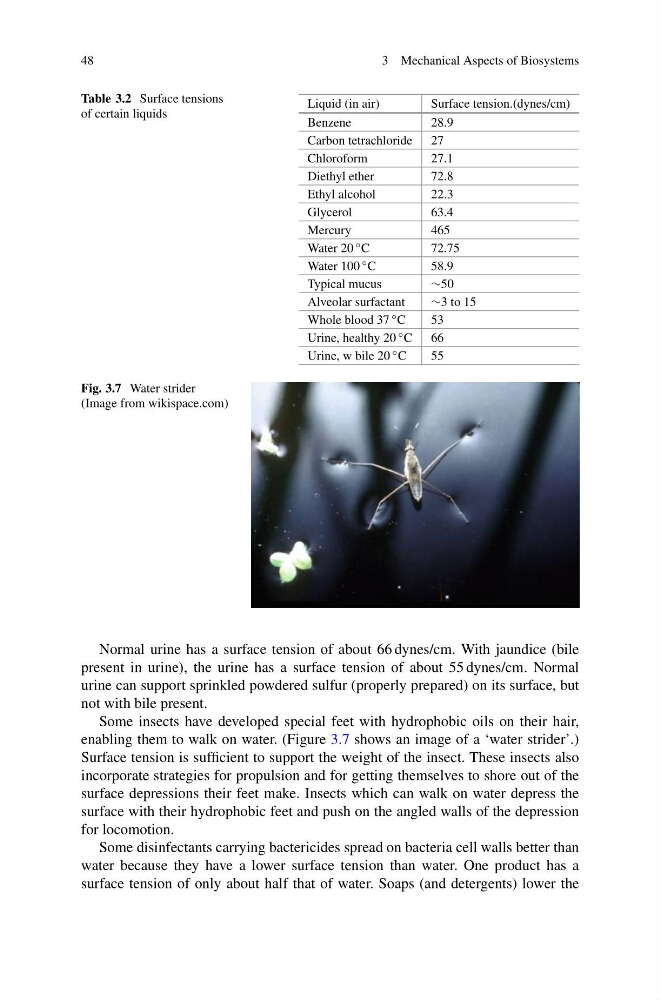
Fig. 3.7 Water strider
(Image from wikispace.com)
Normal urine has a surface tension of about 66 dynes/cm. With jaundice (bile
present in urine), the urine has a surface tension of about 55 dynes/cm. Normal
urine can support sprinkled powdered sulfur (properly prepared) on its surface, but
not with bile present.
Some insects have developed special feet with hydrophobic oils on their hair,
enabling them to walk on water. (Figure 3.7 shows an image of a ‘water strider’.)
Surface tension is sufficient to support the weight of the insect. These insects also
incorporate strategies for propulsion and for getting themselves to shore out of the
surface depressions their feet make. Insects which can walk on water depress the
surface with their hydrophobic feet and push on the angled walls of the depression
for locomotion.
Some disinfectants carrying bactericides spread on bacteria cell walls better than
water because they have a lower surface tension than water. One product has a
surface tension of only about half that of water. Soaps (and detergents) lower the
3 Mechanical Aspects of Biosystems
Table 3.2 Surface tensions
of certain liquids
Liquid (in air)
Surface tension.(dynes/cm)
Benzene
28.9
Carbon tetrachloride 27
Chloroform
27.1
Diethyl ether
72.8
Ethyl alcohol
22.3
Glycerol
63.4
Mercury
465
Water 20 ◦ C
72.75
Water 100 ◦ C
58.9
Typical mucus
∼50
Alveolar surfactant
∼3 to 15
Whole blood 37 ◦ C
53
Urine, healthy 20 ◦ C 66
Urine, w bile 20 ◦ C
55
Fig. 3.7 Water strider
(Image from wikispace.com)
Normal urine has a surface tension of about 66 dynes/cm. With jaundice (bile
present in urine), the urine has a surface tension of about 55 dynes/cm. Normal
urine can support sprinkled powdered sulfur (properly prepared) on its surface, but
not with bile present.
Some insects have developed special feet with hydrophobic oils on their hair,
enabling them to walk on water. (Figure 3.7 shows an image of a ‘water strider’.)
Surface tension is sufficient to support the weight of the insect. These insects also
incorporate strategies for propulsion and for getting themselves to shore out of the
surface depressions their feet make. Insects which can walk on water depress the
surface with their hydrophobic feet and push on the angled walls of the depression
for locomotion.
Some disinfectants carrying bactericides spread on bacteria cell walls better than
water because they have a lower surface tension than water. One product has a
surface tension of only about half that of water. Soaps (and detergents) lower the