

A Optical Limit of Maxwell’s Equations
629
where n = c/v, i.e. the refractive index in the material, which is the speed of light
in a vacuum divided by its speed in the region where n is calculated. This is the socalled ‘eikonal equation’. The gradient of S points in the direction of the propagation
of the wave fronts.
A.2 The Ray Equation
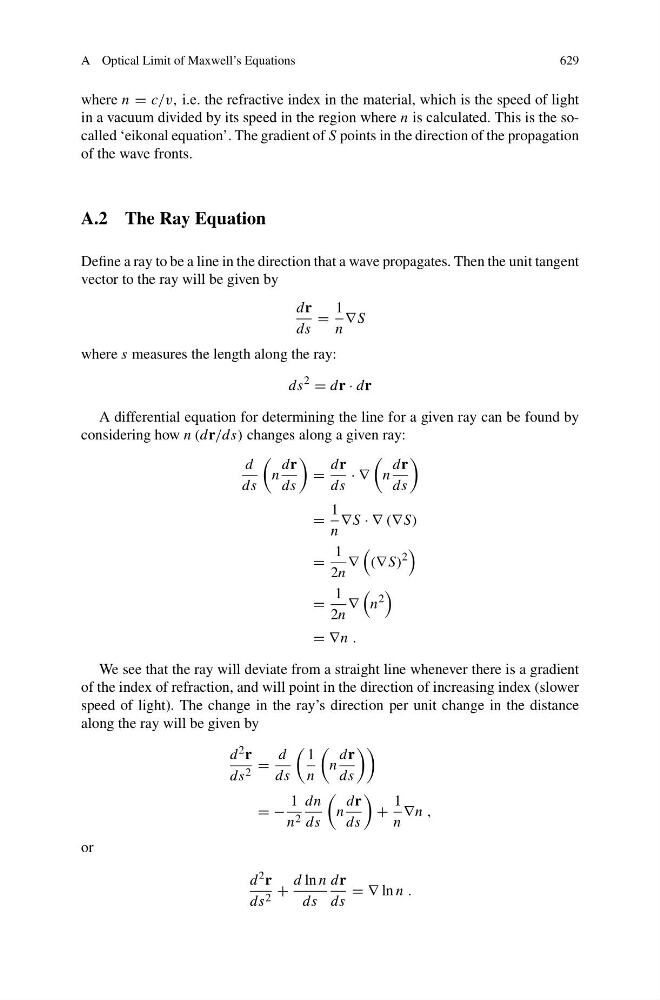
Define a ray to be a line in the direction that a wave propagates. Then the unit tangent
vector to the ray will be given by
dr
ds
=
1
n
∇S
where s measures the length along the ray:
ds
2
= dr · dr
A differential equation for determining the line for a given ray can be found by
considering how n (dr/ds) changes along a given ray:
d
ds
n
dr
ds
=
dr
ds
· ∇
n
dr
ds
=
1
n
∇S · ∇ (∇S)
=
1
2n
∇
(∇S)
2
=
1
2n
∇
n
2
= ∇n .
We see that the ray will deviate from a straight line whenever there is a gradient
of the index of refraction, and will point in the direction of increasing index (slower
speed of light). The change in the ray’s direction per unit change in the distance
along the ray will be given by
d 2 r
ds 2 =
d
ds
1
n
n
dr
ds
= −
1
n 2
dn
ds
n
dr
ds
+
1
n
∇n ,
or
d 2 r
ds 2 +
d ln n
ds
dr
ds
= ∇ ln n .