

628
A Optical Limit of Maxwell’s Equations
Consider a single frequency solution 1 :
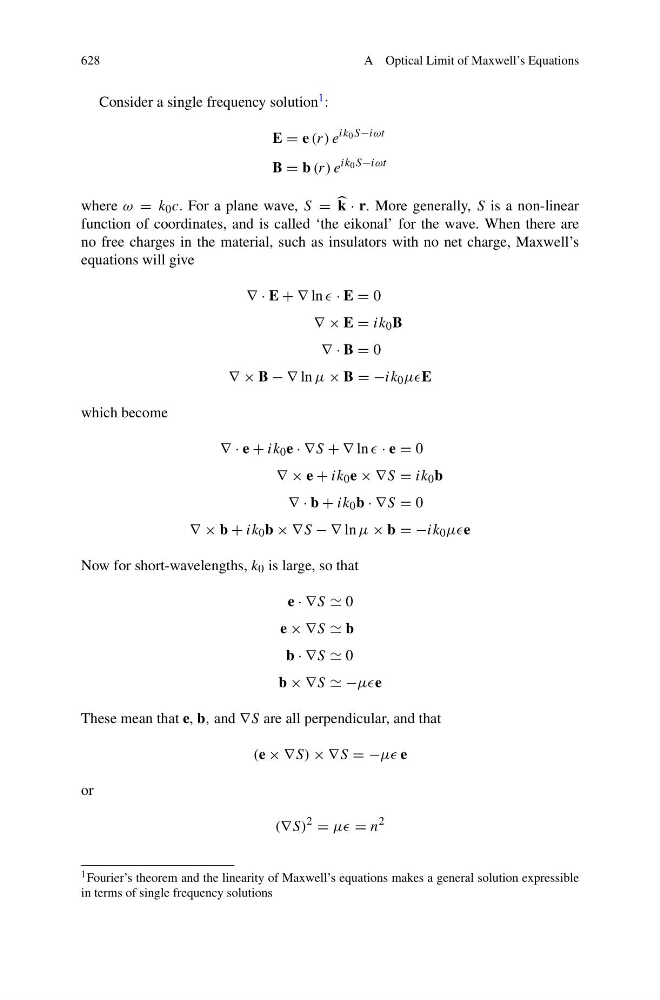
E = e (r) e
ik 0 S−iωt
B = b (r) e
ik 0 S−iωt
where ω = k 0 c. For a plane wave, S = k · r. More generally, S is a non-linear
function of coordinates, and is called ‘the eikonal’ for the wave. When there are
no free charges in the material, such as insulators with no net charge, Maxwell’s
equations will give
∇ · E + ∇ ln · E = 0
∇ × E = ik 0 B
∇ · B = 0
∇ × B − ∇ ln μ × B = −ik 0 μμE
which become
∇ · e + ik 0 e · ∇S + ∇ ln · e = 0
∇ × e + ik 0 e × ∇S = ik 0 b
∇ · b + ik 0 b · ∇S = 0
∇ × b + ik 0 b × ∇S − ∇ ln μ × b = −ik 0 μμe
Now for short-wavelengths, k 0 is large, so that
e · ∇S 0
e × ∇S b
b · ∇S 0
b × ∇S −μμe
These mean that e, b, and ∇S are all perpendicular, and that
(e × ∇S) × ∇S = −μμ e
or
(∇S)
2
= μμ = n
2
1 Fourier’s theorem and the linearity of Maxwell’s equations makes a general solution expressible
in terms of single frequency solutions