

610
16 Energy Flow in the Production of Order
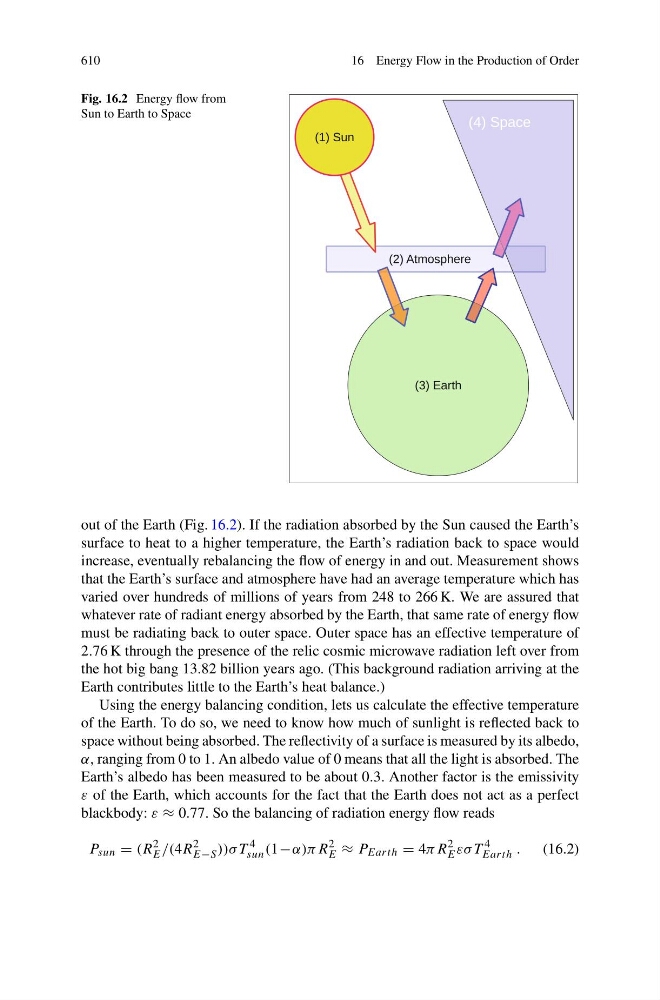
Fig. 16.2 Energy flow from
Sun to Earth to Space
out of the Earth (Fig. 16.2). If the radiation absorbed by the Sun caused the Earth’s
surface to heat to a higher temperature, the Earth’s radiation back to space would
increase, eventually rebalancing the flow of energy in and out. Measurement shows
that the Earth’s surface and atmosphere have had an average temperature which has
varied over hundreds of millions of years from 248 to 266 K. We are assured that
whatever rate of radiant energy absorbed by the Earth, that same rate of energy flow
must be radiating back to outer space. Outer space has an effective temperature of
2.76 K through the presence of the relic cosmic microwave radiation left over from
the hot big bang 13.82 billion years ago. (This background radiation arriving at the
Earth contributes little to the Earth’s heat balance.)
Using the energy balancing condition, lets us calculate the effective temperature
of the Earth. To do so, we need to know how much of sunlight is reflected back to
space without being absorbed. The reflectivity of a surface is measured by its albedo,
α, ranging from 0 to 1. An albedo value of 0 means that all the light is absorbed. The
Earth’s albedo has been measured to be about 0.3. Another factor is the emissivity
ε of the Earth, which accounts for the fact that the Earth does not act as a perfect
blackbody: ε ≈ 0.77. So the balancing of radiation energy flow reads
P sun = (R
2
E /(4R
2
E−S ))σ T
4
sun (1−α)πR
2
E ≈ P Earth = 4πR
2
E εσ T
4
Earth .
(16.2)