

16.1 The Flow of Energy Through the Earth System
609
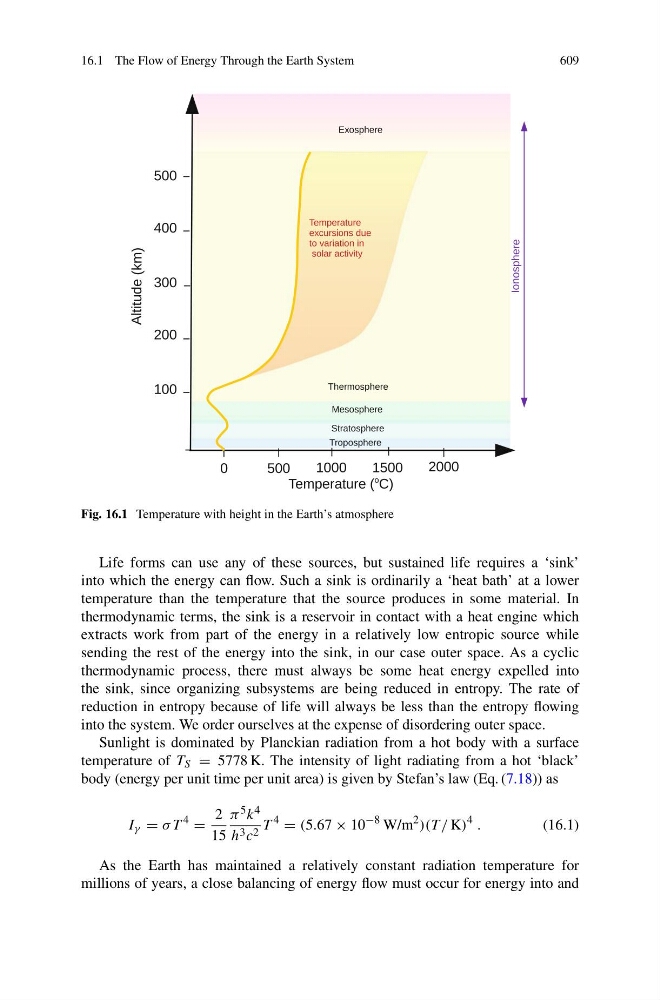
Fig. 16.1 Temperature with height in the Earth’s atmosphere
Life forms can use any of these sources, but sustained life requires a ‘sink’
into which the energy can flow. Such a sink is ordinarily a ‘heat bath’ at a lower
temperature than the temperature that the source produces in some material. In
thermodynamic terms, the sink is a reservoir in contact with a heat engine which
extracts work from part of the energy in a relatively low entropic source while
sending the rest of the energy into the sink, in our case outer space. As a cyclic
thermodynamic process, there must always be some heat energy expelled into
the sink, since organizing subsystems are being reduced in entropy. The rate of
reduction in entropy because of life will always be less than the entropy flowing
into the system. We order ourselves at the expense of disordering outer space.
Sunlight is dominated by Planckian radiation from a hot body with a surface
temperature of T S = 5778 K. The intensity of light radiating from a hot ‘black’
body (energy per unit time per unit area) is given by Stefan’s law (Eq. (7.18)) as
I γ = σ T
4
=
2
15
π 5 k 4
h 3 c 2 T
4
= (5.67 × 10
−8 W/m
2 )(T / K)
4 .
(16.1)
As the Earth has maintained a relatively constant radiation temperature for
millions of years, a close balancing of energy flow must occur for energy into and