

14.3 Brain Models
589
2
2
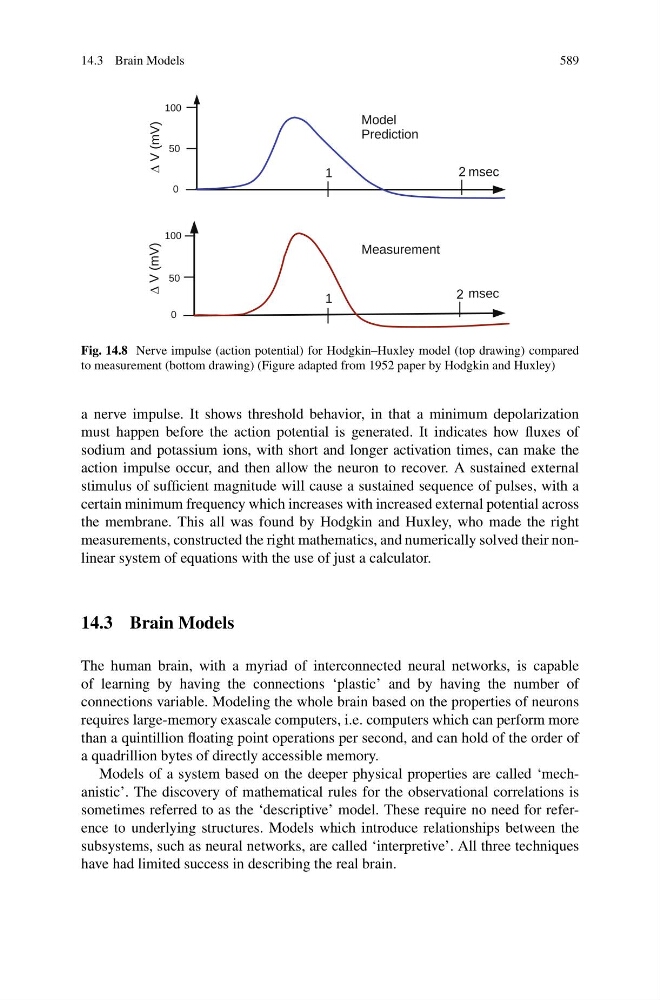
Fig. 14.8 Nerve impulse (action potential) for Hodgkin–Huxley model (top drawing) compared
to measurement (bottom drawing) (Figure adapted from 1952 paper by Hodgkin and Huxley)
a nerve impulse. It shows threshold behavior, in that a minimum depolarization
must happen before the action potential is generated. It indicates how fluxes of
sodium and potassium ions, with short and longer activation times, can make the
action impulse occur, and then allow the neuron to recover. A sustained external
stimulus of sufficient magnitude will cause a sustained sequence of pulses, with a
certain minimum frequency which increases with increased external potential across
the membrane. This all was found by Hodgkin and Huxley, who made the right
measurements, constructed the right mathematics, and numerically solved their nonlinear system of equations with the use of just a calculator.
14.3 Brain Models
The human brain, with a myriad of interconnected neural networks, is capable
of learning by having the connections ‘plastic’ and by having the number of
connections variable. Modeling the whole brain based on the properties of neurons
requires large-memory exascale computers, i.e. computers which can perform more
than a quintillion floating point operations per second, and can hold of the order of
a quadrillion bytes of directly accessible memory.
Models of a system based on the deeper physical properties are called ‘mechanistic’. The discovery of mathematical rules for the observational correlations is
sometimes referred to as the ‘descriptive’ model. These require no need for reference to underlying structures. Models which introduce relationships between the
subsystems, such as neural networks, are called ‘interpretive’. All three techniques
have had limited success in describing the real brain.