

14.2 More Realistic Neuron Models
587
g K = n
4 g
max
K
,
(14.3)
where g max stands for the maximum value of the corresponding conductivity g.
When the gates are all open, m = 1, h = 1, and n = 1. The values for the constants
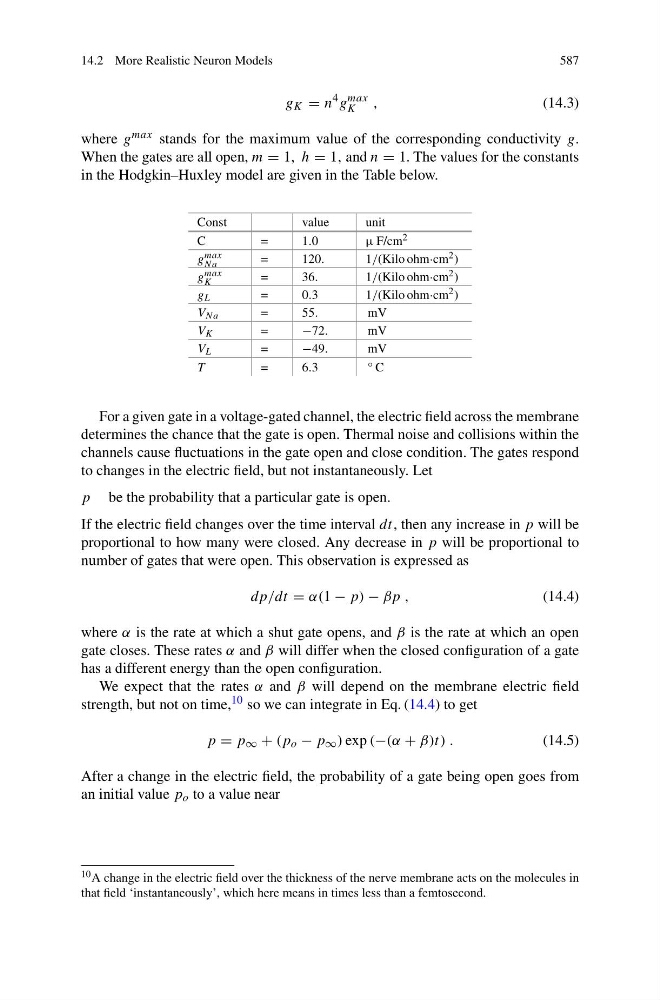
in the Hodgkin–Huxley model are given in the Table below.
Const
value
unit
C
=
1 .0
μ F/cm 2
g max
Na
=
120.
1/(Kilo ohm·cm 2 )
g max
K
=
3 6 .
1/(Kilo ohm·cm 2 )
g L
=
0 .3
1 /(Kilo ohm·cm 2 )
V Na
=
5 5 .
mV
V K
=
−72.
mV
V L
=
−49.
mV
T
=
6 .3
◦ C
For a given gate in a voltage-gated channel, the electric field across the membrane
determines the chance that the gate is open. Thermal noise and collisions within the
channels cause fluctuations in the gate open and close condition. The gates respond
to changes in the electric field, but not instantaneously. Let
p be the probability that a particular gate is open.
If the electric field changes over the time interval dt, then any increase in p will be
proportional to how many were closed. Any decrease in p will be proportional to
number of gates that were open. This observation is expressed as
dp/dt = α(1 − p) − βp ,
(14.4)
where α is the rate at which a shut gate opens, and β is the rate at which an open
gate closes. These rates α and β will differ when the closed configuration of a gate
has a different energy than the open configuration.
We expect that the rates α and β will depend on the membrane electric field
strength, but not on time, 10 so we can integrate in Eq. (14.4) to get
p = p ∞ + (p o − p ∞ ) exp (−(α + β)t) .
(14.5)
After a change in the electric field, the probability of a gate being open goes from
an initial value p o to a value near
10 A change in the electric field over the thickness of the nerve membrane acts on the molecules in
that field ‘instantaneously’, which here means in times less than a femtosecond.