

14.1 Neural Networks as Logic Systems
579
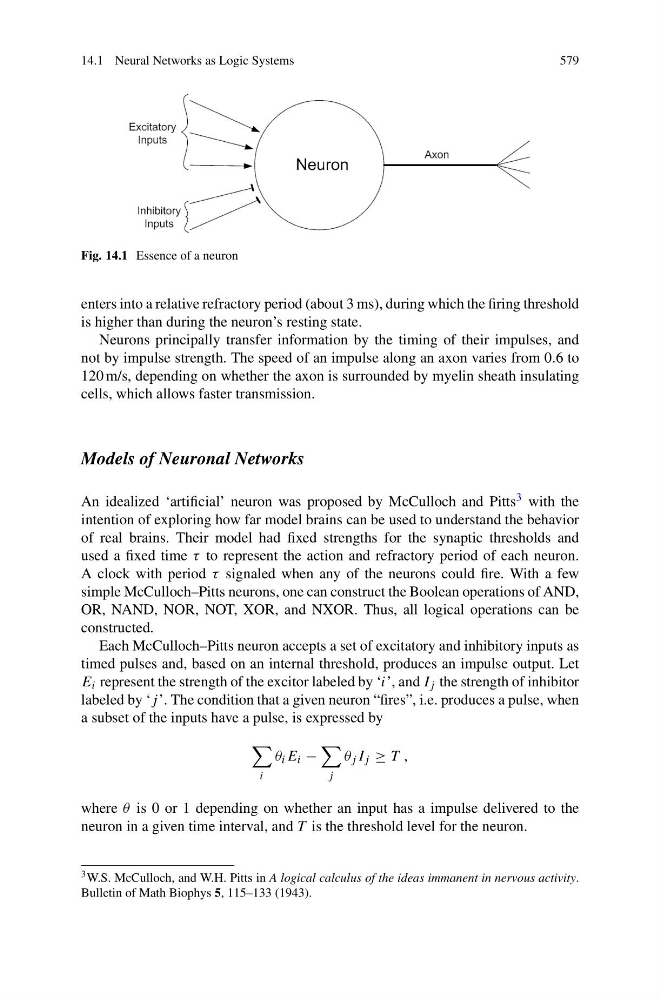
Fig. 14.1 Essence of a neuron
enters into a relative refractory period (about 3 ms), during which the firing threshold
is higher than during the neuron’s resting state.
Neurons principally transfer information by the timing of their impulses, and
not by impulse strength. The speed of an impulse along an axon varies from 0.6 to
120 m/s, depending on whether the axon is surrounded by myelin sheath insulating
cells, which allows faster transmission.
Models of Neuronal Networks
An idealized ‘artificial’ neuron was proposed by McCulloch and Pitts 3 with the
intention of exploring how far model brains can be used to understand the behavior
of real brains. Their model had fixed strengths for the synaptic thresholds and
used a fixed time τ to represent the action and refractory period of each neuron.
A clock with period τ signaled when any of the neurons could fire. With a few
simple McCulloch–Pitts neurons, one can construct the Boolean operations of AND,
OR, NAND, NOR, NOT, XOR, and NXOR. Thus, all logical operations can be
constructed.
Each McCulloch–Pitts neuron accepts a set of excitatory and inhibitory inputs as
timed pulses and, based on an internal threshold, produces an impulse output. Let
E i represent the strength of the excitor labeled by ‘i’, and I j the strength of inhibitor
labeled by ‘j ’. The condition that a given neuron “fires”, i.e. produces a pulse, when
a subset of the inputs have a pulse, is expressed by
i
θ i E i −
j
θ j I j ≥ T ,
where θ is 0 or 1 depending on whether an input has a impulse delivered to the
neuron in a given time interval, and T is the threshold level for the neuron.
3 W.S. McCulloch, and W.H. Pitts in A logical calculus of the ideas immanent in nervous activity.
Bulletin of Math Biophys 5, 115–133 (1943).