

13.4 Scaling Laws in Life Systems
571
It took about 65 years before a reasonable theoretical explanation of this power
law was presented by Geoffrey West, James Brown, and Brian Enquist. 11 Their
model extends Kleiber’s scaling law to a plethora of plants and animals, over
15 decades in range of masses! Moreover, their model describes other universal
properties of life subsystems, such as connections between body mass and heart
rates and growth rates.
Here is the essence of the West, et al., argument as formulated by Etienne, Apol,
and Olff 12 applied to animals:
Assumption 13.1 The nutrient transport system of multicellular animals has a
fractal-like splitting of the arteries. With fractal splitting, there is a massive saving
in the gene system, in that genetic coding for individual arterial branching, sizes and
lengths is not necessary.
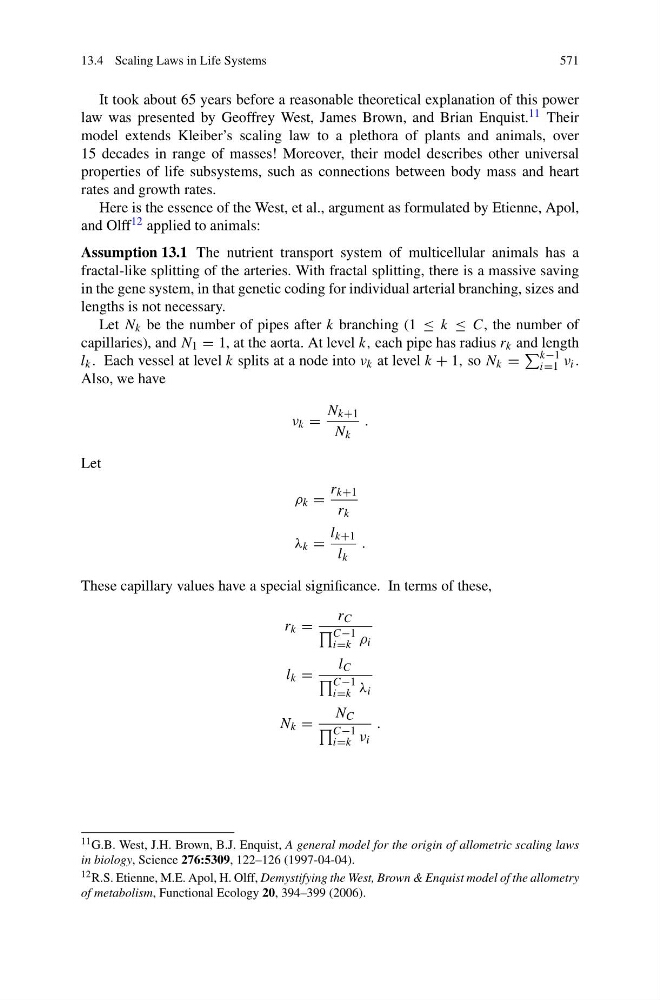
Let N k be the number of pipes after k branching (1 ≤ k ≤ C, the number of
capillaries), and N 1 = 1, at the aorta. At level k, each pipe has radius r k and length
l k . Each vessel at level k splits at a node into ν k at level k + 1, so N k =
k−1
i=1 ν i .
Also, we have
ν k =
N k+1
N k
.
Let
ρ k =
r k+1
r k
λ k =
l k+1
l k
.
These capillary values have a special significance. In terms of these,
r k =
r C
C−1
i=k ρ i
l k =
l C
C−1
i=k λ i
N k =
N C
C−1
i=k ν i
.
11 G.B. West, J.H. Brown, B.J. Enquist, A general model for the origin of allometric scaling laws
in biology, Science 276:5309, 122–126 (1997-04-04).
12 R.S. Etienne, M.E. Apol, H. Olff, Demystifying the West, Brown & Enquist model of the allometry
of metabolism, Functional Ecology 20, 394–399 (2006).