

570
13 Modeling Biological Systems
model based on the biochemistry and biomechanics of the process. In the model, the
rate of growth has non-linear terms coming from the forces of seeds on each other
affecting the production of the growth hormone called auxin.
13.4 Scaling Laws in Life Systems
As complex as life systems are, some very simple relationships among the general
properties of such systems follow from universal properties, such as mass conservation, energy conservation, and dimensional limitations. Many such relationships
were discovered by attempting to connect observables empirically. For example,
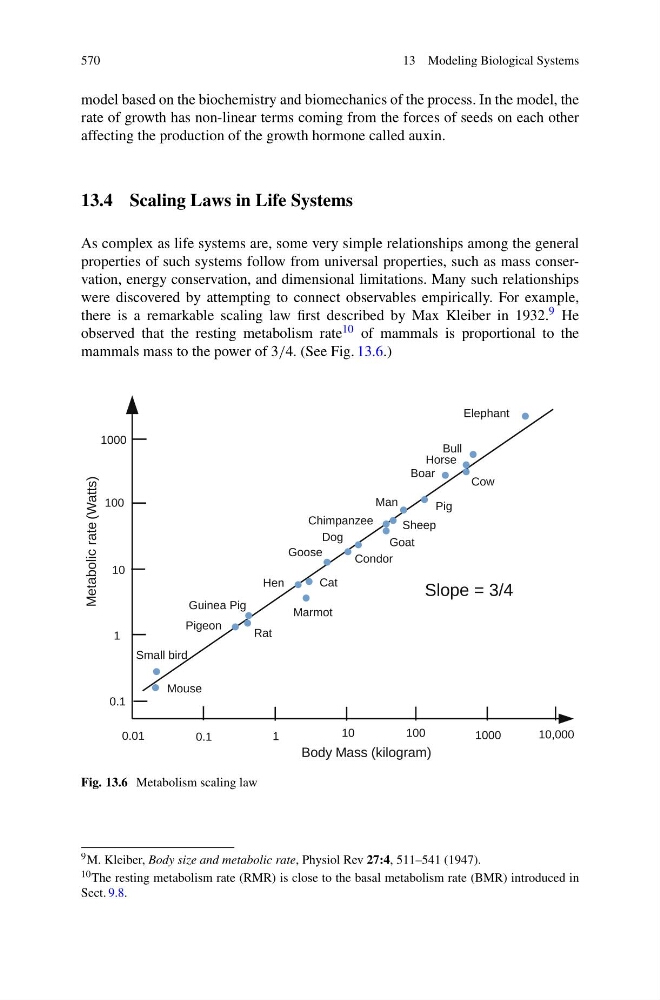
there is a remarkable scaling law first described by Max Kleiber in 1932. 9 He
observed that the resting metabolism rate 10 of mammals is proportional to the
mammals mass to the power of 3/4. (See Fig. 13.6.)
Fig. 13.6 Metabolism scaling law
9 M. Kleiber, Body size and metabolic rate, Physiol Rev 27:4, 511–541 (1947).
10 The resting metabolism rate (RMR) is close to the basal metabolism rate (BMR) introduced in
Sect. 9.8.